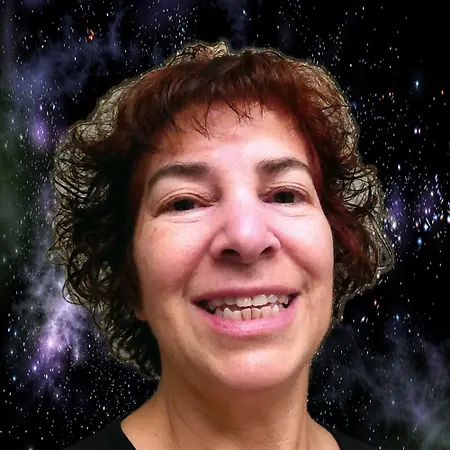
Influential Woman · Aerospace and Space
Candy M. Torres
Creativity Engineer, Technorican
Webster, TX 77598
In Conversation
Candy Torres for Bold. Brilliant. Unstoppable.
Read the transcript
Candy M. Torres: Being an influential woman is a responsibility to distill the essential lessons of my life into a guide for others. I have learned there are no hard and fast rules to success. The future is an uncertain road that demands both vision and resilience. It means having the courage to build your own path when no map exists. My influence is rooted in persistence, taking impossible space dreams and turning them into reality by asking the right questions and refusing to accept barriers. Ultimately it's about ensuring the future is accessible to everyone. Influence is showing others how to design their own unique maps specifically suited to their own lives and the times they live in.
What's one piece of advice you would give to younger women chasing their dreams?
Candy M. Torres: The one piece of advice I would give to younger women is this When the map doesn't exist, you don't wait, you build one. Early in my career, there were no clear paths for someone like me in aerospace, so I created my own college major and forged my own entry into the space industry. Don't let the lack of a preexisting path or the presence of barriers stop you from asking questions, researching the unknown, and organizing the resources you need. Your journey doesn't need to follow a traditional script. It just needs to be designed for the times you live in and the vision you hold. Be persistent. Refuse to be defined by what others say is impossible, and remember that by designing your own map, you aren't just succeeding for yourself, you are opening the door for everyone who follows.
Her Story
About Candy
Candy M. Torres is the Creativity Engineer at Technorican and a long-time aerospace professional. Because her goals were ahead of her time, she created her own college major using the only three space-related courses available: Geology of the Moon and Planets, Astronomy, and a short Astrophysics course. She filled the remainder of her four-year degree with science and math classes. This proved to be a wise choice, as her Astronomy professor later referred her for her first job.
Her career launched in 1976 at Princeton University, where she supported NASA's Orbiting Astronomical Observatory-3 (Copernicus) satellite program—a vital precursor to the Hubble Space Telescope. Candy developed computer skills that improved her production of quarterly NASA reports on Copernicus. When mid-sized computers became available, she stepped into the role of System Manager despite having no prior background in the field. She researched the technology, sought technical advice, and organized a team to network the entire Astrophysics Department.
The Princeton environment allowed Candy’s space activism to flourish. In the late 1970s and early 1980s, Princeton was a hub of excitement regarding NASA’s support for Dr. Gerard K. O’Neill’s space colony concepts. She volunteered for and attended demonstrations of lunar manufacturing ideas that are now being seriously considered for Moon settlements. She also produced several episodes for a local cable television show about the Space Shuttle using NASA videotapes and the help of Princeton students.
After Copernicus was shut down following nearly ten years of research, Candy moved to Houston to support the NASA Johnson Space Center. She joined the team responsible for computerizing tasks for Space Shuttle flight controllers. She worked alongside controllers to learn their processes and trained them on software for Space Shuttle failure and configuration analyses.
Candy took time off to earn her first Master’s degree in Studies of the Future, which included: Strategic Planning and Systems Analysis, Sociology, Research Methods, and Ergonomics. Following her studies, she managed an Human Factors operational database for future long-term space habitation based on lessons from past missions. When the International Space Station became operational, Candy supported Operations Planning and became a flight controller — possibly the first Puerto Rican woman to do so.
Beyond engineering, Candy is a dedicated STEM advocate and informal educator. She works to expand aerospace access for women and underrepresented communities. As a licensed private and drone pilot, she shares her credentials to inspire excitement in people of all ages regarding future possibilities.
Candy has also self-published two books:
- “Born on the Moon – Living in the Space Age”: A scrapbook format of her life’s path.
- “Cosmic Eyes – Space Telescope Ancestors”: A history of the two space observatories that made the Hubble Space Telescopes possible.
Currently, Candy is writing a documentary screenplay about her legacy in space exploration. Her story highlights the struggles and obstacles she overcame, serving as an inspirational account of one woman’s "impossible" dream.
Her Interview
Ten minutes with Candy
01What do you attribute your success to?
I attribute my success to resilience, determination, and a refusal to accept the limitations placed on me from an early age. Growing up as a Puerto Rican girl in the 1950s, I was often told that girls’ dreams don’t come true and they don’t work in science, yet I was determined to pursue my dream of working in space exploration. I followed my instinct to do what makes me happy. A very crucial skill is learning how to learn. Not every job requires a degree and no one knows what the jobs of the future will be. Be flexible in your thinking and look for opportunities even if a specific result is not apparent. Some actions can take years to reveal their true value. My goal has always been not only personal achievement, but to show my community what is possible when you push beyond expectations and believe in your own vision.
02What’s the best career advice you’ve ever received?
When I started my job at Princeton, my boss said: “You’re a professional.” without elaborating on it. I recognized that I represented the department and the university so I had to comport myself in the best manner. I was not just an individual working for only my interests but a much larger community. Diligence in the conduct of the specific tasks was vital to scientific success as well as working together respectfully for the team’s benefit.
03What advice would you give to young women entering your industry?
I would advise young women to forge their own path, expand your mind behind technology, and be flexible. All industries value communications and people skills. Build your knowledge independently, stay persistent despite stereotypes or discouragement, and prioritize networking to open doors along the way. Just as importantly, use your journey to so others can follow.
04What are the biggest challenges or opportunities in your field right now?
The biggest opportunity in my field right now is the renewed push toward long-term space exploration. It has been theory and wishful thinking but now it is becoming a reality and for more than just a handful boing beyond Earth. Ideas once considered visionary are now becoming part of real-world planning, opening the door for an entirely new generation to participate in space development. At the same time, a major challenge is ensuring these expanding opportunities are inclusive, so that people from marginalized communities are not left out of this historic moment in space exploration.
05What values are most important to you in your work and personal life?
The most important value to me is being part of something bigger than myself, using my work to create impact for my community and future generations rather than personal recognition alone. From an early age, shaped by experiences of discrimination and limited expectations for Puerto Ricans, I was determined to challenge those narratives and show what was possible, then bring that success back to inspire others. This mindset guided me even when I applied to the astronaut program in 1977 despite not meeting the physical requirements, because for me it was about following my dream. Whether in my space career or through storytelling, my focus remains on sharing knowledge, expanding opportunity, and helping others see their own potential.
Join Influential Women and start making an impact. Register now.