Her Story
About Carmen
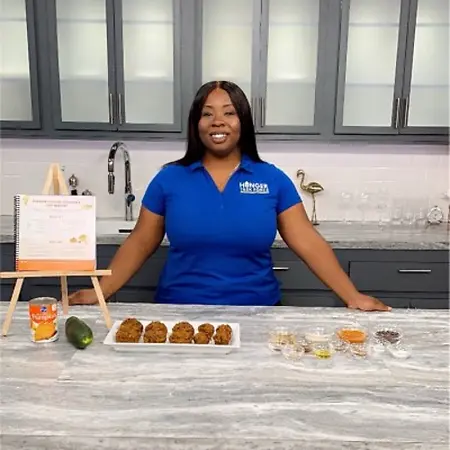
Carmen Baldwin, DTR, is a dedicated community nutrition professional and the Community Nutrition Manager at Hunger Task Force, Milwaukee County’s only free and local food bank. In her current role, she oversees programs that directly address food insecurity and provide hands-on nutrition education to the community, serving thousands of participants each year. With experience across clinical, community, and food service domains, Carmen brings a comprehensive perspective to improving access to healthy food and empowering individuals to make informed nutrition choices.
Carmen’s journey into nutrition began unexpectedly during an internship at the Milwaukee Health Department WIC program, where she witnessed the impact of dietetic professionals firsthand. Motivated by this experience, she earned her Associate of Science in Dietetic Technician from Milwaukee Area Technical College in 2014 and her Bachelor of Arts in Health Communications with a minor in Food and Nutrition from Mount Mary University in 2019. She maintains her credentials as a Dietetic Technician, Registered (DTR), and has contributed to shaping future dietetic professionals as a preceptor and mentor for students.
Passionate about equity, dignity, and community empowerment, Carmen champions initiatives that combine food access with education. Her work emphasizes culturally relevant programming and systems-level change, reflecting her commitment to diversity, empathy, and stewardship. Recognized as a leader and advocate, she inspires both colleagues and community members to prioritize nutrition, build healthy habits, and work collaboratively toward a more equitable and nourishing food system.
Her Interview
Ten minutes with Carmen
01What do you attribute your success to?
I attribute my success to my support system, my family, my father and my mother - the best support system I've ever had. Really, especially in the harder times, my dad was always there to give me words of encouragement, to lift me up. I believe everyone needs support because things get really hard, but again, my family and the love that we have within my family - if it was not for them, I probably wouldn't have gotten through school. I probably wouldn't have been able to get to clinicals or afford books and things like that, so I really contribute my success to my family.
02What’s the best career advice you’ve ever received?
Not to give up. And when you give the best, you get the best. That's something my dad always tells me, especially when things might not look how you might have planned them, but just continue to move forward. Always put your best foot forward and really give everything your all, just because you never know who whatever you do might come across, you don't know how it might impact somebody. So it's really important, no matter what you do, to really give it your all. Whether you're answering phones at a hospital, delivering food, making formula for babies in the NICU, or working with a whole program and organization pushing nutrition education forward - just really hone in on those skills and try your best.
03What advice would you give to young women entering your industry?
Don't be afraid to be straightforward and direct. I think sometimes women might get caught up in a trope that you have to be soft-spoken and all these other things, but when really, just being direct and being stern is really great, because then people are not gonna play with you, so to speak. And don't be afraid to glam yourself up. Don't be afraid to put all that you want to put in to how you present yourself, because I am a firm believer when you look good to yourself, you put good energy out. So don't be afraid if you want to dye your hair a certain color, if you like black nails, or whatever that is for you - don't be afraid to really embrace the things that you really hold dear as a woman, and things that you can self-express.
04What are the biggest challenges or opportunities in your field right now?
One of the challenges we face is food insecurity, and also just around a lot of the different regulations around SNAP and SNAP-Ed. SNAP-Ed was eliminated last year, and it made the landscape of nutrition education really difficult to navigate, because when there were other agencies that were administering nutrition education, maybe we're not in a rural community, but somebody is. Now that it's gone, it just makes it harder to get to everybody and to get to everyone who needs nutrition education so that they can make their own informed decisions. Aside from that, we're also dealing with different work requirements and different barriers to food access, and just explaining that to people and making sure that they fully understand and know ways to navigate that landscape as well.
05What values are most important to you in your work and personal life?
One of my most important values in my work is dignity, equity, being a good stewardship, and diversity. These are Hunger Task Force's core values, and these are things that I literally think about and lean on when I make decisions. But in my life, it kind of bleeds into my life, so being fair, being equitable, having a diverse group of individuals to give you different perspectives. And also just having empathy too. I think sometimes the world is lacking a little bit of empathy. Just taking a moment to see how someone else might feel, how they might be experiencing something, and seeing what you can do just to help, even if it's a little bit. Not saying that you gotta solve someone's problems holistically, but there's something that you can do, and if you can do that, then you should. I also am a firm believer in doing things for the greater good, not for myself, but for the next person, because when you do things like this, it helps everybody, and it will help you too. But just having the next person in mind and doing things for the greater good.
Join Influential Women and start making an impact. Register now.