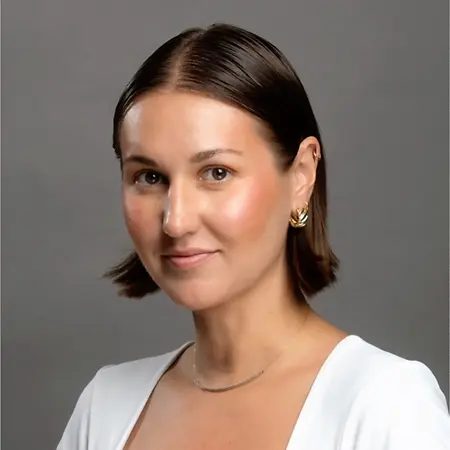
Her Story
About Caroline
Caroline Szujewski, PhD, is a Senior Research Neuroscientist based in Chicago whose interest in neuroscience began at age 16, when she took her first neuroscience course in high school. What started as an early fascination with how the brain works became a sustained academic and professional path spanning 16 years of studying, conducting, and translating neuroscience research.
She earned her bachelor’s degree in Neuroscience from the University of Southern California, where her early research experience included human neuroimaging and structural MRI analysis in cohorts with Mild Cognitive Impairment and Alzheimer’s disease, as well as systems neuroscience research examining the neural control of behavior. She later worked in neurological surgery at Loyola University Medical Center, conducting clinical outcomes research across a range of neurosurgical conditions. These experiences broadened her perspective from basic and computational neuroscience to clinically oriented research and reinforced her interest in how better scientific tools can improve patient care.
Caroline went on to earn her PhD in Neurobiology from the University of Chicago, where her doctoral research focused on the neural circuitry underlying opioid-induced respiratory depression, repeated opioid exposure, and overdose susceptibility. Her work combined experimental neuroscience, circuit-level analysis, quantitative data analysis, and study design, further developing her interest in understanding disease mechanisms and translating complex biological findings into clinically meaningful insight.
Today, Caroline works at Microstructure Imaging Inc. (MICSI), where she develops and validates clinical-grade neuroimaging technologies for neurological disease. Her work focuses on MRI- and PET-based methods, particularly for Alzheimer’s disease, and spans quantitative image analysis, algorithm development, statistical validation, clinical study design, image quality assessment, and regulatory-oriented product validation. As an early member of MICSI, she has also gained firsthand experience in the scientific and operational challenges of building a biotechnology company and translating research into a commercial clinical product.
Her interest in biotechnology extends beyond the laboratory. Caroline has experience evaluating early-stage healthcare and life science companies through venture-focused programs including the George Shultz Innovation Fund and SmartHealth Catalyzer, where she assessed scientific merit, clinical need, market opportunity, and commercialization potential. She is particularly interested in the intersection of science, entrepreneurship, and investment and in identifying technologies with the potential to meaningfully improve healthcare.
Caroline is also active in the biotechnology community through Women In Bio, where she serves as Sponsorship Co-Chair for the Chicago Chapter after previously serving on the Sponsorship Committee. She values mentorship, science education, and community involvement, and has volunteered with educational and local service organizations throughout her career.
Her Interview
Ten minutes with Caroline
01What do you attribute your success to?
I attribute much of my success to the unwavering support of my parents. They recognized my strengths and interests early, encouraged my education and academic pursuits, and always made me feel capable and confident. That support was especially meaningful as a woman pursuing a career in science, where confidence in your own abilities can make a lasting difference.
02What’s the best career advice you’ve ever received?
During a study-abroad experience in Santiago, Chile, a professor once told me, “Vas a ganar” — you’re going to win. I was struggling with a language barrier at the time, and those words reminded me to keep moving forward despite uncertainty and setbacks. I still carry that message with me: work hard, stay persistent, keep learning, and trust that you’ll eventually get where you want to go.
03What advice would you give to young women entering your industry?
Don’t be intimidated by the loudest voice in the room. Confidence and volume aren’t the same thing as being right. Play to your strengths, listen carefully, speak up when you have something important to say, and remember that if you earned your place in the room, you belong there.
04What are the biggest challenges or opportunities in your field right now?
For biotech startups, one of the biggest challenges is the amount of upfront capital and time required to bring a healthcare technology through development, regulatory clearance, and commercialization. Navigating that “valley of death” before meaningful revenue is difficult, but it is also what makes the field exciting: strong science and creative problem-solving can ultimately translate into technologies that meaningfully improve patient care.
05What values are most important to you in your work and personal life?
In my work, curiosity and a genuine desire to keep learning are much stronger motivators for me than external measures of success. In my personal life, I try to stay present, notice the small things, and make time to appreciate what is around me rather than always being distracted by what comes next.
Join Influential Women and start making an impact. Register now.