Her Story
About Carrie
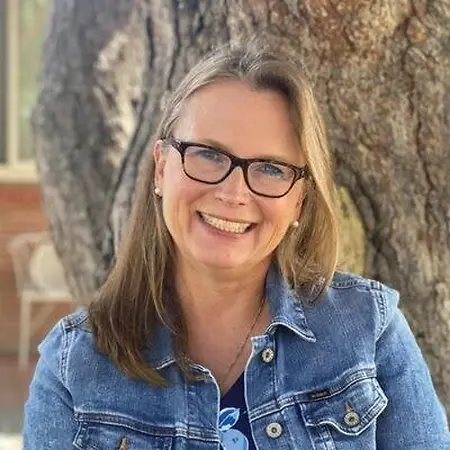
Carrie A. Olson, PhD (she/ella) is a dedicated educator, scholar, and community leader, currently serving as Visiting Assistant Professor of Practice at the University of Denver. She has always had a teacher’s heart teaching her stuffed animals in the basement and collecting dittos from teachers as a child. Growing up in northern Minnesota in a family of teachers, doctors, and nurses, with a grandmother who was also a teacher, Dr. Olson began her teaching journey early, volunteering as a high school Sunday school teacher. She studied education and Spanish in college, falling in love with teaching, and began her professional career in 1985 with Denver Public Schools, where she spent 33 years working primarily with students from families at or below the poverty line. Over 27 years, she organized 37 trips taking 800 students to Washington, D.C. and Europe, raising funds collaboratively to make these transformative experiences possible.
Dr. Olson is an adjunct professor at the University of Denver’s Morgridge College of Education, where she teaches methods for social studies and English language arts at the secondary level, as well as assessment for culturally and linguistically diverse learners. She also serves as Curriculum Director for the Educators Institute for Human Rights, collaborating with partners in the Democratic Republic of Congo to create guidebooks for teachers on Holocaust and genocide education and human rights violations. Fluent in Spanish, she supports schools with Spanish-speaking populations and brings cultural competency, empathy, and innovation to every classroom and program she leads. She is also a Museum Teacher Fellow at the United States Holocaust Memorial Museum, contributing over two decades to Holocaust and genocide education.
Elected to the Denver School Board, Dr. Olson served for eight years, including two terms as board president, navigating significant challenges such as the pandemic, a teacher strike, and five superintendent transitions before her term concluded in November 2025. Known as a “kid watcher,” she has a deep commitment to understanding how students learn best and continually adapts her approach based on their needs and feedback from families. Beyond the classroom, she dedicates her time to volunteer work with the Evergreen Animal Protective League and inspires colleagues, students, and community members through her professionalism, dedication, and lifelong passion for teaching.
Her Interview
Ten minutes with Carrie
01What do you attribute your success to?
Not quitting. I really have a love of students I was always a kid watcher, trying to figure out what makes kids work. I was willing to learn from the students and their families about how they wanted to be taught and what they needed, and I was always willing to grow and change. When there was something I wasn't doing well that wasn't resonating with the kids, I looked to my colleagues and professional development to get better. I'd ask myself, how can I get better at teaching reading to 7th grade boys who don't want to read? What can I learn from them, from research, from practice to bring it all together? I think I was able to successfully take 800 students to Washington, D.C. and Europe over 27 years because I was willing to learn from the students and their families.
02What’s the best career advice you’ve ever received?
My very first year of teaching in 1985, I can vividly remember sitting on the floor of my classroom crying, and the principal came down. Every day I was crying after school, and she held my hands and said, you know, you're going to be a really good teacher, you just can't give up. This is a hard job, but it's also going to be the best job, but just don't quit. Trust yourself, trust the kids, trust the community, trust the families, and you're going to be okay. Sadly, she died a couple years ago, but she stayed a part of my life throughout my whole career. So I think some of the best advice I got was really just keep trying. You also have to take care of yourself and do what fills you, because you're better at reaching out to students when you yourself feel like you have some of your own needs met. What works with one class might not work with another, so keep trying and don't quit. I tell my graduate students that I've made a lot of poor decisions in my life, but becoming a teacher wasn't one of them.
03What advice would you give to young women entering your industry?
Look for mentors in the field and trust yourself. From working with a lot of pre-service teachers, I see a lot of them have really good instincts about what works for kids. They get to know their classroom and their students, and they'll come to me and say, Dr. Olson, I don't know, I'm told to do this, but I'm watching this kid and I think that this is happening. I tell them, great! Trust that instinct of yours, and reach out to mentors and say, why am I seeing a match here? What can I learn from this, and how can I better work with kids? So trust yourself, learn from mentors, and always learn from the children.
04What are the biggest challenges or opportunities in your field right now?
When I started teaching in 1985, I never thought I'd say the words 'put your phone away.' I think the balance of how to balance technology is a big challenge how to help students be prepared for the future and use technology responsibly. I'm an English teacher and I love reading books, so how do you foster reading books digitally and in person? I also think meeting the mental health needs of students, and actually teachers and anybody in education, has changed a lot since I started. We're more willing to talk about it, and students are also more willing to be verbal about it, so just being able to meet all those needs is challenging. I also would say that a lot falls on teachers. When people would say on the school board, well, what's the answer? Well, let's have teachers do it. But we can't keep putting things on teachers without giving them support or taking something else away. Students trust their teachers - if you want to talk about a sensitive topic, it's usually the people who are closest to the students. So it's hard because kids will open up to the people they trust the most, but those people they trust the most are overwhelmed.
05What values are most important to you in your work and personal life?
I want to say love, and I do I loved being a teacher and I still do, even though I'm subbing. I love children. I think working in community is important too, knowing you're not alone. I can remember some of the classes I had that were tough, and I'd have a group meeting and say, look, we all need to do better, what can we learn as a community? So love, working in a community, and the excitement of learning new things - that never got old. To watch that spark light up in a student's eye when they say, oh miss, I finally get it, or they come back after a break and say, you know how you taught us about biodiversity? I saw something on TV about that. It was always so exciting when they saw that what you taught them in the classroom was out there in the real world. I love traveling with students for that reason, because we all worked together towards something, we were traveling in a community, and when we were on the trips, it was great for kids to be able to say, oh my god, I'm standing in front of the Eiffel Tower, or I'm eating chocolates in Brussels, and we read about this, and here I am doing the thing.
Join Influential Women and start making an impact. Register now.