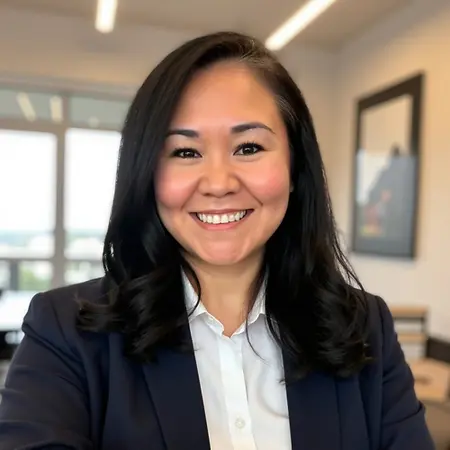
Her Story
About Cecelia
Cecelia Angasan (She/Her) serves as a Grants Manager at Colusa Indian Energy, the first tribally owned company with its own microgrid and solar development system. In this role, she oversees the full grant lifecycle, including opportunity identification, proposal development, compliance review, and post-award management. Raised in a small Alaskan village of fewer than 1,500 people, she brings a deeply personal understanding of energy resiliency challenges, having experienced firsthand the hardships of inconsistent power during harsh winters. That early experience, combined with a strong awareness of underrepresentation of Indigenous communities in infrastructure development, continues to shape and drive her professional purpose today.
Her path into grants management reflects a non-traditional but intentional trajectory. She spent nearly a decade exploring the medical field as a CNA in nursing homes and behavioral health settings while also working in the service industry to support her education. During this time, she balanced college coursework with family responsibilities, including raising twins, which required temporarily pausing her studies. She later completed her degree with the support of her family. Her transition into grants work began when she was invited through a family connection to join a grants team as a coordinator and writer, where she quickly discovered her strongest impact area. Within less than two years, she advanced from Grants Accountant to Coordinator and then to Grants Manager, contributing to the successful acquisition of 16 grants despite significant funding reductions following policy and administrative changes.
Cecelia is committed to continuous professional growth, participating in leadership development opportunities such as Arizona State University’s Indigenous Leadership programs and the Alliance for Tribal Clean Energy’s Tribal Energy Leadership Fellowship. She is part of a fully remote grants department composed of Native American women working across three time zones, supporting Tribes nationwide in advancing energy sovereignty and infrastructure development. She takes pride in helping communities strengthen autonomy over their utility systems, bridging her Alaskan roots with her work in tribal energy development and long-term sustainability initiatives.
Her Interview
Ten minutes with Cecelia
01What do you attribute your success to?
I attribute my success above all to resilience. Coming from a small Alaskan village of about 1,500 people with a single school, my transition to private schools in Texas and later private universities was a major culture shift, and I often felt underprepared. I had to work twice as hard as many of my peers just to keep pace, but I remained committed and never gave up. My journey has included exploring a wide range of paths, from pursuing medicine to working in nursing homes and the service industry, and I value each experience because it broadened my perspective and helped me make more informed choices about my career without becoming narrowly focused too early. I was also deeply shaped by my mother and grandmother, who consistently encouraged me to step outside my comfort zone, travel, meet new people, and continue learning and growing, which has remained a guiding principle in my life. I am equally grateful for the support system around me, including my husband, whose work requires flexibility but who consistently supports my education, fellowship programs, and professional commitments while caring for our three children when I am in class or training. I also credit an important turning point to family connections in Alaska, when a cousin’s wife’s sister working in grants encouraged me to enter the field and gave me my first opportunity. That combination of resilience, mentorship, and unwavering family support has been fundamental to my growth and success.
02What are the biggest challenges or opportunities in your field right now?
One of the biggest challenges in my field right now is the lack of standardized, formal training pathways in grants management, particularly in Tribal energy and infrastructure work. I did not enter the field through a traditional or structured pipeline, so I have often had to learn through experience, which can feel like constantly playing catch-up and trying to fully understand expectations as they evolve. Early on, that uncertainty created a fair amount of pressure and overthinking, especially when recognizing how much there still was to learn in a relatively short period of time. However, I also recognize that what can feel like a gap in formal training is balanced by continuous, real-time growth and adaptability. A year and a half ago, I would not have had even half of the knowledge I have now, and that progression has come directly from being willing to learn on the job and push myself beyond my comfort zone.
At the same time, this challenge highlights a major opportunity in the field. Many Tribal organizations are still building capacity in navigating grant systems from initial application through implementation, which creates a strong need for clear, accessible, and transparent guidance. That gap presents an opportunity to strengthen education, mentorship, and leadership development across Indian Country so that Tribes can more confidently access and manage resources. I also see a broader opportunity in continuing to expand funding pathways and partnerships that support Tribal priorities, whether through federal programs, private sector collaboration, or energy development initiatives. There is still significant work to be done, but that also means there is meaningful space to create systems that are more inclusive, informed, and responsive to the needs of Tribal communities.
03What values are most important to you in your work and personal life?
Representation and giving back to my community are at the core of everything I do. As a tribal member from a small Alaskan village, I grew up very aware of how limited representation and understanding of Indigenous communities can be, even within my own state, where many systems in places like Anchorage are non-Native led. That experience shaped my awareness of how our communities are often perceived and the barriers that come with those perceptions, and it has driven me to take everything I learned through my education and professional experiences and bring it back to support Tribal communities in building capacity, autonomy, and sovereignty, particularly within utility systems and infrastructure development on their lands. At the same time, I place a strong value on equity, especially for women and the next generation. As a mother to a daughter, I am intentional about challenging limiting narratives early and helping her understand that opportunity is accessible and that she is capable of achieving anything she chooses. I also strive to model balance in my own life, showing that work and family can coexist in different but equally meaningful ways. Overall, I am committed to leveling the playing field, expanding representation, and ensuring that Indigenous communities and women alike can see possibility reflected in both their personal and professional paths.
Join Influential Women and start making an impact. Register now.