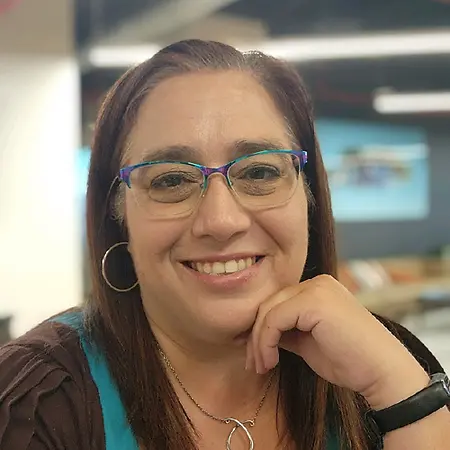
Her Story
About Cecilia
Cecilia Salinas is an occupational therapist and ADHD career coach based in San Antonio, Texas, with more than two decades of experience in healthcare and rehabilitation. She holds a Master’s degree in Occupational Therapy from UT Health San Antonio and began her career working across skilled nursing facilities and home health settings, where she focused on restoring independence and functional ability in patients with complex medical needs. Her clinical background is rooted in practical problem-solving, activity analysis, and patient-centered rehabilitation.
Over time, Cecilia’s work evolved beyond traditional occupational therapy as she began noticing recurring patterns among professionals—especially women with ADHD—who struggled with executive function challenges in demanding work environments. This led her to establish Mind Body Clarity, where she now focuses on ADHD coaching for late-diagnosed women and professionals navigating workplace overwhelm, inconsistency, and burnout. Her approach blends clinical occupational therapy principles with coaching strategies aimed at improving organization, task initiation, communication, and career confidence.
In her current practice, Cecilia specializes in helping neurodivergent women translate their abilities into sustainable workplace performance without masking or chronic overexertion. She works with clients on building systems that align with their cognitive styles, improving self-advocacy, and developing strategies for visibility and advancement at work. Alongside her coaching, she is also a writer and educator, sharing insights on ADHD, workplace dynamics, and neurodiversity through articles, newsletters, and professional content designed to support career growth and self-understanding.
Her Interview
Ten minutes with Cecilia
01What do you attribute your success to?
What I've learned is that modeling the behaviors you want to see is far more powerful than just telling people what to do. When I worked with a nurse colleague who was struggling, sending patient care emails at 2 in the morning, I didn't just give her advice. I said, 'I'm worried about you. How are you doing with everything?' and we worked together on her own systems. The breakthrough came when I helped her understand that when you model what you want to be successful in with your kids, that shows them how to do it, not just telling them what to do but never putting it into practice yourself. By modeling those skills herself, she not only got her paperwork in on time but actually earned a raise. That same principle guided my work with my stepson, who insists on calling me his mom, which I'm so proud of. He went from failing grades to straight A's, not through pressure or punishment, but through me showing him how I manage myself. Watching him succeed by modeling healthier self-management skills has been one of my greatest accomplishments. That's the magic of this work: people flourish when they see what's possible, not just when they're told what to do.
02What’s the best career advice you’ve ever received?
I've been very blessed to have mentors throughout my journey, including coaches I've worked with and patients who've taught me so much. But the most profound influence has been my mother, who is neurodivergent herself. She helped me see and explore the world with curiosity and an open mind. That perspective, that way of approaching life with wonder rather than judgment, has shaped everything about how I work today. It's taught me to look for creative solutions, to value different ways of thinking, and to approach every challenge as an opportunity to learn something new. My mom's support and her own resilience showed me that being neurodivergent isn't a limitation, it's a different lens that can reveal possibilities others might miss.
03What advice would you give to young women entering your industry?
I would tell anybody entering healthcare, and this is primarily women, that empathy is very powerful, but it's not the only thing you bring to the table. Healthcare is usually approached and supported by women, and we're praised for being kind, for being patient, flexible, and going the extra mile. It's really beautiful that we do that. I love that about myself and other women. But it's easy for a lot of those systems to undervalue us, underpay us, and expect us to keep giving without asking for what we need. So understand that your care and empathy have value, but so do your clinical reasoning, your education, and your creative problem-solving skills. This is not just soft work, which is what I think it's often seen as. It's very skilled work. Don't let anyone diminish the expertise you bring. And if you have ADHD, know that our brains don't always work in a straight line. We work very creatively, very divergently. We can make those skill gaps happen, we can be consistent and manage our time with support, and we can see problems that others don't. By taking both that empathy and that hidden strength within ADHD, we can make things very powerful. We can bring a lot to the table, and we can be valued for what we bring to the table. Keep learning through continuing education, because that investment in yourself matters.
04What are the biggest challenges or opportunities in your field right now?
One of the biggest challenges in healthcare, especially for women, is that it's easy for systems to undervalue us, underpay us, and expect us to keep giving without asking for what we need. We're praised for our empathy and flexibility, but that emotional labor often isn't recognized as the skilled work it truly is. For those of us who are neurodivergent, there's an additional layer. Our brains don't always work in a straight line. We work very creatively, very divergently, and we can see and make problems that others don't even recognize yet. That's actually a hidden strength within ADHD. By combining that empathy with the creative, divergent thinking that comes naturally to us, we can make things very powerful. We can bring unique perspectives and solutions to the table. The opportunity is in helping people recognize that value, both in ourselves and in the systems we work within. When we advocate for what we need and showcase our clinical reasoning alongside our compassion, we can transform how neurodivergent professionals are valued in healthcare and beyond.
05What values are most important to you in your work and personal life?
Modeling the behavior you want to see is one of my core values. When you model what you want to be successful in with your kids, that shows them how to do it, not just telling them what to do but never putting it into practice yourself. That principle guides everything I do. I also deeply value bringing positivity and humor, even in the hardest moments. I've received awards for always having a smile and always making others laugh, and I believe that's so important, especially when working with patients who are dealing with losing a leg or recovering from a stroke. They go through stages of grief, and keeping that positive attitude matters. Being a problem solver is another value I hold close. I love figuring out the problems that people don't even know they need to solve yet. Whether it's designing a custom setup for a photographer who's had a stroke or helping an ADHD professional get their paperwork in on time, I'm driven by creative problem-solving. Finally, advocacy is essential to me. I've spent years supporting patients, mentoring colleagues, and encouraging women in healthcare to recognize the value of their expertise and clinical reasoning, not just their empathy. Outside of my professional work, I find meaning in small acts of care, like quilting for veterans and children aging out of foster care through the San Antonio Modern Quilt Guild. I believe these gestures, though simple, can have lasting impact.
Join Influential Women and start making an impact. Register now.