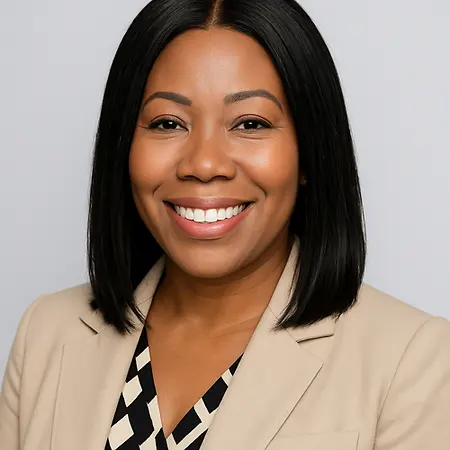
Her Story
About Chante
Chante Graham is a seasoned construction portfolio leader and award-winning documentary filmmaker whose career bridges infrastructure and storytelling.
With more than three decades in commercial real estate and construction finance, she has overseen complex portfolios across major financial institutions, including ABN Amro, Bank of New York, and Signature Bank. She currently works within a nonprofit mortgage company focused on affordable housing and sustainable development. Over the course of her career, she has built operational frameworks, managed high-value construction initiatives, and mentored emerging professionals navigating high-pressure corporate environments. Parallel to her corporate leadership, Chante cultivated a career in film and media through Bric Arts Media in Brooklyn, producing original programming for Brooklyn Public Access Television for nearly a decade. Her documentary work earned an International Film Award in 2015, with screenings in Paris. Across industries, her work reflects a consistent throughline: building systems and shaping narratives. She is currently developing initiatives to support women of color navigating corporate America, with a focus on resilience, equity, and the often-overlooked human impact of high-performance cultures.
Her Interview
Ten minutes with Chante
01What do you attribute your success to?
I attribute my success to disciplined self trust. Even when I'm tired, embattled and uncertain I have learned not to abandon myself. My success is attributed to my family, friends, community and allies that continue to hold space for me throughout my life. Success is not linear, its a constant discovery of who I was and who I am becoming. Learning to trust myself and listen to my body as the world tells me, I am not worthy and do not belong here. Success is more like climbing a ladder, at many points in life you will fall off, but we must remember to get back up and keep climbing. More than a spreadsheet or performance review success for me is when someone says thank you, I am different because of you, its how you make people feel and who is empowered in your presence. You cannot have a long career in any industry if you are moving on autopilot. Success is about being intentional with every move I make. Success is a journey and I am still on it.
02What’s the best career advice you’ve ever received?
The best career advice I’ve lived by is master your craft. Know the fundamentals so well contracts, budgets, compliance, risk so that nobody can undermine your work. Competence creates leverage, and leverage protects you. And I’ll add this: no question is a dumb question. Especially in construction. Ask. Clarify. Confirm. The people who last in this industry are the ones who stay curious, stay sharp, and aren’t afraid to speak up in rooms where they may be the only one.
03What advice would you give to young women entering your industry?
Young women entering the field of construction should invest deeply in learning the fundamentals: contracts, compliance, budgeting, and risk assessment. Competence creates leverage.
Equally important is building a support ecosystem. High-pressure industries can amplify scrutiny, and having mentors and sponsors is critical, don't be afraid to approach someone to be your mentor. I didn’t understand mentorship early in my career. I didn’t have real, official mentors until I was already twenty years in. Track your wins, learn market ranges, negotiate early, and don’t wait until you’re exhausted to ask for a raise. Do not mistake visibility for support.
I would also say to younger women who are starting their careers in general be intentional. Start with the things that you love, or you're innately good at. It could be writing, cooking or poetry. Cultivate your gifts, whatever they are. Be intentional about what you want to do in your career and life. Don't go through the motions of I have a job and I have to pay my bills. Don't stay in a place for four, five, six, or ten years that you're unhappy in. If you are unhappy by year two and it's not the work you want to do, has nothing with your innate talent, then make a move to pivot and change course. Think about construction, foundation is key. Build your foundation with intention. Think about building that thing that you are great at, comes naturally, simultaneously in your job. Make sure it's in line with who you are as a person. You would hate to work a job for twenty or thirty years, get to the end of that job, and just say, okay, what did I get out of this? I just paid bills and took a few vacations. It's challenging to pivot as an older person but not impossible, I had to do it many times. Early in your career is a time of discovery, so while you're discovering, be intentional about what it is you want to do. The years go by quickly, especially when you have a family, and become a mother. Sometimes our dreams get placed on the back burner. So commit and bet on yourself over any corporation!
Those are the things that will ultimately bring you joy. If you work on those things early, you will have a fulfilling life. Don't let fear of the unknown immobilize you. We know when we are growing and we know when we feel stagnant. You can't waste time, with a job that is going nowhere, that job needs you, remember that. Never lose your dignity. That is the advice I would give to my younger self. I would have been intentional about my gifts and passions. Sometimes it takes knowing what you don't want to know what you do want. So be patient with yourself and always give yourself grace. As you get older what you have cultivated will fuel your life when you retire. Retirement just means you pivot to something else. You would hate to wait until you're 80 years old to say, hey, what am I going do now? Cultivate your gifts early and don't let people talk you out of your dreams. The skills that you develop in your career can also be used to work for yourself if you have an entrepreneurial spirit. Don't be afraid of your own success. Finally, prioritize your well-being. Success should not come at the cost of your health. The strongest leaders are not those who endure the most pressure silently, but those who build sustainable careers with clarity and boundaries.
04What are the biggest challenges or opportunities in your field right now?
In sustainability the work is moving faster than the industry’s readiness. Retrofits are complex systems work. You’re dealing with aging buildings, tight budgets, residents or tenants still living in place, permitting, procurement, and timelines that don’t care about your intentions. There’s a real shortage of contractors and trades who truly understand high-performance upgrades. Another challenge is equity. In construction, access to capital is still a constant barrier especially for BIPOC developers and building owners. Communities that need healthier housing the most face the biggest hurdles and are often the ones fighting the hardest just to get financing, resources and lower energy bills.
The opportunity is that sustainability is no longer optional it’s becoming the standard. There’s room for new leaders, new systems, and new ways of doing the work. If we can build stronger education pipelines, train contractors for the reality of retrofit work, and align funding with real community needs, we can create jobs, improve health outcomes, and make buildings more resilient without leaving marginalized people behind.
And there’s also room for growth: leadership, owner’s rep work, project controls, risk management, development, consulting. The people who can communicate clearly, manage pressure, and deliver results are always in demand.
At the same time navigating corporate America as a Black woman presents its own set of complexities. High pressure infrastructure and finance environments often lack equitable presentation, the burden of performance, visibility, limited sponsorship, mentorship and credibility can be disproportionately heightened. In many cases Black women in financial and technical spaces are expected to perform at exceptional levels while navigating high level scrutiny and limited margin for error. Addressing this dynamic is not only an equity issue, its a leadership imperative. One structural challenge in corporate America is what research refers to as the "broken rung". Women are often hired into entry-level roles but face disproportionate barriers at the first promotion into management. For Black women the gap is even wider creating compounding effects across our entire career trajectory, especially because we are advanced at lower rates than our peers. Addressing the broken rung is not only an equity issue, its an operational one. In addition to the broken rung, the persistent pay gap remains a defining challenge. Women continue to be compensated at lower rates than their male counterparts, and for Black women, the disparity is even more pronounced. These gaps also compound over time affecting not only immediate earnings, but long term wealth accumulation, retirement security and financial stability. Organizations that fail to develop diverse environments and leadership pipelines weaken their own long term resilience.
Having operated in these environments for over three decades, I've seen first hand how representation, mentorship and structural clarity impact not only individual careers but overall organizational effectiveness. However, what is discussed far less is the physiological impact of navigating these environments and how they influence health. Chronic stress, hypervisibility, limited margin for error, and the burden of representation can contribute to measurable nervous system strain and negative health outcomes for women operating in these spaces. Often over-looked is the human cost. Financial inequity paired with heightened scrutiny and performance pressure lead to sustained stress load, a factor linked to adverse health outcomes for women operating in high-demand corporate environments.
Long term resilience in organizations require attention to those systems that support the people inside of them.
05What values are most important to you in your work and personal life?
The values that matter most to me at work and in my personal life are alignment, integrity and care. By alignment, I mean I want what I do to match who I am. I’m not interested in building a life that looks good on paper but costs me my peace. I want my work to feel honest, grounded, and sustainable in my body. I value integrity, doing what I said I would do, being clear, and being accountable.
I value relationships, moving with respect, building trust, and treating people like people, not titles. I also value being a safe person for another woman who looks like me. Because this industry can be biased, discriminatory, racist, and sexist and I know what it feels like to be the only one in the room carrying that weight quietly. I want to be the one someone can trust and call in a moment of weakness. The cheerleader who says, “Go for that role. Ask for the raise. Speak up in that meeting. You belong here.” I want my presence to make the path a little less lonely and a little more possible.
Join Influential Women and start making an impact. Register now.