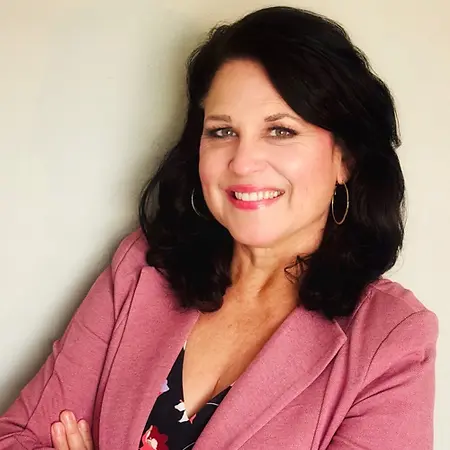
Her Story
About Cher
Cher Knebel is the Founder of Living Happily Connected, a communications leader, speaker, and healthcare messaging expert dedicated to strengthening human connection in an increasingly digital world. She brings more than 40 years of experience in communications and public relations, having earned her degree in Communications and Public Relations in the 1980s. She currently serves as a Senior Communications Consultant at Optum, where she leads provider- and member-facing communications that emphasize clarity, health literacy, and trust, ensuring complex healthcare information is translated into meaningful, actionable guidance.
Cher’s healthcare communications journey began in the late 1980s in human resources, where she developed wellness and employee health content for corporate newsletters. In the mid-1990s, she joined PacifiCare, working across behavioral health and corporate communications, followed by a role at Pinnacle, where she continued building her expertise in healthcare messaging and member engagement. After stepping away for approximately 12 years to focus on family life as a stay-at-home mother and freelance writer, she returned to the industry with a broadened perspective on balance, resilience, and purpose. Throughout her career, she has consistently brought deep commitment and energy to her work, driven by a strong passion for meaningful communication and impact.
Thirteen years ago, Cher launched Living Happily Connected as a blog, which has since evolved into a comprehensive framework, speaking platform, and body of work focused on social connection, wellness, and longevity. Her approach is informed by global research and practices, including insights from the Blue Zones, as well as cultural connection traditions such as community festivals and shared celebration practices around the world. She discovered her passion for this work after speaking at Cornerstone Church in Arizona, where she first explored the impact of connection during life’s most meaningful moments. Today, she integrates research in positive psychology, social health science, and lived experience to advocate for connection as essential to well-being and longevity highlighting evidence suggesting that poor social health can significantly impact lifespan. She is actively expanding her platform through speaking engagements, blogging, Substack, Instagram, and upcoming video content on YouTube, continuing her mission to position social connection as a vital component of human health and happiness.
Her Interview
Ten minutes with Cher
01What do you attribute your success to?
I would say my biggest attribute is communication. I've done the Clifton Strengths Finder, and one of my strengths is communication. I've just always been on a mission to share what I've learned and what I know. Even in high school, I worked at this Park Lane Hosiery booth at the mall in my small town of Visalia, and people would come to me to find out where the parties were. I'd tell them, okay, there's a party on Fifth Avenue, on this and that. I've always been the one that wanted to share what I know to help people. I have an extreme amount of energy, and I've always felt for the underdog. I felt for people that were going through tough stuff. So I think my attributes of communication, of caring so much about people and having empathy for ones that are going through a tough time, has just always been part of who I am. I was publicity director in student government, I was co-yearbook editor. It's always been about informing, it's always been about communicating. That's why I love speaking. I just love being able to share with the audience. I would think that's my biggest attribute. That's really what has helped me to be successful in my communications history. I've always been a connector, and now I've really embraced using my communication skills to talk about how we need to hold on to humanity and humanness, treating people right, treating each other like human beings instead of robots.
02What are the biggest challenges or opportunities in your field right now?
I think the biggest challenge and opportunity right now is around AI and technology. I saw this film about a month ago called AI, the Documentary, and it talked about the potential of AI taking things down, robots taking over. But something about that clicked with me, and I thought, I need to use my communication skills to be able to talk to people about this. I've been seeing in the news how young people are booing the billionaires who go up and speak to them saying they need to embrace AI. I'm listening to all the podcasts, there's a guy named Tristan Davis for humanity in AI, and I feel like I'm fighting for it. I mean, I feel like it was important before, but now it's like we have to hold on. Worst case scenario is we've got 5 years, or 10 years, and things are going to change. Well, you better enjoy yourself now. You better lean into your relationships now. As I said in my speech, don't put your social health and your relationships in the hands of the tech companies, because they want you to be on your phone 24-7. Don't put it in the hands of your employers. They're not going to ask if you're seeing your friends Friday night. And don't put it on the back of your to-do list and just say when I get around to it. We have to hold on to humanity, the humanness, treating people right, treating each other like human beings instead of robots. That's going to give us longer lives. People are leaving years on the table by just saying it doesn't matter, by just saying, okay, I'll focus on physical, I'll focus on nutrition, and then the third pillar is the social health. I think people think it's just a nice-to-have, but I'm really leaning in to get some more of my experiences with that out there.
03What values are most important to you in your work and personal life?
The most important value to me is putting my health first, because I don't want to lose 10 more years. I recently went on a health quest and worked with a health coach, losing 10 pounds. I now walk 8,000 to 10,000 steps every day and I journal, which I didn't do before. I was one of those people that if I'm not accountable, I'll put everybody else's needs first. If my two adult kids are going through something, I'd drop everything. But now I have this structure of not letting that go, because I've just been somebody who thought I was going to have my own company, I was going to be president one day. I was wearing suits at 16. I've just been very ambitious, and I've had to balance it. I took about 12 years off as a stay-at-home mom and freelance writer, and I learned what it's like to curb those tendencies to want to do everything. Now that I have kids out of the house and a very supportive husband who's doing his own thing, I make sure that I put my health first. I think it's really about saying you cannot put yourself at the bottom, and that gives me the energy and the balance to do everything else I want to do. I also value being intentional about my connections. Five years ago, this Memorial Day weekend, I was working remote full-time and had let all my connections go. Here I am, the advocate for connection, and I let it all go because of COVID, too much work, the Great Resignation. I talked about this at a wellness speech a couple weeks ago, and I just think about where I am today and how intentional I am. I create tools for women to not make that mistake, to not put it all into work or just caregiving. I've gone through it personally, but I also do the research, and there's more and more research showing us that it's a matter of life and death.
Join Influential Women and start making an impact. Register now.