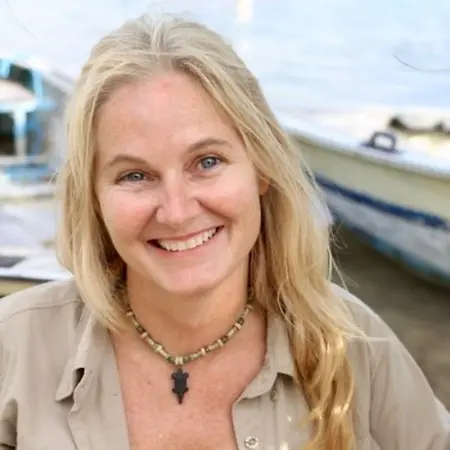
Influential Woman · Published Research Biologist
Cherie Chenot - Rose
"Crocologist" Crocodilian Specialist, GiveaCroc, LLC.
Sebastian, FL
Her Story
About Cherie
For over 30 years, I’ve lived at the thrilling intersection of science and adventure. As a research biologist, I’ve traveled from the rough, adrenaline-pumping waters of the Bering Sea, where I was the only woman aboard deep-sea commercial fishing vessels for the National Marine Fisheries, to the untamed, deadly jungles of Belize, where my husband, Vince, and I blazed a trail to establish Belize's first crocodile conservation organization, ACES (American Crocodile Education Sanctuary).
Navigating male-dominated fields requires more than courage. It requires a willingness to be underestimated and the determination to carve out space even when none seems available.
What began as a newlywed’s adventure in 2004—living completely off-grid and hand-building our dream home sanctuary in the heart of a deadly jungle—transformed into a decade-long, high-stakes crusade to protect endangered crocodilians. Vince and I documented American crocodile populations, spearheaded countrywide rescues, and served as a daring bridge between awe-inspiring apex predators and local communities.
But our passion exacted a staggering personal cost. In 2010, fueled by a local psychic's sinister divination—that we were hiding missing children underground to feed to captive crocs—a violent mob of villagers burned our home and sanctuary to the ground, destroying everything we had built and killing many rescue animals.
I faced a choice. In that moment of total ruin, I discovered an unbreakable spirit. Instead of walking away, I found deep, unwavering faith—a conviction that our work was bigger than our circumstances. That resolve kept us there for four more years, during which we secured international research grants—including years of support from La Fondation Brigette Bardot—published five critical studies on Belize’s crocodile populations, and shared our story on global television, including Animal Planet, National Geographic, and the World Wildlife Foundation. Staying wasn't just about the science—it was about reclaiming our purpose from the ashes of adversity and transforming our work into a powerful, lasting legacy.
Today, based in SE Florida, I continue my passionate work in crocodilian conservation through GiveaCroc, LLC, alongside my one true love, Vince. My focus remains on bridging the gap between humans and wildlife by providing expert monitoring and education that empowers people to safely coexist with the prehistoric beauty of alligators and crocodiles. Alongside my memoir in the works, A Caribbean Croc-Tale chronicles my savage journey—a testament to resilience, the thrilling and dangerous realities of conservation, and the enduring power of finding your purpose in the most unexpected places. Now 60, I aspire to inspire other women to stand firm in their dreams and to show that one can find opportunity in any waters, no matter how turbulent—just like a crocodile.
Her Interview
Ten minutes with Cherie
01What do you attribute your success to?
When people ask what I attribute my success to, I don’t point to a single achievement or a moment of brilliance. We don’t walk our paths alone. Every person who’s entered my life has left a piece of perspective that is now part of my inner compass.
I think of my life as a shoreline—forever shaped by the waves of every soul I have ever met. Each voice, lesson, and challenge has washed over me, leaving me with wisdom that defines who I am today. From the crewmates who tested my limits at sea to my mentors who shared their expertise, every person I have met has helped shape me.
Having spent decades studying the silent, steady power of crocodilians, I’ve learned that the most profound strength isn't in fighting the current but in trusting one's ability to navigate it. Resilience isn’t merely surviving turbulence—it’s recognizing the opportunity hidden within it, with quiet patience.
To the women navigating your own storms: remember that you do not swim these waters alone. Every challenge you have faced has not just been an obstacle—it’s a teacher. Every person who has entered your life has left a piece of truth that is now part of your inner compass.
You are stronger than the turbulence you face and more capable than you realize. Keep your eyes on the surf, trust your own depths, and hold fast to the faith that you have the power to find your way through any water.
02What’s the best career advice you’ve ever received?
"Keep on Keepin' On."
03What advice would you give to young women entering your industry?
If you find yourself standing at the edge of a career you are drawn to—one where you feel like an outsider or are unsure whether you’ll be welcome—my advice is to claim your curiosity as your qualification and simply show up.
In the 90s, when I was one of the less than a few women aboard Alaskan fishing vessels—I met only one other woman working aboard a commercial fishing vessel in six months—I was considered 'bad luck.' But the resistance I faced wasn't about my ability; it was the status quo’s fear of change. Later, when I was carving out a place in the male-dominated world of crocodilian research, I learned that you don't need an invitation to prove you belong. You just need to show up with relentless passion. If you can move past the fear of not fitting in, you will find that your presence is exactly what changes the landscape for everyone else.
When you find your rhythm, you will see the shift—not just in your own life, but in those who come after you. My greatest pride isn't just the crocodilians we’ve saved; it’s the former students who arrived with no experience and now run their own successful research programs and wildlife rescues.
Don't worry about whether you fit—focus on the work. Find mentors, ask questions, and be patient with your growth. You might be the first woman to walk that path, but your footsteps will light the way for those who follow. Your courage in the face of uncertainty is exactly what opens the door for the next generation.
04What are the biggest challenges or opportunities in your field right now?
The most pressing challenge in crocodilian conservation today is the rise in human-crocodilian conflicts, especially here in Florida. We are the only place on Earth where crocodiles and alligators coexist, and as their populations grow alongside human development, encounters are becoming inevitable. The American crocodile—once endangered throughout most of its range—has recently reached numbers sufficient to be downlisted to threatened status in the United States. I believe the recent increase in alligator attacks is directly linked to this success: as the crocodile population expands, it places significant pressure on existing alligator habitats, forcing alligators into smaller, more fragmented areas where they are more likely to encounter humans.
My goal is to dispel the fear that drives people to seek the removal of crocodilians in situations where they are not actually a nuisance. I believe this shift in perspective is critical because the loss of apex predators compromises the health and balance of the entire ecosystem. Through GiveaCroc, Vince and I do more than simply respond to conflicts—we proactively seek out and assess nuisance and problematic crocodilians before incidents occur. Additionally, we strive to educate the public on how to live safely alongside alligators and crocodiles—going beyond the typical warning to ‘stay a safe distance from the water’s edge’ by explaining actual crocodilian behavior. For instance, we teach that feeding local wildlife, such as ducks and turtles, inadvertently conditions alligators and crocodiles to lose their natural fear of humans, creating nuisance animals and increasing the likelihood of future conflicts.
It’s about inspiring awareness and teaching that these magnificent creatures are not monsters to be feared but necessary apex predators that we must learn to manage and respect, because their survival is ultimately vital to our own.
05What values are most important to you in your work and personal life?
At my core, I have always been an educator. I firmly believe that we fear what we don’t understand, so education plays a vital role in shifting our perceptions toward reverence and in helping us learn to live fearlessly.
This philosophy—that one must replace fear with understanding—guided me through my most intense years in the jungle. I’ve survived flesh-eating bacteria, jaguars, armed poachers, and wrestling twelve-foot crocodiles. Even after losing everything in an arson attack, Vince and I stayed in Belize for another four years because we still had crocodiles in captivity, and I absolutely refused to abandon them. My mission continued to educate the public and replace their fear of crocodiles with respect for the important role these apex predators play in maintaining the health of our mangrove ecosystems, enabling us to coexist safely.
However, when my passion turned into an obsession, I also learned an essential lesson about balance—that people in our lives need to come first. When a physical injury I sustained inadvertently put one of my students in harm’s way and nearly put me in the jaws of an angry crocodile, I realized it was time to pivot.
As my father, an only child, grew sicker and his mother aged, I, also an only child, realized I was all they had. True strength isn't just about surviving the wild—it is knowing when to evolve. For me, that meant extending my passion for protection to include my family, just as deeply as I protected crocodilians.
Today, my calling to educate and protect extends far beyond family and crocodile conservation. It’s rooted in a deep, unwavering devotion to the lives of those around us—a belief that we are all responsible for one another’s well-being. Having donated my left kidney to my father in 2009, I have seen firsthand the life-altering impact of that gift. I’m a fierce champion of organ donation—a vital cause that saves lives every day. On average, seventeen people lose their lives each day while waiting for an organ. Those who wait the longest typically need a kidney. Most of us are born with two kidneys, and in a world where we can save a life with a simple act of generosity, the opportunity to give is a profound privilege.
If you are unable to be a living donor, you can still save and improve lives. A single organ donor can save up to eight lives. Being an organ donor is a simple yet heroic decision—you can register at organdonor.gov today. It takes only a few minutes to sign up, but the impact of that choice can last a lifetime.
Additionally, I am writing a non-fiction narrative about my years in Belize. This gripping true story recounts the life-and-death struggles of American newlyweds Vince and me as we leave the U.S. and our loved ones to chase our dreams, build an off-grid life in Belize’s deadly jungle, and devote our lives to protecting the country’s endangered crocodiles. When a village soothsayer falsely claims we fed missing children to the captive crocodiles, it sparks a violent mob that sets our home and croc sanctuary on fire, propelling us on a quest to find justice, ourselves, and the savage truth. Once published, I intend to pay it forward by raising awareness and funds for missing children worldwide.
Ultimately, my core values are rooted in dismantling fear through education, protecting the vulnerable and misunderstood, and stepping up for those who need us most.
Join Influential Women and start making an impact. Register now.