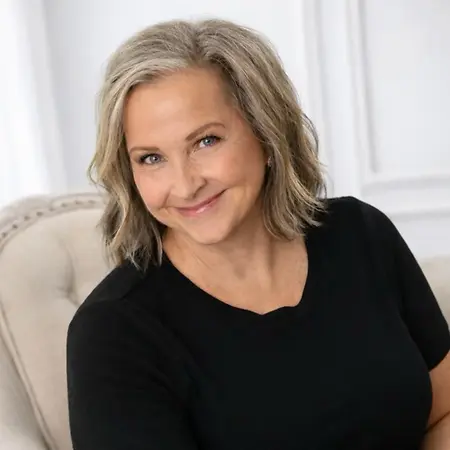
Influential Woman · Early Childhood Education
Cheryl Hovey, EdD
Program Director Early Childhood | Keynote Speaker | Trainer, Fisher College/Ez Ed 2 Go
Warwick, RI 02889
Her Story
About Cheryl
Cheryl Hovey, EdD, is the Early Childhood Program Director and Assistant Professor at Fisher College in Greater Boston, where she leads the development and expansion of early childhood academic programs while teaching and mentoring future educators. Her professional career is rooted in a deep commitment to infant and toddler care and early childhood education. She earned her bachelor’s and master’s degrees from Wheelock College in Birth to Three Development and Intervention with a specialization as an infant-toddler specialist, and later completed her Doctorate in Education at Walden University, where her research focused on how educators build secure attachments with infants and toddlers experiencing toxic stress. During her 13 years at Fisher College, she has significantly expanded the early childhood program from a single associate’s degree and certificate option to include multiple academic pathways, including a 30-credit certificate, additional associate’s degree options, and bachelor’s and master’s degree programs she helped design. She is especially proud that early childhood education has become the largest degree-enrolled program at the college.
In addition to her academic leadership, Cheryl is the founder and president of Ez Ed 2 Go, an early childhood consulting and professional development organization that provides specialized training for educators, programs, and organizations. She recognized a need for high-quality, research-based training that goes beyond foundational skills and focuses on strengthening relationships, supporting brain development, and improving classroom practice for infants and toddlers. She is a nationally recognized keynote speaker, workshop presenter, and trainer who translates early childhood research into practical strategies that educators can immediately apply in their classrooms. Her areas of specialization include attachment theory, temperament, trauma-informed care, and developmentally appropriate practice, with a strong emphasis on improving outcomes for children and families through educator support and workforce development.
Cheryl is deeply committed to elevating the early childhood profession and advocating for children, families, and educators. She believes early childhood educators are highly skilled professionals whose work has a profound impact on society. Guided by the values of collaboration, mentorship, and service, she is passionate about supporting the next generation of early childhood professionals while promoting equity and high-quality care for young children. Through her teaching, consulting, conference presentations, and leadership work within professional organizations, she continues to advance the field of early childhood education by bridging research, policy, and classroom practice. Outside of her professional work, she remains dedicated to lifelong learning and strengthening early childhood systems locally and nationally.
Her Interview
Ten minutes with Cheryl
01What do you attribute your success to?
I attribute my success to finding my true calling and passion when I was placed in an infant room early in my career - I discovered my love for working with babies and infants who have no voice and need unconditional care. The mentorship I received was absolutely vital to my journey. Professor Joan Marshall, who has since passed away but remains like my little guardian angel on my shoulder, believed in me when I was just a girl from Franklin, Massachusetts, and she pushed me to pursue higher education at Wheelock College when I thought it was a stretch for someone like me. Gwen Morgan also took me under her wing, telling me she needed to pass the torch and connecting me with incredible opportunities to work with organizations like the National Center for Children in Poverty and the University of Virginia. These mentors showed me that I could make a real difference in the field of infant-toddler care and early childhood education. I also credit my success to staying grounded in the real work - I've been in the classroom, I know what educators are going through, and I make sure my training and teaching is applicable for people working in the field. My determination to elevate this profession and show that early childhood educators are highly qualified professionals, not babysitters, drives everything I do. And personally, obtaining my doctorate was huge for me - I wanted to make sure no one could ever say no to me because I didn't have the credentials, and I wanted to show my daughter and my granddaughter Lola that if you dig your feet in and work through challenges, you can achieve anything, even if you weren't a great student in high school like I was.
02What’s the best career advice you’ve ever received?
The best career advice I ever received came from my mentor Joan Marshall, who told me 'Cheryl, you need... we need more people in the infant-toddler field.' She saw something in me and pushed me to continue my education, helping me write my application essay for Wheelock College when I thought going to a school in Boston was a stretch for someone like me - I was just a girl from Franklin, Massachusetts. She showed me that I had the ability to make a real difference in this field and that the work with infants and toddlers was vital and needed more qualified, passionate professionals. Another pivotal moment was when Gwen Morgan told me 'I need to pass the torch' and connected me with incredible opportunities. At first I joked that I don't play with fire, but she believed in me and helped me see that I could carry forward the important work of advocating for young children and elevating the early childhood profession. These mentors taught me that when someone believes in your potential and opens doors for you, you have a responsibility to walk through them and then do the same for others.
03What advice would you give to young women entering your industry?
My advice to young women entering early childhood education is that you can absolutely make a difference and change the lives of young babies and children. This field is so much more than babysitting - we are highly qualified professionals providing vital care and education that lays the foundation for children's entire lives. Don't let anyone diminish the importance of this work. I've had people ask me why I was getting my doctorate when I work with babies, and my response is that I want to make sure your child has a great foundation, and I never want to be in a position where someone says no to me because I didn't have the credentials. If you're passionate about this work, pursue your education, get credentialed, and don't be afraid to advocate for yourself and for the profession. We need more people, especially in the infant-toddler field, who understand child development, neuroscience, and how to create secure attachments with children, particularly those who have experienced toxic stress. And remember, if you dig your feet in and work through the challenges and obstacles, you can achieve anything - I was the first in my family to go to college, I wasn't a great student in high school, but I found my passion and I kept pushing forward. Lean on your colleagues, collaborate instead of compete, and always remember that our ultimate goal is providing high quality care for all children.
04What are the biggest challenges or opportunities in your field right now?
One of the biggest challenges and opportunities in early childhood education right now is elevating the profession and changing the perception that we're just babysitters. We need to establish that childcare is a vital facet for society - we realized this during COVID when things shut down and people were asking 'what are we gonna do?' - but we still struggle with low salaries that aren't equal to what early childhood educators are capable of doing in the classroom. This is a marginalized field with low income, which is why programs like the 40% scholarship we offer at Fisher College for full-time early childhood students are so important - we're making education affordable so people can obtain their degrees and create professionalism in the field. We need highly qualified staff to oversee and educate children, not just watch them. There's also a vital need for quality infant-toddler training and professional development. When I started, there wasn't much available beyond infant massage or sign language - educators were forced to sit in preschool trainings about circle time and large groups, which isn't applicable for infant-toddler care. The opportunity is in providing specialized, applicable training that addresses what teachers actually face in the classroom - what do you do when a baby won't stop crying, how do you create attachments with infants experiencing toxic stress, understanding neuroscience and child development. We also need more women in higher administrative roles and more female business owners in this field. I'm looking for new board opportunities now that my term at AEYC is finished, because advocacy and collaboration are essential to moving this profession forward.
05What values are most important to you in your work and personal life?
The most important value to me is making a real difference in the lives of children, especially infants and toddlers who have no voice and need unconditional love and care. I'm driven by the belief that we need to provide high quality care and lay a great foundation for all children, and I'm passionate about elevating the early childhood profession to show that this work is vital and requires highly qualified professionals. Collaboration is central to how I work - I don't operate competitively because we're all in the same field with the ultimate goal of providing quality care for children. I believe in lifting others up, whether that's referring students to programs that might be a better fit than mine, subcontracting trainings to other professionals whose expertise matches the need, or mentoring the next generation of educators. Accessibility and being present for my students is important to me - I pride myself on being accessible, meeting with students often, and forming real relationships because adult learners, especially first-generation students, need guidance and someone to believe in them. In my personal life, I value staying grounded and pouring into myself so I can pour into others. My garden is my sanity - when the world starts to get on fire, gardening grounds me because you have to have patience, you have to cultivate and enrich the soil, and it doesn't happen overnight. I also value travel and maintaining deep, lasting relationships - I've stayed connected with my French exchange student friend for 44 years and with the family I nannied for in graduate school, because those connections and experiences enrich my life. And now as a new grandmother to Lola, I'm excited to share with her the importance of education and showing that you can achieve anything if you work hard and push through obstacles.
Join Influential Women and start making an impact. Register now.