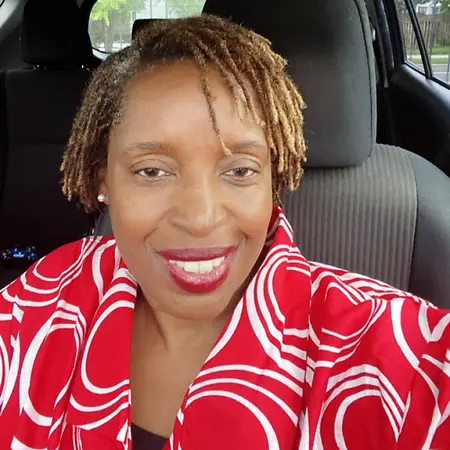
Her Story
About Chimene
I've been teaching at Howard University for about 14 years as an Associate Professor in the Department of Nutritional Sciences, and I've been a dietitian since 2001. What led me to education was seeing so many young people being admitted to facilities for rehab because poor nutritional health and non-communicable diseases were leading to chronic conditions - kidney failures, all kinds of health issues. I reached out to my advisor, Dr. Lillian Williams, and she said it sounds like I need to be in education. So I went into health education and got a doctorate in health education from Columbia University, and then got another doctorate in philosophy, a PhD focusing on nutrition and communication from Howard. The real reason I got into nutrition is that I wanted to solve world hunger. I really feel like we could solve world hunger if we look at portion sizes and what we're doing with food, because there's a lot of waste. I started with the notion that I could do something about that, and now as I'm getting older and really into it, I'm into farming and looking at food as medicine. My goal is to feed one million children - if I could feed one family at a time, I'm going to be able to get close to my goal of ensuring children don't go hungry. I've done a TED talk about malnutrition and there's a video on YouTube about the problem of malnutrition and what we could do to solve that. My main area of expertise is food as medicine - using food to address chronic health conditions, looking at how we could reverse diabetes through portion size and food control. I recently developed a model called the African Caribbean Center for Integrated Nutrition Model to look at using local, indigenous food wherever we go, whether in the Caribbean or Sub-Saharan Africa, to improve nutritional health and reverse health conditions. I've written books including 'Rooted in Flavor: The Taste of Uganda' and 'The Taste of Tanzania' looking at local recipes to get people to eat as locally as possible. I was recently a visiting professor at the University of Dar es Salaam in Tanzania for 6 months. During the semester, I'm a 12-month employee at the university, and I also do various consulting as a clinical dietitian to various organizations. I'm currently writing a book and working with colleagues in the Philippines to translate my children's book 'Mama Veggie and Papa Fruit: An Adventure for the Gardner's Garden to Eat Healthy' into Tagalog, Spanish, and French to reach broader communities.
Her Interview
Ten minutes with Chimene
01What do you attribute your success to?
I attribute my success to the women that carried me. My mother is an amazing woman - she worked really, really hard for us, a single woman raising 6 children in America. Her and her ability to pray have been incredible. I also have another auntie by the name of Aunt Lolia, Auntie Lolia. She's absolutely amazing, about 5'11 but a powerhouse in terms of a woman that prays and prays for her nieces and her nephews. I think that those prayers have helped me to be able to not be afraid. When I was taking my board exam for dietetics, I said, Auntie Loli, I'm taking my board exam, I'm so scared. I cannot not pass, I have to pass. She said, of course you'll pass, darling! I'm gonna go, what time is your exam? I said, it's at 9 o'clock. She said, okay, go sit there and pray, but I'm gonna go ahead and pray for you. When you finish, call me. When I finished the exam and saw that small letter that says congratulations you passed, the first person I called was Auntie Lolia. I said, oh my god, Auntie Lolia, I passed, I passed! She said, okay, good, I know you were going to pass. Now let me go back and take my nap, because I had to call her so early in the morning. These women have been amazing to me, the way they love me and pray for me for the various things that I was trying to achieve. They are the ones that have really held me up in prayers.
02What’s the best career advice you’ve ever received?
The best career advice I've ever received came from Dr. Moore. He said, 'You got this. Keep pushing.' I was at a point where I didn't have the finances, I didn't think I was going to be able to make it, and he just passed me and said, Castor, keep pushing. I was like, okay, keep pushing. When I got to Howard, I felt intimidated by the whole notion of being a professor, and then I saw this quote that says, the will of God will never take you where the grace of God can't keep you. And between those two pieces of advice, it kept me going, even when things are difficult.
03What advice would you give to young women entering your industry?
My advice is that it's always good to have a mentor, but do not pick a mentor that's going to tell you what you want to hear. Pick the mentor that's going to tell you the truth. If you don't want a mentor that's gonna tell you the truth, it's gonna really hinder your success. And it's okay to want more than what you see. For me, I started saying I just want to get my master's, that's what I started with. I said I just want to get my master's, that was it. But then I got a PhD, so it's okay to always evolve to the next level. It's okay, and age is not a barrier. I tell people that all the time - go for what is it that you want. And don't be afraid to do it. And if you're afraid, go ahead and do it anyway. Even if you're afraid, go ahead and do it anyway.
04What are the biggest challenges or opportunities in your field right now?
The biggest challenges are the funding to do the research, and then the fact that you're competing with a lot of misinformation about nutrition. It's the amount of misinformation that are out there, and you're competing with that. Sometimes I'll have people come to me for nutritional consultation, but they'll tell me, when I looked, I checked on Google, and I did ChatGPT, they said this and this, said that. What I have to do is take what they were saying to me and say, then how can we apply that to helping you to get where you're trying to go? Because you can't fight the resistance - you have to go along with the resistance, because otherwise you're gonna fight them and you're not gonna be effective. You gotta go along with the flow. I had a lady say to me, I take a cup, 6 ounces of apple cider vinegar or something, she said it helps to burn fat. I said, okay, is it helping you to burn fat, and what is the diet doing to your stomach? So we started talking and she's like, oh, I see what you're saying. If I had said no, don't do that, she was gonna resist, because these are adults. You can't tell adults what to do, you could only help them to get to the next level. You gotta do it in a way where you say, I'm not gonna say different, but how can I add some additional value? And that's what I've been teaching my students. When somebody says something contrary to the science, you don't fight them and say no. What you say is, how can I add some additional value? Then you give them the science associated with that, because otherwise they're not going to want to hear what you gotta say.
05What values are most important to you in your work and personal life?
Honesty and integrity are critical to me - to always operate with honesty and integrity. I know they sound synonymous, but let me give you an example. There was one time there was a mistake made when I first started my career as a dietitian, and because of the way that I did it, it pointed finger to somebody else, and they wanted me to remove that. I didn't. I said, because that's not what I saw. I wrote exactly what I saw. A couple of months later, the people were really upset that I was not willing to change what I saw, and the treatment wasn't nice, so I asked the administrator if I could transfer. He said no, you cannot transfer, because not only are you good, but you're honest, and I know I could trust you. I was like, but do you see how they're treating me? He said, that's not about you, that's about them, because you stood your ground. Can you believe it? I was once removed from a committee because they said, no, she can't be on this committee because she has integrity. Can you imagine integrity could hold you back? I always feel like when you lie once, if you lie for something once, they're gonna expect you to lie over and over and over again. I didn't want that. My father was like, once you lie for something, they're gonna keep expecting you to lie. And he's like, you gotta come to a position and not be afraid to tell the truth. He said, you gotta know who you are and not be afraid. You don't know the power that you have if you're not afraid to tell the truth. So I always tell the truth. The thing is, I have to learn to say the truth with kindness, not just like, that's ugly. I gotta say it with some compassion. When I tell the truth and I'm telling the truth, I sleep well at night. I don't have to worry about confessing that lie to somebody's face. But I do have to confess, like, God help me to say the truth in kindness, because sometimes how you say the truth matters too.
Join Influential Women and start making an impact. Register now.