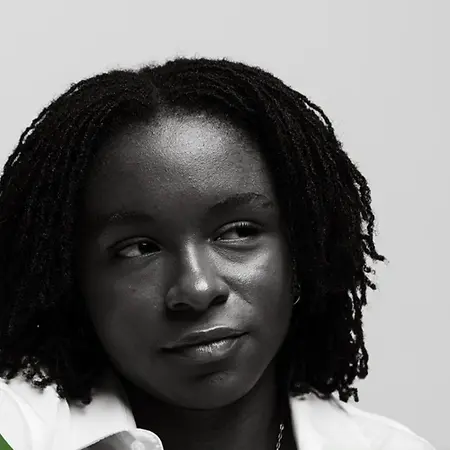
Her Story
About Chinaza
I grew up in Abuja, the capital city of Nigeria, where the education system typically pushed students toward either science or liberal arts paths like law and clinical science. I couldn't find myself fitting into either of those categories, but I always knew I was an artsy child. My favorite thing was going to art stores and picking out crayons and pencils - the stationery store was my happy place, and it still is. In 11th grade, while sitting down with my counselor trying to figure out what I wanted to do with my life, I stumbled upon UX design during Nigeria's presidential elections. I saw on the news that they were having issues with voting because we still vote with thumbprints and ink on paper, and if you make a mistake or something smudges, they cancel that whole vote. I realized that if people could use ATMs every day, there had to be a way to create an electronic voting system that met users where they are. That's when I understood what UX design really means - building products, services, or experiences that are intuitive, easy to use, and enjoyable, with no confusion or friction. Good design and good technology meet the users where they are, not the other way around. I changed to an American curriculum school in Nigeria, which opened up more possibilities for my career path, and my parents always supported my creative goals, which wasn't common back home where art as a profession isn't taken as seriously. Now I'm in my third year at Savannah College of Art and Design in Atlanta, and I love working with systems, particularly Internet of Things products with multiple touchpoints and broad ecosystems of devices. I serve on the executive board for the African Students Association, working on communications, posters, social media, and content creation. I'm also a visual designer for the Flux Club, our school's UX Design Club. One of my proudest achievements was working with Helping Mamas, an Atlanta-based nonprofit, to design a modular vending machine system that dispenses period products and baby supplies with dignity and equity. Watching the CEO's reaction when we presented our work - she was in tears because we took her dream and made it into something real beyond her imagination - reminded me why I do this work. Outside of design, I love sports and anything that takes me outside and away from my computer. I ran track in high school, and now I play volleyball, love table tennis, swimming, and I just discovered hiking. Being Nigerian, I have an innate work ethic to be really good at whatever I've devoted my life to, especially when I think about all the things it took to get here and not being able to go home every holiday. That pushes me to not be mediocre and to do the people who stand behind me proud.
Her Interview
Ten minutes with Chinaza
01What do you attribute your success to?
I'm a spiritual person, and I really do believe God has given me a lot of the creative energy and strength to carry out what I do. But aside from that, I think it's my family as well. I grew up in a place where doing art as a profession is not something people have quite caught up with in terms of its seriousness, but I had parents who supported my goals and my creativeness always. I was never afraid to think, oh, I can do something in the creative field. I've talked to some of my peers that grew up back home as well, and their parents said they need to be doctors and lawyers, but I have parents who support my dreams. I also think it's personal work ethic. Being Nigerian, we kind of all have, in our different industries, an innate work drive to just be really good at whatever it is you've devoted your life to. When you've come from far away and not every holiday you get to go back home, when you kind of think of all those little things of being from a different place and all the things that it took to get here, that kind of pushes you to really just not be mediocre and do the people that stand behind you proud. Those are the three things that really keep me going and help me decide to wake up every day and keep going.
02What’s the best career advice you’ve ever received?
Go at your own pace. I feel like there is a sort of need internally to compare your journey with somebody else's, to compare how fast you're going, how quickly or not quickly you're hitting the marks. I would say, honestly, just go at your speed. Use yourself as the benchmark for improvement. Don't focus on, oh, this person is better at me at this. Focus more on, are you better than you were six months ago? Just take it at your own pace, and everybody's path is different, essentially. Comparing it is just gonna drive you insane.
03What advice would you give to young women entering your industry?
Be patient with yourself. You're not gonna be great at everything from day one. You're gonna get frustrated. Things are gonna not go your way. But really just persevere and be patient with yourself and your process, and don't be afraid to ask for help when you need it. A lot of the times, especially in college, when you're in a classroom with a lot of people, it's difficult to be like, oh, I don't know. But you're paying for the thing, you deserve to be there, you're in the seat. The accomplishment, the goal is to get out as much information as possible, so if you need to ask, however stupid you think the question is, ask it, because you're even more stupid if you don't get the answer. Just be patient with yourself, and use the resources around you. Trust the process.
04What are the biggest challenges or opportunities in your field right now?
I think accessibility in design is a really big thing. I watched a video of a man that was living with a disability, and he was wheelchair-bound, and he was trying to get to a certain borough in New York from some other borough. As somebody who is able-bodied, it never occurred to me that the process of using the subway as a wheelchair user is much more complicated. What would take an able-bodied person like 15 minutes took him almost 45 minutes, and it was insane. In my specific situation with mobile and digital design, I think about things like how a lot of people, more than what you would imagine, are colorblind, so you have to think about text and pictures and backgrounds, text sizing, text-to-speech. You have to sort of rewire your brain and just remember that everybody's not the same. A lot of people are neurodivergent or have some kind of difference in how they learn and how they perceive information. So just sort of educating yourself as much as possible on those different things and implementing them in your design before, not just as a, oh, that's the thing I have to add as an afterthought. No, these people are real, and they exist, and they deserve things to meet them where they are. Having accessibility as an afterthought, I think, is the biggest challenge.
05What values are most important to you in your work and personal life?
I think a big one, and this kind of goes for both but more for work, is empathy. Being a designer, I think there's a thing where they tell you to take yourself away from the design, and I think in UX specifically, that almost can't work, because you need to be empathetic to design for a different person. You need to be able to put yourself in their shoes and sort of have the empathy and the human remorse to understand somebody's going through a pain point, there's a problem, and it's your job to do something to alleviate that pain. Just be empathetic and put yourself in the shoes of the user, and I think that goes for my personal life as well. Try to be an understanding person, be empathetic, lead with kindness. Even with the project I did for Helping Mamas, I am fortunate enough where going into a store and buying a tampon or a box of pads is not something I struggle with financially, but you have to put yourself in the shoes of someone who almost has to strip away their dignity and go ask, oh, I need this thing, and I can't afford it. You need to be able to put yourself in their shoes, and it really helps in the design process because it's almost like a virtual reality thing where you can see from their perspective. You can't be in a better position to fix the problem.
Join Influential Women and start making an impact. Register now.