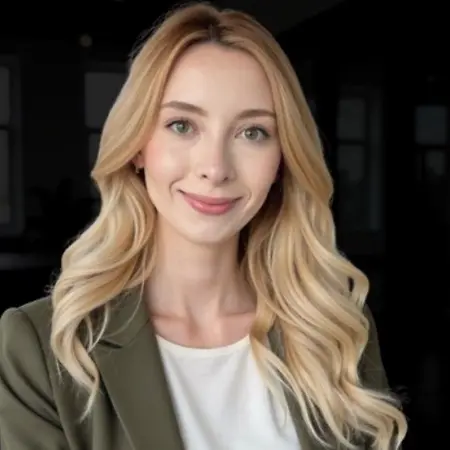
Her Story
About Chloe
Chloe Kelly is a seasoned real estate development professional serving as Director of Entitlements & Engineering at 68 Ventures, one of the Southeast’s leading privately held development firms. Based in Fairhope, Alabama, she brings more than 12 years of experience across land acquisition, portfolio management, operations leadership, and entitlement execution. Her career has centered on guiding large-scale residential, commercial, and master-planned development projects from raw land through regulatory approval and construction readiness. Throughout her career, Chloe has overseen more than $150 million in land acquisitions and managed 50+ development projects across Florida, Alabama, Mississippi, and North Carolina. She is a licensed real estate broker in both Florida and Alabama and has deep expertise in zoning, permitting, environmental compliance, and development feasibility. Her work regularly involves coordinating with engineers, surveyors, environmental consultants, and municipal stakeholders to ensure projects meet technical and regulatory requirements while advancing efficiently through entitlement processes. In addition to her corporate leadership role, Chloe is actively engaged in industry development and mentorship. She is a founding chapter leader, an initiative focused on empowering women in land development and construction-related fields. A University of Florida graduate with an MBA from Florida Gulf Coast University, she has also completed advanced certifications in construction management and environmental disciplines. Her career reflects a blend of technical expertise, operational leadership, and a commitment to expanding access and opportunity within the development industry.
Her Interview
Ten minutes with Chloe
01What do you attribute your success to?
First and foremost, I would say God. Along the way in my career, I've had so many people and opportunities at times when they had faith in me, and I didn't necessarily have faith in myself. I'm really thankful for the organizations that I've worked for in providing me those opportunities to try and fail and try again, and then succeed. I think that's the biggest thing that I'm grateful for - having the platforms to enable myself to learn and try new things. The people who believed in me when I was young and inexperienced, who were willing to invest time and energy into my development, made all the difference in my journey.
02What’s the best career advice you’ve ever received?
The best advice I received is to be brazen in asking for help and to be confident enough in yourself to acknowledge when you're not the expert in the room, and then seek out the people that are. It's about having the courage to be vulnerable and admit what you don't know, rather than pretending to have all the answers. This advice has been invaluable throughout my career, especially starting out so young in a field where I was surrounded by people more educated, more experienced, and significantly older than me.
03What advice would you give to young women entering your industry?
I would say do whatever you can to identify a mentor, or multiple people, and have the courage to reach out to people that are doing the things that you want to do and ask for them to provide you insight into how they got to where they are. The biggest thing is to self-advocate. You control, to some extent, your future and your destiny, and you need to have the courage to reach out to people that you see doing the things that you want to do or that you aspire to be like. Be proactive. There are so many people in this world that are doing big things that would love the opportunity to pour into somebody else, but they're not going to seek that out - you have to seek them out. Don't get discouraged if somebody doesn't have time, keep going, because there will be somebody that's willing to pour time and energy into helping you if you reach out to them and you request that of them. Having mentors and connections with people who could provide me knowledge and context when I needed it has been so valuable in my career, and I want other women to have those same opportunities.
04What are the biggest challenges or opportunities in your field right now?
I would say one of the largest challenges that we're having is what I would consider attainability in housing. While affordability is a hot-button word, I use the term 'attainable housing' because affordable housing has a specific HUD definition. The reality is that inflation has been really difficult, interest rates have been really difficult, and if you look statistically, the average home buyer used to be in their mid to late 20s about 20 to 30 years ago, but now the average home buyer is in their 40s. That's a huge issue. As a development company, we can't manage all the factors because as everything goes up, our cost to do business obviously goes up. The unfortunate reality is that in our area, people's incomes have not increased as much as the cost of living and the cost of goods. That's a hard problem to have because we're primarily a single-family home developer, and we want to develop land into lots that a home builder can build on and sell a home to a home buyer for. We're not doing build-to-rent or trying to build for institutional buyers. We have to be so cognizant of whether people can actually afford a home and how we make it more affordable. Because there are so many costs that are fixed in nature, what you're seeing is smaller lots and smaller homes. Whether or not people like it, that's what the majority of the country at this point can afford. We hear from people that they would prefer larger homes or larger lots, but the reality is that for most Americans, they can barely afford to buy a starter home, let alone some of these larger, more affluent-type products. We hear the same concerns across all four states where we operate - people want to be able to afford to buy a home, but what they can afford continues to diminish year after year.
05What values are most important to you in your work and personal life?
I would say grit, because our area of work, and also just in my personal life, I think grit is one of the qualities that is applicable to any aspect of your life. Having the tenacity to keep going when things aren't going the way you want them to, or you're discouraged, and having that personal fever to get up and do it again, and be willing to fail multiple times before you ultimately succeed - because it's a person that believes that failure is inevitable, but success is also inevitable. If you're willing to fail a couple times, you will win one of those times. I would also say integrity. Integrity is applicable to everything that you do and every facet of your life, and being authentic with who you are. As I've developed in my career, I've gotten better about being vulnerable. Starting out so young in a dynamic career, surrounded by people that were more educated, more experienced, and significantly older than me, led to a lot of insecurity on my end and a lack of confidence. I was so concerned about perception because I wanted to be taken seriously and considered a professional. I felt like I had to be this version of myself in order for people to see me that way. But as I've gotten older and more experienced, I'm significantly more comfortable being vulnerable with people and acknowledging my flaws and deficits. I feel more confident in myself that somebody knows me for me, independent of my professional accreditation. I think that's really powerful, because there's been conversations where I've been vulnerable or shared something, and it's led to really meaningful connections. I used to never show that side of myself because I was scared that doing so would somehow eliminate my credibility. Now, the older I get and the more experience I have, I realize that you can parlay your vulnerableness into values of other people.
Join Influential Women and start making an impact. Register now.