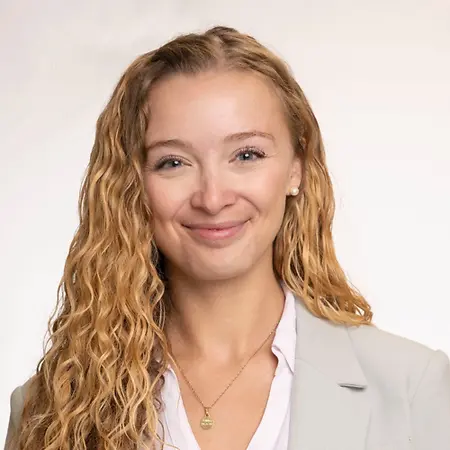
Her Story
About Chloe
My journey into science communication wasn't a straight path. I started out in science research, earning my PhD in biochemistry from the University of Miami, where I worked on physiological amyloid with connections to cancer and Alzheimer's disease. During grad school, I was posting about my life as a PhD student on social media, talking about the science I was doing, the techniques, and progress updates. I didn't call it science communication at the time, but looking back, that's exactly what it was - translating the science into language people could understand. After finishing my PhD, I knew I didn't want to stay in academia, but I liked the idea of being at the edge of cutting-edge research without doing the research myself. That led me to patent law, where I worked at Arnold & Porter for a couple of years, helping scientists patent their inventions. It was really cool getting to be at the edge of new inventions and understanding how scientists could protect their work. But last summer, I left patent prosecution and started doing full-time science communication. Now I work with Biotech TV as a science correspondent, focusing on next-generation biotech leaders and cool science. I do science explainers and interviews with scientists. My work is largely self-directed - I spend a lot of time looking at the news, keeping up with the latest science, reading, writing, and video editing for social media. What I love most about my career is that I'm able to stay at the front edge of cutting-edge science and help make it accessible so other people can hopefully enjoy it too.
Her Interview
Ten minutes with Chloe
01What do you attribute your success to?
I think one of the biggest things I focus on as a science communicator is humanizing the scientists behind the science. If you're leading with that authenticity, showing that this science is done just by people like you and me, I think it helps people appreciate that science ultimately is a human endeavor. A common misconception, especially in the past 6 to 10 years, has been that when one piece of science news seems to contradict something said before, people think science is inconsistent. But that's not the case - science is always just building on new information and new things. We're constantly learning and building onto that science. I think recognizing that from the human lens hopefully helps more people appreciate the scientific process, and you have to see everything through your own human lens.
02What’s the best career advice you’ve ever received?
I think it's rip off the band-aid. You do a lot of planning, you do a lot of prep work, but at the end of the day, nothing's getting done unless you just put yourself out there. I've carried that with me in grad school and beyond. I think everything I've done has been about just ripping off the band-aid and going for it, regardless of those people in the back of your head - mainly yourself - worrying if you're not doing it right or you're not doing enough. But you're never gonna know unless you don't start.
03What advice would you give to young women entering your industry?
I think you should stick to your area of expertise to start with - niche down into whatever specific science you're talking about. But also, don't be afraid to experiment with different content and different ways of how you do it, like long form, short form, video, carousel posts. Science communication is such a vast field, and it's only growing as people are starting to actually put a name on it. I think the more you're willing to experiment while keeping true to your expertise, the better.
04What are the biggest challenges or opportunities in your field right now?
I think the opportunities are that it's an expanding field. This term, science communication - I hadn't even heard of this word maybe 5 years ago, and now I'm actually seeing job titles for this sort of thing, which is really exciting. I hope to see more opportunities for scientists to apply their skills in this communication space in the future. The challenge is that because this is a new, growing field, especially for PhD-level expert researchers transferring their expertise into social media or other platforms, the traditional academic structure doesn't prepare us for this. It's rare to see a class in science communication or communication practices 101, even in undergrad. We're expecting researchers to know how to present at conferences in their own field just fine, but what does that look like when they're talking to high schoolers or their family? We need to start providing more opportunities like courses, workshops, and seminars to give people the skills and basic framework understanding of how to proceed in this vast world that is science communication. We're starting to realize, especially with how nuanced and niche different sorts of science have become, why it's becoming more important to have people that are true experts in the field who have studied and read the papers for years to know how to translate that stuff effectively.
05What values are most important to you in your work and personal life?
I think staying true to your passions is most important, because that was something I lost along the way, especially during my PhD. I was so in the weeds of research that I lost what really meant I went into science to begin with. Then I left research for a while, and I was like, does that mean leaving science altogether? But by following my passions, I found my way back to a niche I didn't even know existed.
Join Influential Women and start making an impact. Register now.