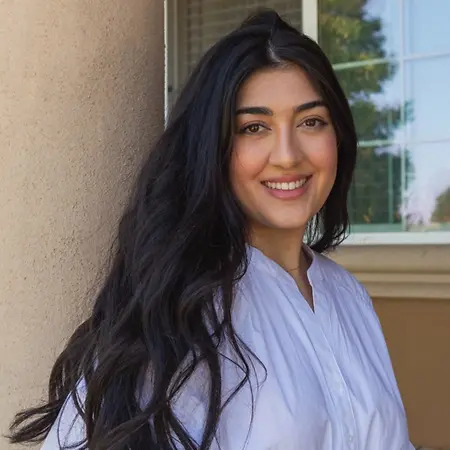
Her Story
About Christina
Christina Bouri is a Middle East policy expert based in Washington, D.C., currently serving as a Middle East Fellow with The Episcopal Church in its Office of Government Relations. In this role, she acts as the Church’s in-house regional expert and liaison to the Episcopal Diocese of Jerusalem, Cyprus, and the Gulf. She advises on humanitarian and policy issues across the Middle East, with a focus on conflict zones, and regularly engages with congressional offices through briefings, coalition-building, and advocacy for humanitarian access and institutional support. Previously, she worked as a Research Associate at Council on Foreign Relations, where she contributed to research and analysis on Middle East affairs, including humanitarian crises, climate impacts, and regional political dynamics. She has also participated in policy-focused fellowships, including with Young Professionals in Foreign Policy as a Rising Expert in Middle East Policy. Her work often explores the intersection of human security, sectarian dynamics, and the effects of conflict on vulnerable populations in the region. Christina earned her Master of Arts in Middle Eastern Studies from Harvard University and holds a Bachelor of Arts in International Relations from the University of the Pacific. Her academic and professional background reflects a consistent focus on humanitarian issues, regional conflict analysis, and interfaith and policy engagement. She is fluent in Arabic and French and is known for her work examining the humanitarian consequences of conflict, particularly in the Levant and broader Middle East region.
Her Interview
Ten minutes with Christina
01What do you attribute your success to?
I attribute my success to an ironclad sense of discipline and a mindset forged by my father's upbringing. Growing up, my father always told me, "You can cry about it for 5 minutes, but it won't change anything. So, let it out, it's therapeutic, but you can't give up. Life goes on, and you must keep pushing." His parents were refugees from Palestine to Jordan, and he had a tough upbringing filled with hard work. But, he never stopped. He is goal-oriented and driven. I feel that I've inherited his motivation-when I'm having a bad day, or something doesn't go as planned, I see it as a redirection, and I keep moving forward. I try to recalibrate. Thus, I've developed a mindset that the only way over something is through it. I consider everything as part of a page in my book of wisdom.
02What’s the best career advice you’ve ever received?
The best career advice I have received is that there is no traditional path to make a difference. Traditional paths are overrated. I didn't think I would land a fantastic opportunity at the Episcopal Church-I thought I would end up at the State Department-and who knows, I might end up there one day. But, I have been afforded career opportunities that have given me a platform to do work with vulnerable populations, which is what I'm interested in. So, my advice is to not shut down any opportunity because it doesn't fit a certain image or cookie-cutter idea of a coherent career trajectory, because no path is linear.
03What advice would you give to young women entering your industry?
I always became nervous when I was asked to speak on panels because I've always been the youngest person in such settings. I felt under-qualified. However, a valued colleague once gave me a piece of advice, and I've passed it on to mentees. They told me not to feel discouraged because I was asked to speak for a reason. That reason is not only my academic and professional background, but my lived experiences. Since then, I've had mentors tell me that my lived experiences are valuable and they bring a rich perspective to vital discussions on the Middle East. For young women that want to enter this field, I would advise on leaning into your experiences and not shying away from them. You have an understanding and a lens that people may not have because we are all so different. Lean into that lens and those experiences. That, in and of itself, is a powerful tool. Although career prospects in foreign policy look bleak right now, there's lots of work to be done and there will be opportunities for young women to take on roles that will shape the future of the field. With that in mind, I would advise against turning down opportunities that don't fit the cookie-cutter idea of what you think a career should be. It's marathon, not a sprint, and no successful career comes from a linear path. The diversity found in your career trajectory will reap many benefits like an array of skills and a network of mentors, colleagues, and friends.
04What are the biggest challenges or opportunities in your field right now?
I think the greatest challenges in my field right now pertain to the future of foreign policy. We've lost institutional knowledge across the public sector since January 2025. There's a hole of some sorts in the field of foreign policy, and many people are also afraid about what happens next in the Middle East. It feels like, as much as we write, advocate, or speak on panels or roundtables, the field of foreign policy is ill-fated right now. And this isn't the sense solely on the Middle East, but rather, every foreign policy topic. I don't think it will be fixed overnight.
05What values are most important to you in your work and personal life?
I've found that people who talk the most are the people that have the least to say, and the people that speak the least are the ones whose words carry the most weight. I personally value speaking when I have something to say. One of my first bosses, who is one of my mentors, would encourage me to write when he felt like there was something to be written. I find speech to be a valuable mechanism for change- speak when you think it's valuable, because sometimes, speaking can make things worse. I've encountered instances where people in certain settings will speak on a topic of which they have limited knowledge. Uninformed statements can be dangerous and using one's discernment in the foreign policy space is a vital tool for true impact.
Join Influential Women and start making an impact. Register now.