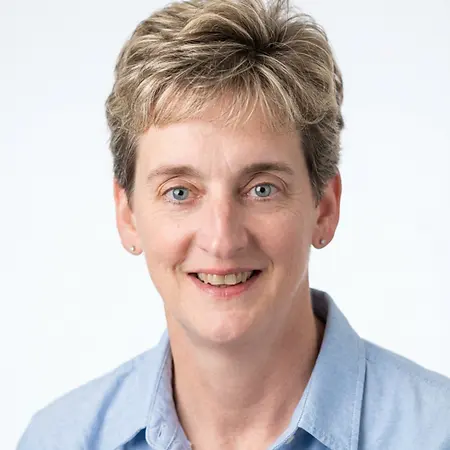
Her Story
About Christine
Christine Urish, PhD, MS, OTR/L, BCMH, FAOTA, is an accomplished occupational therapist, educator, and mental health specialist with more than three decades of experience in higher education and clinical practice. She currently serves as Professor of Occupational Therapy and Doctoral Capstone Coordinator at Drake University in Des Moines, Iowa, where she mentors students across bachelor’s, master’s, and doctoral occupational therapy programs. Christine is also a Senior Occupational Therapist in behavioral health at University of Iowa Hospitals and Clinics, maintaining an active clinical practice that complements her academic leadership.
Christine earned her PhD in Education/Rehabilitation Counselor Education from University of Iowa and her Master of Science in Occupational Therapy from Western Michigan University. Board Certified in Mental Health and recognized as a Fellow of the American Occupational Therapy Association (FAOTA), she is widely respected for her expertise in behavioral health, faculty development, mindfulness, and occupational therapy education. Her work has included contributions to nonprofit organizations, study abroad programming, and mental health advocacy initiatives, as well as service on editorial and professional committees throughout the field.
Throughout her career, Christine has demonstrated a strong commitment to advancing occupational therapy practice, education, and professional leadership. She has served on the editorial board for the journal Occupational Therapy in Mental Health and has been actively involved with American Occupational Therapy Association (AOTA) through leadership, certification review, and advocacy roles. Known for her collaborative and compassionate approach, Christine continues to inspire future practitioners while contributing to the growth of occupational therapy and mental health services nationally and internationally.
Her Interview
Ten minutes with Christine
01What do you attribute your success to?
I attribute my success to my single mother, who was very determined that I be able to stand on my own two feet, complete my education, and be able to take care of myself. I owe a lot to my mother, and since she was a single parent, I also owe a lot to her parents, because they were very influential in my life. My grandfather only had an 8th grade education, but he was a very successful insurance salesperson and had his own insurance agency. He really instilled in me that, Christine, there is nothing that you can't do. If you want it bad enough, you will figure out how to make it work. You will figure out how to do it. I've also met some amazing mentors along the way - my PhD mentor, my master's thesis mentor. I've been blessed with some amazing mentors in my life. So I would say family, mentors, and my faith.
02What advice would you give to young women entering your industry?
I would say don't let anything stop you. If you really want to be in higher education and you really want to be an occupational therapy educator, or just be an educator, period, avail yourself to opportunities, no matter how small, to gain experience. If students say to me they'd like to teach at some point in time, I tell them to go give an in-service in the community, offer to be a guest lecturer at a university, do things and network. My students always laugh and say, is there anyone you don't know? I'm not scared to go and talk to people, so you have to put yourself out there. Have I always been this way? Oh, heck no. But you have to get out there, and you have to put yourself in front of people. That may be scary, and that may be uncomfortable, but you have to do it. Networking is king, or queen, or however you want to say it. You have to get out there and put yourself in front of people.
03What are the biggest challenges or opportunities in your field right now?
The biggest opportunity in my field right now is definitely recruiting students and making people aware of what occupational therapy is and what we do. This generation that is college age, there are a smaller number of them, so we're all battling for a smaller number of students to go to college. Most people don't know what occupational therapy is. They say, oh, you're gonna find people jobs, and I'm like, yeah, that's really a narrow part of what I do. We help people with the skills for the job of living, so if a person has an injury or an illness and is unable to do the daily activities - self-care, work, leisure - that they want to be able to do, occupational therapists help either rehabilitate them or help them be able to do the activity maybe in a different way or use some adaptive equipment. People know what physical therapy is, people know what nursing is and medicine, but they just don't know what occupational therapy is. Another big opportunity is continuing to advocate for services that are needed. With cuts to Medicare and Medicaid, people need to receive care, so we need to continue advocating for services that are needed for individuals who could benefit from them.
04What values are most important to you in your work and personal life?
The values that are most important to me are honesty, integrity, compassion, and faithfulness. These are important to me in both work and home. One thing I try to instill in my students is that I'm giving them an education, but at the end of the day, what I really want them to be is a good person. If I educate a student but at the end of their graduation I have to carry them across the stage because they're so beat down, then I have failed. I need to make sure that they are well-rounded as an individual, not just as an occupational therapy practitioner, but as a person.
Join Influential Women and start making an impact. Register now.