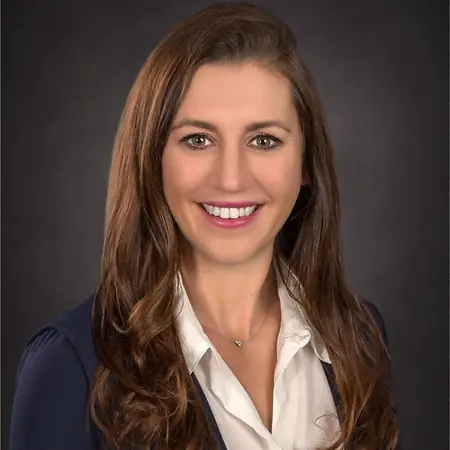
Her Story
About Christy
I am an Assistant Professor of Organizational Behavior and Human Resource Management, specializing in stigma theory with a focus on underrepresented workers in our workplaces. I've been an assistant professor since 2019, and in my current position since 2021. My research is motivated by addressing practical problems in workplaces and providing evidence-based solutions. I'm particularly proud of my work as a disability researcher, including a four-part study published about two years ago examining Section 503 of the Vocational Rehabilitation Act. We documented how this legislation impacts hiring evaluators when applicants self-disclose disabilities, finding that it significantly improves hiring outcomes, particularly for people with mental disabilities. This kind of research helps document interventions at the legislative level that can truly make a profound difference in people's lives who have had trouble accessing employment. I'm a professional member of both the Society for Industrial and Organizational Psychology (SIOP) and the Academy of Management (AOM). What I love most about my career is that we get to identify and experience problems or challenges in a variety of workplaces, design studies to isolate these problems and provide evidence that they exist, and then think about potential solutions.
Her Interview
Ten minutes with Christy
01What do you attribute your success to?
I am so sensitive to the number of women who have helped mentor me and get me to where I am. That's not to discount the men who have been supportive allies and helpful colleagues, but there's just something about women supporting women that I find uniquely powerful. There's a unique understanding in the sisterhood, especially when you have partners or kids and you're trying to juggle work and family and all the invisible labor of what we do. I draw a ton of courage from that sisterhood, and it uplifts me often. The men in the space who really understand and support that sisterhood, who suggest me for things, celebrate my success, root for my promotion, and help me advance are also critical. I absolutely would not have achieved any of that success without my female mentors, my female collaborators, and our male allies. We really need their full-throated support, because it is just amazing how much a little bit of preference or thought can do when it shapes our career trajectory.
02What advice would you give to young women entering your industry?
I would say that success isn't linear, and my best advice that I give to my students and my kids all the time is, if you try your absolute best, and you work your hardest, and you continue to learn, and you give a 100% full-throated effort to everything you do, there's just no way that you cannot wind up being successful. Even if something doesn't come as easily to you, or maybe it's not as natural of a fit, everyone will see your potential, and you'll continue to get recommended for things that just continue to be better and better fits for you. Giving your full-throated effort into every single thing that you do will ultimately help you end up where you're supposed to be, and success will beget success. In terms of going into academia, the academic career path is this amazing hidden gem that I think you can get into from so many different points of view. The gateway to distinguish yourself beyond excelling in school and having good letters of recommendation and doing well on standardized tests is experience in research labs. If you're interested in workplace psychology or organizational psychology, the experience with research, but also experience in the workplace, in the corporate workplace, are probably the two areas of experience that really make you competitive in this field. You understand the phenomenon that are actually relevant and salient in the modern workplace, and you also understand research methods and how you go from an interesting problem to collecting data to actually being able to examine that problem. Careers are not linear, and lean into that. If you give your full third of best effort, you're gonna wind up where you should.
03What are the biggest challenges or opportunities in your field right now?
I think from a values perspective, one of the reasons I love my profession so much is that social justice is such an integral component of our communities, trying to figure out how to help people who haven't had the same opportunities, who come from different backgrounds, how to better integrate our society so that we're all more connected and helping each other in positive and productive ways. Unfortunately, that perspective has kind of come under fire lately, and that has been disheartening for those of us who really have seen the difference that workplace-related initiatives can make for people who have trouble getting hired at all in the first place because of assumptions about their background. We know that there are groups that face discrimination in hiring, including people with disabilities, criminal backgrounds, religious identification, veteran status and diagnoses of PTSD, and we know there are initiatives that work to help them get into the door and be productive in the workplace. It's disheartening to see some of those science-backed initiatives that we know work receive less than full-throated support. Research is a really wonderful mechanism, and science is a really wonderful mechanism to agnostically explore research questions and provide scientifically-based evidence for what works and what doesn't, so I've sort of doubled down on the scientific method. The other challenge is the struggle of AI, both in our classrooms, in our research, and in our profession. The landscape is so varied, and the research is taking a lot of time to catch up with the practice. There are such strong opinions on all sides. On one hand, we want students who can think independently and critically, but on the other side, we have employers who are using AI every single day and don't want to recruit from schools who don't teach students how to responsibly employ AI-based learning and tools. On the education side, that's a real difficult line that universities and educators are taking extremely different stances on. In our research, I take the view that it's not primary research if we're not doing it ourselves. There's different research coming out about how AI has begun to degrade the quality of research in our field.
Join Influential Women and start making an impact. Register now.