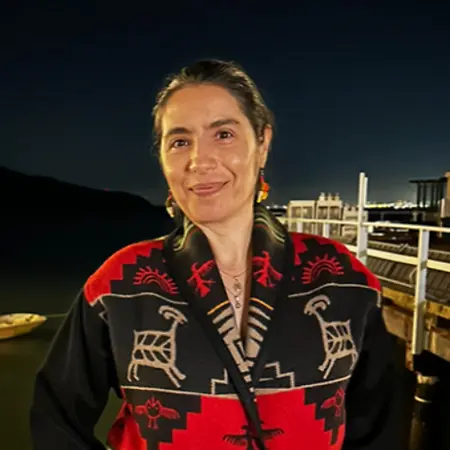
Her Story
About Claudia
Claudia González, Claudia González Consulting Founder, is a Human Security & Transitional Justice Expert, Public Policy Consultant, and Human Rights Advocate with more than two decades of experience in peacebuilding, conflict resolution, and human rights. She founded her consulting practice in 2018 after extensive work across international development and post-conflict reconstruction contexts, and she holds a background in Political Science and Conflict Resolution. Her practice supports public institutions, international organizations, and community-based organizations in designing and implementing safe systems of care, training, and support in contexts affected by violence, historical memory, and human rights challenges. She also builds institutional capacity with a focus on technical rigor, cultural sensitivity, and ethical responsibility, and she was selected for the Alliance for Historical Dialogue and Accountability Fellowship at Columbia University.
Originally from Colombia, Claudia developed her early career working with national institutions and civil society organizations on peacebuilding and transitional justice initiatives, including land restitution and historical memory programs. Her first client when launching her consulting practice was the Colombian Consulate in San Francisco, where she had previously worked supporting victim services and community-based human rights initiatives. Her work in Colombia has been recognized with an Honorable Mention of the Human Rights Prize, and she has contributed to large-scale reintegration and territorial rights initiatives. After immigrating to the United States, where she is now a proud citizen, she continued her advocacy and consulting work while also volunteering with survivors through San Francisco Woman Against Rape. She has also been awarded a scholarship through Prospera, supporting her continued professional development as a Latina entrepreneur.
Her work bridges policy, research, and practice, with contributions to academic and applied fields including oral history, transitional justice, and gender-based violence prevention. She is featured in the textbook Gender and Political Violence: Women Changing the Politics of Terrorism and is a co-author of Documenting and Interpreting Conflict Through Oral History, reflecting her focus on ethical methodologies for collecting and interpreting narratives in conflict-affected settings. She is also the creator of the award-recognized program “I Am Memory: Memory, Body, Territory,” developed with women survivors of armed conflict, and continues to provide consulting services focused on building survivor-centered systems of care, strengthening institutional response capacity, and advancing human rights in complex social and political environments.
Her Interview
Ten minutes with Claudia
01What do you attribute your success to?
I would say that my commitment and responsibility are central to my success. Transparency is also very important in my work, especially because I work with different polarized sites and analyze sensitive contexts. But I would say I'm definitely committed to believing that it's possible to live in peace and to live better, even with differences. Working in such sensitive environments requires maintaining integrity and a deep sense of purpose.
02What’s the best career advice you’ve ever received?
One of the best pieces of career advice Claudia has embraced is to always remain authentic and deeply understand why she chooses to do the work she does. She believes that self-awareness, integrity, and a clear sense of purpose provide the foundation for making meaningful contributions in even the most challenging environments. That guidance has helped her stay grounded throughout her career, ensuring that her work remains focused on service, human dignity, and creating lasting positive change.
03What advice would you give to young women entering your industry?
My advice is to learn first more about what is it that is calling her about this specific work. She needs to understand whether the work is within their own communities or if it's international work, and to be able to understand the needs. The impact on security matters as well, very much, so I would emphasize how important that is to take into consideration. It's important to understand what is it that is calling them so they can also understand from their position that they are holding how they can address this work. It's not necessary if you're not in a war setting to go into one. You can learn about supporting women survivors of violence in other ways. I would be very happy to accompany them on the journey of understanding that. It's delicate. You also want to take care of yourself and understand the capacity and the impact that you really are able to make in a difficult setting.
04What are the biggest challenges or opportunities in your field right now?
Right now, I think people are really concerned about these questions and are looking to diminish conflict. They are looking for place-making experiences and programs that can really work on the limits and the frontiers of humanity. The opportunity is to really use all of what we have gathered as humanity for good. For example, bringing it together with the technology we have for the protection of nature and human security. I would say people more than ever are looking to work and to continue to contribute, making change.
05What values are most important to you in your work and personal life?
The values most important to me are commitment, responsibility, and transparency. I also deeply value systems of care and community care, which I mention especially for my work with the lands and the territory and all of that. I believe in the importance of how the relational work functions in between all of these elements. For my personal restoration, I practice radical self-care. I have very strong practices of self-care that are very important, including processing through art and living, the preparation of my food, my exercise, and the craft work that I do with my hands. I focus on mind, body, physical, and mental health in order to stay strong and restore myself. I was fortunate enough to have met an Indigenous elder from the South about 20 years ago, and I have been working with her. She has taught me so many things and also informed my work a lot. That's an important and significant part of the care I provide myself and also for the communities I work with.
Join Influential Women and start making an impact. Register now.