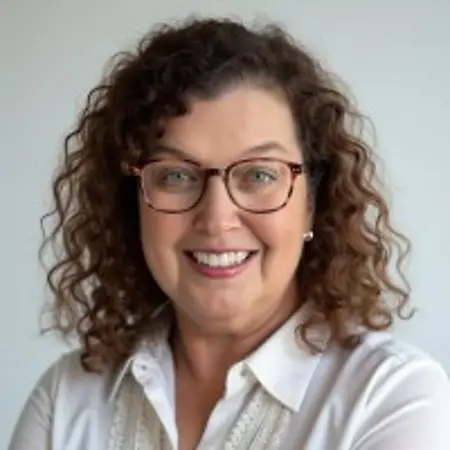
Her Story
About Corinne
Corinne Smith, PhD, MBA, RHIA, CCS, CDIP, CHDA is a dedicated Professor and Program Coordinator at the Montgomery College Health Information Management Program, where she has served for 18 years. Her journey into health information management began in the early 1990s after she initially left college uncertain of her career path and took a position with a radiology group. Over five to eight years, she discovered her passion for health information management, earning an associate degree, followed by a bachelor’s and a master’s degree, all while working full-time and raising three children. In 2022, Dr. Smith achieved her Ph.D. in Educational Psychology, demonstrating her commitment to lifelong learning and the pursuit of educational goals.
When she joined Montgomery College as adjunct faculty around 2008, the Health Information Management program was small, serving just 12 students, and faced possible closure. Under the leadership of former director Sue Mysky, Dr. Smith transitioned the program from classroom-based to fully online courses using Blackboard, first as Clinical Coordinator and then as Program Coordinator. Through these efforts, the program grew to over 82 full-time students, becoming the largest health information management program in Maryland and consistently exceeding national averages in graduation and certification rates. Dr. Smith credits her talented faculty team for this success and takes pride in nurturing a program that profoundly impacts healthcare through education and professional development.
Beyond Montgomery College, Dr. Smith teaches as an adjunct professor at Purdue University Global and the University of Maryland Global Campus. She holds multiple AHIMA certifications, including RHIA, CCS, CDIP, and CHDA, and serves as a Commissioner At-Large for CAHIIM, focusing on coding exam development and certification. She is deeply passionate about the power of data in healthcare and believes in the transformative impact of education within communities. Her dedication to her students and the field of health information management continues to inspire both the next generation of professionals and her colleagues alike.
Her Interview
Ten minutes with Corinne
01What do you attribute your success to?
I attribute my success to obsessive-compulsive goal setting and persistence. I am a list maker - every night I make my list, and I say I make a list for my list. Because of the nature of my job, I have to be a goal setter, but it's also just who I am. I have this motto that sometimes gets me in trouble, but most of the time it gets me to places I didn't expect to be, which is: how hard can it be? I always look at someone else I know who's done something and think, I'm as smart as her, I could do that. My PhD is a great example - I was working at UMGC for somebody who had her PhD from the place where I ended up getting mine, and I thought, I'm as smart as her, I could do that. What does she have that I don't have? How hard could it be? I just throw myself into it. I tell people, find somebody who has what you want and ask yourself, am I as smart as that person? What does that person have that I don't have? I could do it. It's about persistence and not being afraid to take a risk. Now, that 'how hard can it be' attitude can actually get you in a little trouble - like in 2014 when I was asked if I would skipper a boat for the Annapolis to Bermuda race. I had just learned how to sail 4 years before that, and they're asking me if I want to skipper a 36-foot boat with 5 other crew in a race 765 miles away into Bermuda. I was like, how hard can this be? And it was actually quite hard, way harder than I thought it would be. It turned out okay - nobody got hurt and we ended up getting second in the race, which was awesome. But I'll never do that again. So it kind of started to temper my whole 'how hard can it be' with a little bit more, maybe calm down with that one.
02What’s the best career advice you’ve ever received?
I can tell you there were two women in my life who have made a huge impact on me. One is Dr. Joan Rhines, who was the director of the program at Stevens College when I was out there. Keep in mind, I was in my 30s when I was doing that, and I remember going to graduation very pregnant with my second baby. She said that it was very important that as a woman who wanted more than just a career in life, that I choose a career that would allow me to have more. She said, you know, you can have a family, you can be a great mom, and you can have a social life and have hobbies, and you can also be amazing in your job. I saw her do that, and it was kind of an advice-by-example thing, where she told me stories about how she used to bring her kids in with her and they'd sit and play next to her desk while she graded papers. She really showed me that I could be a professor at a college and still have other parts of my life as well. I don't know if it was advice as much as modeling that I didn't have to make a choice between one or the other. The other person who made a huge impact was the former director of my program, Sue Mysky. She was very much supportive of being creative in your program and pursuing new ideas. She said, don't be afraid of change, and don't be afraid of innovation, of trying something new. If it doesn't work, you go back to what you did before. Trying something new is what's going to help you progress forward. She never held me back when I had crazy ideas. Together, these two women taught me that I could have it all and that innovation drives progress.
03What advice would you give to young women entering your industry?
For women coming into my industry, for people who are wanting to do health information management programs right now and are going to be moving into the field, I would say you've invested in yourself - keep investing. Keep investing in your future and make sure you have as many options as possible. That's what education does - it gives you options. Don't sell yourself short. Go out there and get as much education as you can, because that's what's gonna give you those options for the future. When the job that you wanted isn't available, you have skills you can translate to something else. You've got a degree or credentials after your name that are gonna hold weight. I feel like women, we have to lead with a little bit more oomph than men. We have to bring the credentials, bring the education, bring the stuff to the table. We can't just show up, because a lot of times we're not seen as enough. That's why I would say to women, just invest in yourself. It's fine if you want to get married and have kids and do all this other stuff, but make sure you're investing in yourself, because down the road you want those options. Having those credentials, having that education means you won't have to fight to be heard - you will be listened to. Even next to a man who doesn't have as much experience or education or credentials as you, you will be heard because you carry that weight.
04What are the biggest challenges or opportunities in your field right now?
I think the biggest challenge in my field right now is certainly AI, which is having a big impact on the management of health information and management of health data. But that also is creating a lot of new opportunities, great opportunities, especially for women who are working in the field already and who understand the value of the information that we manage for healthcare. It gives us opportunities to really step up and show leadership in how this data is collected, how it's managed, how it's used, because that's what's going to impact people's healthcare. I think that's probably the biggest opportunity right now - just embracing the technology, all of this new technology that's coming out. Healthcare's gonna be changing a lot in the next 5 to 10 years. Probably the biggest challenge is that the economy's not great right now, so getting into the field is maybe harder than it has been in the past. People aren't hiring the way they used to - there aren't as many opportunities to get in at the ground level and be trained on the job. They're like, no, we don't do training on the job anymore. Also, the hiring market is global now. Because a lot of work is now done online, you can hire somebody from any country in the world. So that's a little bit of a challenge, but I think that would apply to many professions right now.
05What values are most important to you in your work and personal life?
Honesty, integrity, and being very transparent with people are most important to me. One of the things I have above my desk is, we say what we do, and we do what we say. Being a person that other people can rely on, keeping your word, and being honest about what you can and can't do, or what you will and won't do - I think there's a lot of power in that. I'm very much about telling people what I will do, and then I do exactly what I say I'm gonna do. If I say I'm gonna show up, I show up. If I say I'm gonna get something done at a time, I do it. And if I can't, I tell them, hey, I need this, and then I do that. I guess it's being authentic - being very authentic to who you are and what you're capable of doing. I believe your primary responsibility on this earth is to leave it better than you found it, to contribute something to the world that puts good into the world. That's why I believe so much in teaching, because it really is making a difference in people's lives.
Join Influential Women and start making an impact. Register now.