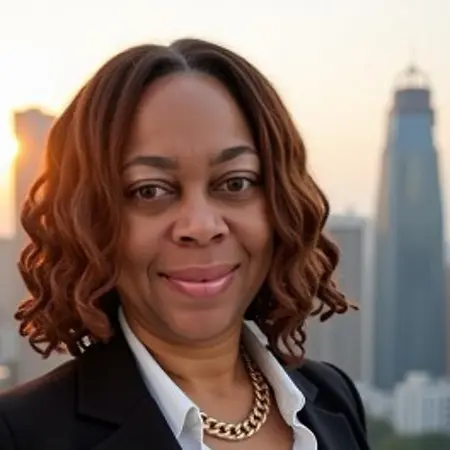
Influential Woman · Behavioral Health Innovation SUDHealthcareTech
Cynthia Dupree
Founder and Principal Investigator, NAR Institute
Chesapeake, VA
Her Story
About Cynthia
My journey in behavioral health began in 1996 after I was a victim of an armed robbery - a young man threatened to blow my head off right on the spot. That traumatic experience became the serendipity of my career, leading me to work on Virginia State death row as a counselor. From there, my career took off across multiple settings. I've worked as a substance abuse counselor, correctional officer, then corrections counselor in the prison system, special education teacher, and school guidance counselor. I worked as a SARP Counselor at the Substance Abuse Rehabilitation Program housed at the Portsmouth Naval Medical Center, collaborating with military doctors, providers and the full interdisciplinary team delivering addiction treatment care to active duty military. What drives me is that entrepreneurial spirit. When I see people cycling through a treatment program over and over, it bothers me, because that is a sure sign more needs to be done and what's being done is not enough. When I take the position it can be done better or differently, I know there's a purpose for me in it. My favorite role has been program management, though I didn't even know there was a term for what I was doing before completing my official certification PMP training. I get annoyed with ineffective systems after following protocol over a long time absent positive results. That interest is what has identified something new and interesting for the benefit of real change. I'm on fire about my patent-pending innovation called The NAR (Neuro Adaptive Addiction Recovery System). It predicts relapse in addiction treatment. This is going to reduce readmissions, reduce hospital costs, and fundamentally change how we treat alcohol and drug abuse. The NAR will give each individual person real, true, individualized treatment. It will give people with substance abuse addiction a real second chance at possessing optimal living. It will allow people to live longer, have more opportunities with their families, helping those who feel lost and want to stop their addictions, actually stop addiction. Since February 27th, my typical day has been planning, mapping out this new NAR Process to address addiction, emails, contacting people, having interviews to get this pilot program rolling, looking for hospitals to get involved, and working with IRB boards for academic studies. This is something God gave me, and I'm so super-excited to help people change their lives.
Her Interview
Ten minutes with Cynthia
01What do you attribute your success to?
I attribute my success to my relationship with God, for starters. He's given me the passion and the purpose. But I also have to say that losing my father, who was an alcoholic most of his life, has been what allowed me to flourish in my work and relationships. I really didn't know him because he was into the alcohol, so I grieved the relationship that I never had with him. Even though we lived in the same house till I was grown and had a good relationship, it was always surface - never like daddy's little girl. Our conversations were never deep because of his sickness with alcohol. From age five until he passed just four years ago, I saw the phases he went through from alcohol - he lost both legs at the knee, his vision was gone, his digestive system wasn't the same. That really shaped who I am today because I wanted to be totally opposite of him. That was my motivation to be a better person. I only have one daughter who's 32 now, and I wanted to be what I couldn't have with my relationship with my dad. Those characteristics of wanting people to be fully present - that's my approach to my work. My dad was never emotionally available to me, and I think it was because of his relationship with the alcohol. Nobody wants to lose their dad like that, and I missed all those years with him even though he lived in the same house with me.
02What’s the best career advice you’ve ever received?
The best advice I received came from Joanne Kaminski, and what she said was always document everything. Document, document, document. That's as simple as it is. If you're unable to document what you're doing with your client and what you're not doing with your client - because sometimes the client might say they don't want to do something - there may be some hidden reason why someone needs to know. You're getting audited, or something comes up, and you don't have a record about it. If I had Ten Commandments, they would all be document, document, document - that's how serious it is. You always want to know what you were doing with your client, was it effective, and what's non-effective. Then you know where to pick up at if you need to amend your treatment plan, bring more resources, get more education. You need to know where you're going with the client so that you can be beneficial for the client and the client's outcome. Let the client tell you what they want. Don't tell them what they need. Let them tell you what they want, and then you come to a place where it's reasonable and what's effective for the client, what's beneficial.
03What advice would you give to young women entering your industry?
First, you have to be thick-skinned. This is not an industry for thin-skinned folk. Second, never give up. There's always something for you. Each one of us has our own purpose. It's okay that you don't know it right away, today, right now. Give yourself time in the industry, and you will identify it. Don't give up. Also, you have to have a specialty. If you're gonna work in substance use, like addiction, you have to have a specialty. Be competent, identify what area, and just go for it. Be credentialed. A lot of people will try to offer substance treatment services and addiction substance use treatment services, but they're not credentialed. Mental health is one window, addiction treatment is another window. They're co-occurring, but they're not always the same. You can have a mental health license, but you're not credentialed to do substance use. So that can get very dangerous for the person who needs care. Make sure you're credentialed appropriately for your state. Get credentialed.
04What are the biggest challenges or opportunities in your field right now?
The biggest challenge in my industry is the different types of drugs that are on the street, and then with the new laws - there's so many variations in interpretation of what's legal with marijuana, as well as the consequences. I'm here in Chesapeake, Virginia, and Virginia Beach might have something different for a client. Their consequences might be different there. Even the way that different legal authorities talk with clients, they have a different way of interpreting the same information. I run into that a lot with clients. Just being able to keep up with what's happening with the laws takes daily attention - it's every day. I need to check any new laws, any new information, and then the treatments. Being able to effectively treat someone, whether it includes a medication - how is it going to affect this person's work, this person's lifestyle and their family, their obligations? Those are three major challenges. It also impacts their ability to pay me, so that's my third challenge too. I have to keep a really good, healthy, appropriate balance servicing the client and being the liaison or support for the client. I cannot exactly advocate for them, but I can give them information and other resources where they can get assistance with advocating.
05What values are most important to you in your work and personal life?
The values that are really important for me are truth, trust, and respect. I have to have those. It's very hard to work with somebody who is less than truthful because you can't count on them to give an honest account of something if they're not being truthful. When I'm working with a client, I have to know that this person - I can trust that they're giving me a true account of something, of an event, an experience. If not, then I have to look at, okay, does this person have some mental health issues that we need to look at? I use that all the time. Trust, truth, honesty - I have to have those when I'm working with someone. Eventually you want to build a relationship with the client that you're working with, and that happens through the process of you being honest, you telling the truth, with reason as a professional. I don't tell them my personal business. I'm there to help them, so they're my priority. I have to have that conversation with them about being truthful, about being honest, and just looking at what we're working with. Some of these are internal issues, and if they're not ready to work with them, we see what we can do - what can we work on? What are you ready and willing to work on for your treatment?
Join Influential Women and start making an impact. Register now.