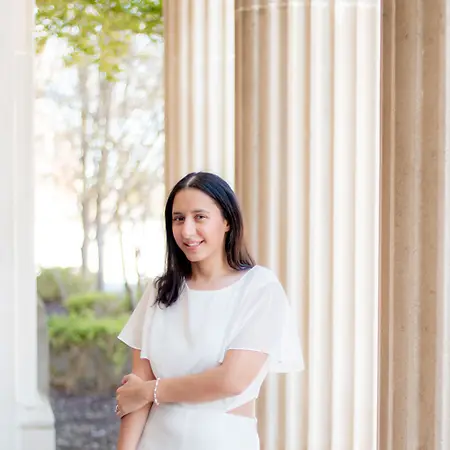
Her Story
About Daniela
Daniela has been working in higher education for the last few years, a path that began unexpectedly when a mentor suggested a role while she was an undergraduate student. She quickly realized the work resonated with her own experiences overcoming barriers as a first-generation student. This personal connection fuels her motivation to support students, helping them navigate challenges and access opportunities they might not encounter at home. Currently, Daniela serves as a College Access Advisor, focusing on increasing post-secondary access for first-generation students in Appalachia. She works closely with middle and high school students, guiding them through the college preparation process and creating opportunities for those who might not otherwise consider higher education. Her professional philosophy emphasizes being “a caring adult” in a student’s life—someone who can truly change their trajectory through guidance, encouragement, and support. In addition to her advising work, Daniela is pursuing a master’s in Clinical Mental Health Counseling, aiming to integrate her college-access efforts with mental health support for students facing anxiety, depression, and other challenges. Her prior experience includes serving first-generation students at Eastern Kentucky University and providing translation and interpretation services for a Lexington-based nonprofit. Daniela’s career is defined by her commitment to breaking down barriers and providing holistic support that empowers students to achieve their full potential.
Her Interview
Ten minutes with Daniela
01What do you attribute your success to?
I personally attribute my success to the people that I have in my life, whether that's my spouse, who has been the most supporting, loving person, my daughter, who's a huge motivation for me, but also every single mentor that I've had. Every mentor that I had at EKU, my parents, my twin sister and my family overall. My family, and my community is what I think has made the difference. I did not plan to go into higher education. It just happened. It was something that a professor (Dr. Abbey Poffenberger) came to me as an undergrad student and said, hey, we have an opening, I think you should apply. I was a sociology major, I did not know what I would pursue after graduation, but once I got into higher education and I saw the change that I could create, and the impact that I could have, that just kind of changed the trajectory of my life.
02What advice would you give to young women entering your industry?
To any young women entering higher education, I would say be proud to be the youngest person in that room, be proud of everything you have accomplished so far. However, always demand more for your students and for yourself as a professional.
03What are the biggest challenges or opportunities in your field right now?
A major challenge in education today is the rising mental-health needs among K-12 and undergraduate students, including anxiety and depression. An important challenge for me is to integrate college-access advising with clinical mental-health services to provide more comprehensive support for Appalachian students.
04What values are most important to you in your work and personal life?
Some of the most important values to me are definitely family, community, and education. You do need a village, and that does not necessarily stop when you become an adult. Education has the ability, has the power to change somebody's life. I would say those are definitely some of my top values, not only just because of what education can do for other students, but what education has done for myself. Being first-gen, being the first person in my family to pursue a master's degree, being a first-gen professional - those are all things that I do not take for granted. I am grateful of the experiences that I have. I would not be the person I am today, without these values in my life.
Join Influential Women and start making an impact. Register now.