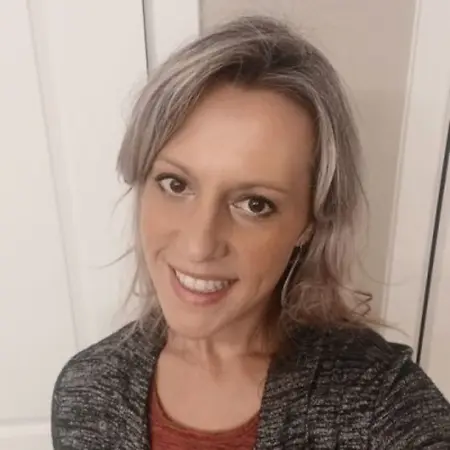
Her Story
About Darla
My career has spanned 18 years across two distinct but complementary fields. I started with 8 years in geosciences working as a geologist, which is still my true passion because I just love science in general. Unfortunately, the economic downturn in oil and gas hit in 2015 when oil prices tanked, and I was laid off in February 2015. I had been working on my Master's of Science in Geology and didn't finish until May 2015, so I had to shift out of oil and gas and ended up in IT. For the past 10 years, I have worked in IT as a project management office analyst, project coordinator, and for the past three and a half years as an IT problem manager. It has been really wonderful so far because I have been able to use my skill sets from both geology and IT and put them all together to be more strategic and transformational, working on digital transformation initiatives and more governance and process-oriented projects. In my current role, I review anything that may have happened overnight, including critical incidents, and work with my colleague who is overseas to monitor issues. We schedule brainstorming sessions to investigate recurring incidents, gathering the right people together like a project manager would do to solve issues. We host brainstorming sessions with both technical and non-technical team members because sometimes problems are based on people and processes, and other times they may be due to incorrect coding in a software package. We get down to the root cause and implement permanent fixes so issues don't reoccur again.
Her Interview
Ten minutes with Darla
01What are the biggest challenges or opportunities in your field right now?
I would say the biggest challenges are mostly resource constraints and budget cuts. In today's time, everyone is trying to cut costs here and everywhere, and sometimes those permanent fixes require additional money to be invested into a new software upgrade or may need more resources to push out a new upgrade or to actually fix an issue. To get around that challenge, we are trying to utilize AI to help us brainstorm fixes for some of our issues that occur. We use different AI applications like Claude, ChatGPT, or Copilot, and we can throw in our issue and ask it to suggest some brainstorming on what could be the root cause and what could be some of those fixes. AI sometimes brings more things to the forefront that we humans might not have thought of, especially whenever we are all already overwhelmed. But we still need the human interaction, because if you put garbage in, you are going to get garbage out. You have to prompt AI correctly, and you have to have the human still to go through and see if this really even makes sense. You still need the additional people and the technical people to really understand what is going on as well.
Join Influential Women and start making an impact. Register now.