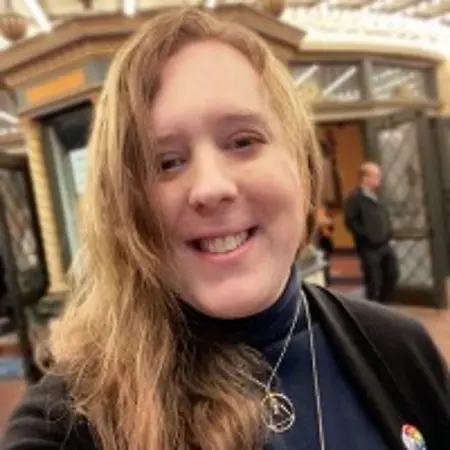
Her Story
About Dawn
Dawn Jessup is a Postdoctoral Research Fellow at the University of Michigan specializing in pharmacology and substance use disorder research, with a primary focus on opioid withdrawal and dependence. She works as a substance abuse researcher developing novel therapeutic approaches aimed at improving outcomes for individuals undergoing opioid withdrawal. Her current work centers on investigational allosteric modulators designed to be used in combination with existing standards of care such as buprenorphine, naltrexone, and methadone. These compounds are being developed to reduce the severity of withdrawal symptoms, particularly the challenge of precipitated withdrawal that can occur when buprenorphine is administered too soon in emergency settings, ultimately improving patient willingness to initiate and remain in treatment.
In her day-to-day role, she conducts experimental research on emerging drug candidates, leads a team of approximately four researchers, and contributes to mentoring and training the next generation of scientists. She has worked in opioid overdose, addiction, and dependence research for approximately seven to eight years and recently completed her PhD in Pharmacology and Toxicology in 2024. Her academic path began with a Bachelor of Science in Forensic Biology, initially inspired by an interest in forensic science, before transitioning into biomedical research through mentorship that guided her toward doctoral training. Since completing her doctorate, she has continued advancing federally funded research focused on developing new medications and translational therapies for substance use disorders.
Beyond her research, Dawn Jessup is deeply committed to education, mentorship, and expanding access to scientific careers for students from non traditional backgrounds. She actively engages with community colleges and universities to expose students to biomedical research and supports those pursuing careers in medicine, pharmacy, and related health sciences, with a strong record of mentoring students through advanced training pathways including MD PhD tracks. She is also an advocate for LGBTQIA+ representation in STEM and medicine and participates in scientific policy advocacy, including recent engagement in Washington, DC with professional organizations to promote sustained federal funding for research in addiction, cancer, and public health as a long term national investment.
Her Interview
Ten minutes with Dawn
01What do you attribute your success to?
I would attribute almost all of my success to very good mentors and my mother and my grandmother, who were very strong-willed women in business. Without them as direct and clear examples, I would not have gotten this far at all. Everyone but me, really. Like many people before me, I've been fortunate to have these strong influences on my life who showed me what was possible and helped guide me along the way.
02What’s the best career advice you’ve ever received?
The best advice I ever got was when I was young and in undergraduate, and I was asking my mentor what I should do because I wasn't satisfied with forensic science and I wanted to know what to do with the rest of my life. It's a very difficult question for any mentor to answer. But the best advice I ever got was, well, no one's going to open the door for you and lead you through it. You're going to have to be the one to initiate that. So if I had to give advice to the next generation, it would almost certainly always be, you know, whatever you do, do it with purpose, because no one's going to open that door for you.
03What advice would you give to young women entering your industry?
I would suggest to young women entering my industry that there will still be setbacks. There will be times when it feels like the deck is a little stacked against you. But they are fortunate that they now live in a time where there have never been more women in science. Seeking out those spaces and leaning on each other is of tremendous benefit, and I would highly suggest they take full advantage of that, especially when times are tough. We are very fortunate to be in this moment where there are more women in science than ever before, and that network of support is invaluable.
04What are the biggest challenges or opportunities in your field right now?
The biggest challenges in drug dependence right now are lack of funding and regulatory uncertainty. The lack of funding is fairly self-explanatory - both in terms of our friends in criminal justice and on our side of things, which is the biomedical clinical intervention side. More resources certainly help address more problems. But the biggest opportunities right now are for young scientists getting in and asking important questions that are not just about the basic anatomy and physiology of addiction, but being able to ask questions about how this affects the clinical aspect and how it affects the patient directly. We've done a lot of work over the last 30 years to explain the basic physiology and anatomy of addiction science, and we're sitting at a very interesting time in this field where, because of advances in technology, we are able to start asking more human-driven questions. What students of the next 10 years will be able to ask will be much more translationally interesting - not just about the mechanism of how it works, but almost directly about how it affects a person directly. When you're not directly working on a patient, you can be a little distant from those kinds of questions, but we've found a point in this field where those questions are a little bit easier to address. I think it's a very exciting time for incoming students.
05What values are most important to you in your work and personal life?
I think having worked both in counterterrorism, drugs of abuse, and medicine broadly, one of the things that we as academics and scholars are drilled with every time is that at the end of the day, you're going to reach a point in your career where people will take you at face value. And at that point, you are only as good as your word. So integrity and honesty are the most important things. I think that, especially in this day and age, being true to your word and being honest with yourself, both professionally and personally, are the most important values.
Join Influential Women and start making an impact. Register now.