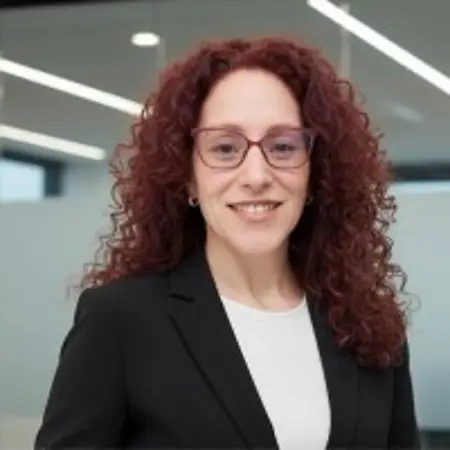
Influential Woman · Marketing
Deborah Szajngarten
Founder and Fractional CMO, Firebird Fractional Marketing
Sloatsburg, NY 10974
Her Story
About Deborah
Deborah Szajngarten is a Chief Marketing Officer and founder of Firebird Fractional Marketing, specializing in helping startups at critical growth inflection points. She partners with B2B and B2G technology companies that have achieved early product market fit and some level of founder led sales, but whose growth is not yet repeatable or scalable. Her focus is on building the full go to market engine including positioning, demand generation, and sales alignment so companies can transition from early traction to predictable revenue driven scale. She brings a consistent track record of stepping into high stakes environments and turning fragmented marketing efforts into structured high performing growth systems.
Deborah began her career in large global consumer and technology organizations, including Samsung, where she led communications for North America. Early in her career, she made a deliberate decision to move away from large corporate structures in order to gain broader scope, faster learning, and more direct impact. That decision led her into the startup ecosystem through IAC, where she worked on early stage digital media ventures, including the incubation and scaling of what would become Vimeo. She helped evolve Vimeo from a small internal project with no defined business model into a scaled platform that grew into an approximately 80 million dollar business, establishing its foundation as a major global video brand.
Her career has since been defined by a pattern of transformation and turnaround leadership. At Booker, she rebuilt a struggling startup by overhauling its brand and constructing both demand generation and thought leadership engines, contributing to a successful acquisition. At Radware, she repositioned a legacy hardware focused business into a recognized cybersecurity brand, achieving placement on the Gartner Magic Quadrant and strengthening its inbound pipeline and market valuation. Most recently, at Carbyne, she helped scale the company from early stage challenges to a successful exit through Axon, driving significant revenue growth and GTM infrastructure. Today, she is actively seeking her next opportunity, particularly with founders, especially women led startups, who have strong products and early market fit but need an experienced operator to build and scale the business into its next phase of growth.
Her Interview
Ten minutes with Deborah
01What do you attribute your success to?
My success has always come from a combination of drive, curiosity, resilience, and a willingness to keep growing.
Early in my career, I was fueled by the desire to prove what I was capable of. I worked hard, pushed myself, and built the discipline that became the foundation for everything that followed. Over time, that motivation evolved. It became less about proving myself and more about using what I had learned to create impact — for companies, teams, customers, and the people around me.
I’ve learned to recognize the difference between an opportunity that looks good on paper and one that is truly aligned. The best moments in my career have come when preparation, instinct, and timing came together — when I had put in the work, understood the market, and could feel that the next opportunity had real momentum.
I’ve also learned to trust my judgment. Not every impressive opportunity is the right one, and not every “yes” is a strategic move. The more experience I’ve gained, the better I’ve become at identifying where I can create the most value, where the mission fits, and where the conditions no are right to build something meaningful.
At this stage of my career, I’m motivated by impact. I want to use my experience to help companies grow, help teams succeed, and contribute to work that leaves something stronger behind.
02What’s the best career advice you’ve ever received?
Some of the best career advice I’ve ever received came indirectly through experience.
I’ve learned as much from the best managers I’ve had as I have from the worst ones. The great leaders taught me what strong leadership, trust, mentorship, and integrity look like in practice. The difficult experiences taught me just as much about the kind of leader — and person — I wanted to become.
I’m still close with the very first manager I ever had. We still support each other professionally when it makes sense, and some of the people I worked with early in my career — especially during my time at a PR agency — have become lifelong friends. That shaped the way I think about professional relationships.
Early on, people used to say, “Be kind to everyone because the people you meet on the way up are the same people you’ll meet on the way down.” There’s truth to that, but over time I’ve come to see it differently. I believe in being kind to people because relationships matter — not transactionally, but genuinely. The professional relationships we build often outlast the organizations themselves. Careers evolve, companies change, but trust, reputation, and integrity stay with you.
I’ve also learned to pay attention to what your instincts are telling you. If something consistently feels wrong — if work fills you with dread, if you’re experiencing that Sunday-night anxiety every week — you owe it to yourself to ask why and answer honestly. Sometimes we stay too long because of fear, comfort, ego, or external validation.
One of the most important things you can do for yourself is maintain enough stability and confidence to make decisions from a place of strength rather than desperation. Having a financial cushion, trusting your judgment, and not allowing ego to drive your choices gives you the ability to shape your own path thoughtfully.
At the end of the day, your reputation is built over decades. How you treat people, how you lead, and how you carry yourself through difficult moments matters far more than any single title or company name ever will.
03What advice would you give to young women entering your industry?
There are a few things I’ve learned over the course of my career that I believe deeply.
First: always put the work in. Potential alone doesn’t earn you the spot. Talent matters, but consistency, preparation, and execution are what build credibility over time. Early in your career, that work ethic helps you develop your skills and earn opportunities. Later in your career, it matters just as much — because every new level requires a different version of you. You can’t rely on what got you here. You have to continue learning, adapting, and growing.
If you commit to something, give it your full effort. Show up fully. That mindset compounds over time.
The second thing is: know your worth. Don’t allow people to diminish your value or make you question what you bring to the table. Confidence doesn’t have to be loud, and strength doesn’t require ego. You can stand your ground, advocate for yourself, and still take the high road.
As a leader, I’ve managed large teams and mentored many early-career professionals, and the people I invest in most are the ones who approach challenges with ownership and curiosity. If I present a problem and someone comes back with thoughtful ideas, possible solutions, and a willingness to think strategically, that stands out immediately. It shows initiative, engagement, and a genuine investment in the success of the business and the team.
At the same time, I believe strongly in learning the environment before trying to change it. You can’t walk into every organization assuming everything needs to be reinvented. Strong leaders take the time to understand why things work the way they do, identify opportunities for improvement, and then thoughtfully propose better solutions.
I’ve always approached work with the mindset of: I’m here to do this job to the best of my ability. That doesn’t mean sacrificing yourself or being available 24/7. Healthy cultures recognize effort, respect boundaries, and value people as human beings. There are seasons that require extra work, but there should also be trust, flexibility, and mutual respect.
If you consistently give your best, operate with integrity, and treat people well along the way, you build a career — and a reputation — that lets you sleep well at night.
04What are the biggest challenges or opportunities in your field right now?
One of the biggest opportunities — and challenges — in marketing right now is that we’re at a true inflection point. AI is fundamentally changing how we work, how we create, how we analyze information, and how companies go to market. As marketers, we’re once again being asked to learn an entirely new set of tools, workflows, and capabilities in order to stay effective and competitive.
What makes this moment unique is the speed. There’s enormous pressure across organizations to adopt every new AI platform, automation tool, or workflow as quickly as possible. In many cases, companies are moving so fast that they haven’t fully stopped to ask the more important questions: Does this actually improve outcomes? Does it strengthen the customer experience? Does it support business continuity, brand integrity, security, and long-term strategy?
The companies that will win aren’t necessarily the ones adopting the most tools the fastest. They’ll be the ones that approach AI strategically and thoughtfully — understanding where it creates real leverage versus where it introduces risk, noise, or operational instability.
I also think there’s a misconception that AI replaces strategic thinking. It doesn’t. If anything, it increases the importance of strong strategy, good judgment, creativity, and human insight. AI can accelerate execution, surface patterns, and improve efficiency, but it still requires people who understand markets, customers, storytelling, positioning, ethics, and business priorities.
For marketers specifically, this means we have to evolve again. We have to become fluent not only in brand and demand generation, but also in data interpretation, AI-assisted workflows, governance, content authenticity, and cross-functional operational thinking.
At the same time, this shift creates incredible opportunity. The marketers who are willing to learn, adapt, and thoughtfully integrate these technologies have the chance to drive enormous impact — helping organizations move faster, communicate more effectively, and create smarter, more scalable growth engines than ever before.
05What values are most important to you in your work and personal life?
The values that matter most to me — both professionally and personally — are honesty, integrity, passion, accountability, and fully showing up for the things and people that matter.
I believe in giving 100% to whatever I commit to. Whether it’s leading a team, building a company, mentoring someone, supporting friends and family, or pursuing personal goals, I think presence and effort matter. People feel when you genuinely care, and I’ve always tried to bring that level of energy and commitment into both my work and my life.
Integrity is incredibly important to me. I believe your reputation is built over time through consistency — through doing what you say you’ll do, treating people well, being honest even when it’s uncomfortable, and making decisions you can stand behind. I don’t think success means much if it comes at the expense of your values or the way you treat other people.
I also believe deeply in pursuing joy. I think there’s a misconception that happiness is something we eventually arrive at once we achieve enough success, money, recognition, or material things. My experience has been the opposite. Happiness isn’t something we find — it’s something we create intentionally through the way we live, the relationships we build, the work we choose to do, and the ability to appreciate what we already have.
For me, abundance comes from purpose, growth, meaningful relationships, curiosity, creativity, and experiences that make life feel rich and connected. That doesn’t mean ambition disappears — I’m still deeply driven — but I think ambition is healthiest when it’s aligned with fulfillment rather than constant scarcity.
At the end of the day, I want to build a life and career that feel meaningful, impactful, and authentic — and help create that same sense of possibility and growth for the people around me.
Join Influential Women and start making an impact. Register now.