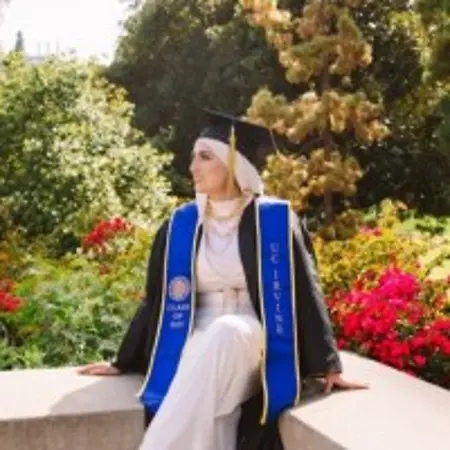
Her Story
About Deena
Deena Ayesh is a dynamic global health and human rights scholar, currently working as a community health researcher at MLK Community Hospital in Los Angeles and a program manager with the NYU Applied Global Health Initiative. She is deeply committed to improving healthcare outcomes for marginalized and displaced populations, including the SWANA diaspora and refugee communities. Deena's work combines on-the-ground community engagement—supporting diabetic women through clinical research, conducting ethnographic interviews, and providing patient education—with broader global health initiatives focused on health systems and equity. She has worked with a multitude of agencies locally and abroad, including collaborations with UCI School of Medicine, NYU School of Global Health, Catholic Medical Mission Board, UNICEF Tanzania, the refugee nonprofit Tiyya, UNRWA, and regional offices in the Middle East.
Deena’s academic journey reflects her dedication to cross-disciplinary learning and equity-focused research. She earned a Bachelor of Science in Biology with a specialization in Anthropology from UC Irvine and has a Master's in Global Public Health from NYU. She has participated in intensive fellowships and research programs, including the Global Health Crisis Fellowship in the Palestinian Territories, where she directed cross-disciplinary teams studying health carcerality, structural violence, and abolition medicine. Her research has been presented at international conferences, demonstrating a strong commitment to evidence-based solutions in global health justice and equity. Beyond research, she is a dedicated advocate and mentor. She has extensive volunteer experience supporting refugees, community health initiatives, and end-of-life care. She has been recognized as one of Arab America’s 30 under 30, reflecting her leadership and impact in health equity and social justice. Whether through clinical research, global health program management, or advocacy for marginalized populations, Deena combines scientific rigor with cultural understanding, striving to reimagine healthcare systems to be more just, inclusive, and responsive to the needs of communities affected by conflict, displacement, and systemic inequities.
Her Interview
Ten minutes with Deena
01What do you attribute your success to?
I attribute my success to a combination of persistence, curiosity, and the willingness to navigate my own path. Growing up low-income, I started at community college and had to figure out much of my educational journey on my own, which taught me resourcefulness and resilience. My background in biological sciences, combined with a minor in medical anthropology, helped me see health through both a scientific and social lens, which has been essential in my work in global and community health. I’ve been fortunate to gain experience across many roles—community health, program manager in global health, clinical research, and community organizing—and each has taught me the importance of listening to people’s stories, prioritizing marginalized communities, and using my voice and positionality to advocate for others. Balancing these roles has reinforced that curiosity, empathy, and hard work are just as important as technical expertise. Ultimately, I think my success comes from embracing opportunities even when they felt uncertain, not being afraid to be the different voice in the room and fight for what you believe in, finding the capacity to learn in every experience, and committing to using my skills for a cause that continuously gives back. I’ve seen how showing up consistently, taking the time to really listen to the community, and advocating for justice across the system can create meaningful impact, and that is what drives me every day to keep going.
02What’s the best career advice you’ve ever received?
Don't be afraid to make mistakes. That advice really helped me with entering new doors without any direction and just taking that risk. Another one is the idea that you miss every shot that you don't take. I really internalized this mentality when entering an unfamiliar environment, because mistakes are how you learn, so it's really important to be open to trying anything and everything the world presents you with, because you really have nothing to lose besides missing out on that potential opportunity, if you don't go for it. This mindset therefore challenged me to always put myself in new situations, and from them I discover new things to learn, build on skills that I might not have used before, and meet new connections that end up making a great impact in my life. A lot of the things that I have done were never anything I was expecting to accomplish, but they were only made possible by throwing myself into a new door that seemed scary, but was ultimately worth it.
03What advice would you give to young women entering your industry?
I’d say to embrace risk and experimentation—don’t limit yourself to a narrow path and don't be afraid to take on roles that feel unfamiliar or intimidating, because they’re often the ones that teach you the most, opening doors you never expected.
04What are the biggest challenges or opportunities in your field right now?
The biggest challenges in my field right now are navigating system-level harms, notably when looking at the impacts of geopolitical conflicts and supporting vulnerable populations in crisis zones. A lot of people in need are unable to get the services and rights they deserve, and I pray our collective efforts can help alleviate some of these burdens.
But at the same time, there are some opportunities which grant hope and excitement: there are ways to reimagine the field to be more liberated, and to use community-based strategies that honor the people on the ground to create meaningful, real-world change.
05What values are most important to you in your work and personal life?
The values that guide my work the most are human rights, community solidarity, and justice, always centering stories of the people in my research, service, and advocacy.
Outside of work, building creativity and feeding the soul is something I find important, because it fuels my inspiration and appreciation for some of the beauty the world can offer. I personally express my creativity through fashion styling and exploring art, or spend a lot of time reading & reflecting in nature. I believe that sustaining this work requires caring for ourselves as much as we care for others, because you can never pour from an empty cup.
Join Influential Women and start making an impact. Register now.