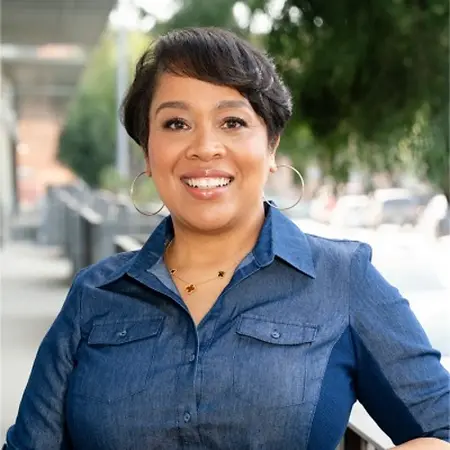
Her Story
About Delores
Executive Officer of Step Up, a national organization dedicated to empowering young women through mentorship, academic support, and career readiness programs. With more than two decades of experience in the nonprofit sector, she has built a reputation as a fierce, resourceful, and compassionate leader committed to advancing equity, inclusion, and opportunity. Her leadership is rooted in a deep understanding of community needs and a passion for creating pathways that enable young women to define and pursue their own visions of success.
Throughout her career, Morton has demonstrated exceptional expertise in strategic planning, program development, fundraising, and organizational leadership. Prior to becoming CEO of Step Up, she held senior leadership roles at Points of Light and City Year, where she led large-scale initiatives focused on volunteerism, education, and community impact. Her work has consistently centered on building sustainable programs, fostering strong partnerships, and cultivating inclusive organizational cultures that empower both staff and the communities they serve. She is also an active nonprofit board member, supporting organizations aligned with her commitment to social justice and economic opportunity.
Morton’s leadership philosophy emphasizes mentorship as a transformative force and positions confidence, access, and representation as critical components of success. Under her guidance, Step Up has expanded its reach and impact, delivering innovative programming that supports young women from high school through early career stages. Known for her engaging voice and thought leadership, she frequently shares insights on confidence, leadership, and professional growth, inspiring others to reframe challenges and embrace growth opportunities. Through her work, Delores Druilhet Morton continues to shape a more equitable future by investing in the next generation of leaders.
Her Interview
Ten minutes with Delores
01What do you attribute your success to?
I attribute my success to three things: community, clarity of purpose, and the willingness to be uncomfortable. I have never been the smartest person in every room, but I've always been intentional about which rooms I walked into — and I've never been afraid to ask for help once I got there. Growing up, I didn't always have access to the networks or mentors that could have accelerated my path. That lived experience is part of what drew me to Step Up. I knew firsthand what a difference one caring adult, one open door, one honest conversation could make. When your "why" is that personal, it doesn't feel like work — it feels like a calling. I've also been deeply shaped by the women around me. My mentors, my colleagues, the young women in our programs — they push me to be better every single day. Success, for me, has never been something I achieved alone.
02What’s the best career advice you’ve ever received?
The best advice I ever received was: "Don't wait until you feel ready, because ready is a myth." We spend so much time waiting for the perfect moment, the perfect credentials, the perfect confidence. But the leaders I admire most — the ones who have made lasting change — didn't wait. They showed up, they said yes, and they figured it out in motion. For women especially, there's often an internal bar we set impossibly high before we'll raise our hands. I've learned to raise mine anyway. The second piece of advice that stayed with me: relationships are your most valuable currency. Be generous with your time, show up for people, and invest in connection before you ever need it. The network you build with integrity is the one that sustains you.
03What advice would you give to young women entering your industry?
To every young woman stepping into the nonprofit, social impact, or women's leadership space: know your value and then communicate it without apology. This sector has a complicated relationship with ambition. We are conditioned to lead quietly, to ask for less, to justify why we deserve the resources, the seat, the salary. I'm telling you: stop justifying your worth and start demonstrating your impact. Learn the language of outcomes, not just outputs. Funders, boards, and partners need to see the return on investment your work creates — be able to speak that fluently. And find your people early. Mentorship and sponsorship are not the same thing. A mentor advises you; a sponsor advocates for you when you're not in the room. Pursue both. And when you reach a place of influence reach back and bring someone with you. That's the whole point.
04What are the biggest challenges or opportunities in your field right now?
We are living through one of the most consequential moments in the history of women's leadership and economic equity, and I say that with both urgency and optimism. The challenge is real: the funding landscape is shifting, the policy environment is volatile, and the needs of the young women we serve are growing more complex. Mental health, economic insecurity, and the pressure to compete in a workforce increasingly shaped by AI are not abstract issues for our girls. They are daily realities. But here is what I know to be true: challenge and opportunity are two sides of the same coin. AI, for example, is the biggest workforce disruption of our lifetime, and we have a choice. We can let it widen the equity gap, or we can ensure the next generation of women is equipped to lead in it. At Step Up, we are leaning into the latter. The organizations that will matter most over the next decade are the ones that stay close to the community, adapt without losing their core, and build the kind of trust that no algorithm can replicate. That is where I am placing our bets.
05What values are most important to you in your work and personal life?
At the top of my list is integrity, which means doing what I say I am going to do, especially when no one is watching. In this work, your credibility is everything. The girls we serve, the donors who trust us, the board that governs alongside me all need to know that my word means something. Close behind that is equity, not just as a programmatic principle, but as a lens. I ask myself constantly: who is this serving, who is missing from this room, and what would it mean to do this justly? And then there is joy, which I think gets underestimated as a leadership value. I lead with joy intentionally. This work can be heavy. The world our girls are navigating is not easy. But I believe that hope is a strategy, that celebration is sustaining, and that when people feel seen and valued, they give their best. Personally, I try to bring those same values home, to show up fully for the people I love, to be present, and to never let the mission crowd out the relationships that make the mission worth pursuing.
Join Influential Women and start making an impact. Register now.