Her Story
About Dia
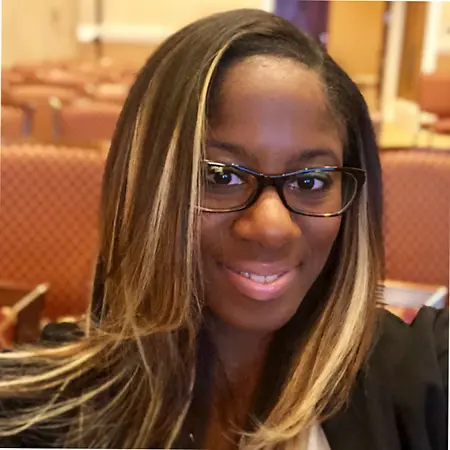
Dr. Dia Jackson, Ed.D., is a nationally recognized special education and Multi-Tiered Systems of Support (MTSS) expert and Senior Researcher at the American Institutes for Research. She has dedicated more than 21 years to improving outcomes for students with disabilities, combining deep expertise in research, policy, and practice. Her work with U.S. Department of Education, Office of Special Education Programs (OSEP)-funded initiatives has positioned her as a trusted leader in advancing evidence-based practices, equity, and instructional quality across diverse educational systems nationwide.
Dr. Jackson began her career as a special education teacher in the Washington, D.C. area, where she spent nine years working in both inclusive and self-contained classrooms while also serving as a university professor. Driven to expand her impact beyond the classroom, she pursued a Doctor of Education in Applied Neuroscience in Special Education from The George Washington University. In 2014, she was recruited by AIR, where she has since led and supported large-scale initiatives focused on special education instruction, MTSS implementation, and culturally responsive practices. Her work involves partnering with state education agencies, school districts, and leaders across the country to assess needs, design professional learning, and deliver training, coaching, and technical assistance that strengthens systems and improves student outcomes.
In her current role, Dr. Jackson develops and leads high-impact projects addressing disproportionality, equity, and best practices in special education. Her day-to-day responsibilities include creating professional development content such as trainings, webinars, and resources, as well as writing proposals for grants, research studies, and strategic initiatives. Among her most notable achievements is co-authoring the widely recognized High-Leverage Practices in Special Education, which identifies 22 essential practices that educators should implement daily to support students with disabilities. This work has been broadly adopted across states and districts, shaping guidance documents and professional learning nationwide. Dr. Jackson remains deeply committed to ensuring that all students receive high-quality, equitable educational opportunities.
Her Interview
Ten minutes with Dia
01What do you attribute your success to?
I attribute my success to staying focused on what's truly important. In education, there are always a lot of shiny new things and trends that come and go, but I have remained narrowly focused on what the research clearly shows actually works to improve outcomes for students with disabilities. Perseverance has been absolutely essential to my journey. I have also been creative about finding opportunities, making connections, and finding ways to get in front of the people who are directly working with kids every day. That combination of focus, perseverance, and strategic relationship-building has allowed me to make a real impact in the field.
02What advice would you give to young women entering your industry?
I would say do what you're passionate about and focus on that passion. But more specifically, find a need in the field that you are passionate about addressing. Those two things need to align - your passion and a real need. You can build your career on being passionate about something, but if it doesn't actually have much impact or address a genuine need in the field, you won't create the outcomes that matter. So find a need that you're passionate about, and stay focused on that goal. Don't get sucked into administration or different fields or all kinds of other things that might pull you away. Keep your energy directed toward making a real difference in the area you care about most.
03What are the biggest challenges or opportunities in your field right now?
There are so many challenges facing my field right now. The current political climate is very challenging because this administration is anti-research and anti-science, which makes it difficult to get the funding we need to do the important work that helps us learn what's best for kids with disabilities. It's not about buy-in - it's mainly about securing the resources to continue the research. Another major challenge is staffing. Schools across the country are dealing with challenges in getting qualified teachers, especially special education teachers. This makes it difficult for me to train the right people and help them put best practices in place when they don't have a consistent staff. Schools are really focused on just trying to get through day-to-day with a bunch of substitutes, which makes it hard to implement best practices with any consistency. Despite these obstacles, I stay focused on what the research clearly shows works to improve outcomes, even with all the shiny new things that are always coming and going in education.
04What values are most important to you in your work and personal life?
Impact is the most important value to me - doing work that is actually meaningful and impactful. I know that teachers and leaders are really strapped for time, so whenever I'm developing a resource, training, or anything for them, I'm extremely cognizant of what they need right now and what's going to be most impactful for them to put into place tomorrow. I stay away from overwhelming them with theory and instead focus on giving them concrete strategies that are based in research, using their time on what really matters to improve outcomes. Relevance is critical - everything I create needs to be immediately useful. Honesty and transparency are also really important to me, both personally and professionally. This means citing my sources, pulling from credible research, and being transparent about data and challenges. I try to get schools to do the same - to be honest about their data and the issues they're having. Everybody wants to look like the best school district in the world, but we can't move the needle if we're not going to be honest about what the issues are and what contributed to them so that we can chart a new course forward.
Join Influential Women and start making an impact. Register now.