Discover how honoring exhaustion through compassion and stillness can redirect your career and reignite your purpose beyond burnout.
Her Story
About Diane
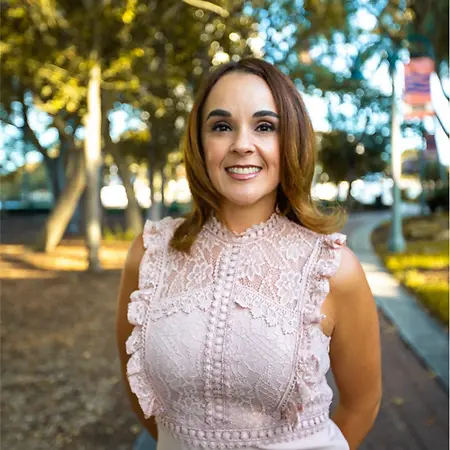
Diane Rodriguez, MSN, RN is a dedicated Nurse Educator and Clinical Instructor based in the Miami-Fort Lauderdale area. Her journey into nursing began at 18 when she was pregnant with her son, who required care in the NICU. Witnessing the compassion and skill of the nurses caring for him inspired Diane to pursue nursing, a path that replaced her earlier interests in marketing and photography. She began her studies at Miami-Dade College initially thinking she would become a school teacher but soon shifted her focus to nursing. Since graduating in 2006, Diane has gained extensive experience across multiple areas of healthcare, including pediatric oncology, emergency care, and outpatient urgent care, building a foundation rooted in compassion, teamwork, and patient-centered care.
Over the years, Diane has combined her clinical experience with a passion for education. She earned her Master of Science in Nursing Education from Barry University while working in outpatient urgent care and later in quality education, where she focused on performance improvement, patient safety, and clinical outcomes. Currently, she serves as a Clinical Instructor at Galen College of Nursing, specializing in maternal-newborn and pediatric nursing. Diane thrives on mentoring and guiding students, helping them develop critical thinking, clinical judgment, and confidence while navigating the rapidly evolving landscape of healthcare.
As a Latina educator, Diane prioritizes creating inclusive learning environments that celebrate diversity and foster curiosity. She is deeply invested in preparing the next generation of nurses to embrace technology thoughtfully, believing that tools like AI should enhance nursing practice rather than replace it. She is actively expanding her expertise in AI and healthcare through a course at Johns Hopkins University to ensure nurses are part of the decision-making processes shaping the future of healthcare. Diane’s career reflects a commitment to excellence, empathy, and innovation, empowering her students to deliver safe, compassionate, and evidence-based care in every setting.
Her Interview
Ten minutes with Diane
01What do you attribute your success to?
When I reflect on my journey, the answer to what has carried me forward is clear: my family and friends, whose unwavering support has been my anchor; the mentors who believed in me before I fully believed in myself; and my faith in God, who I trust has guided every step — including the ones I did not fully understand at the time.
That foundation made it possible to show up fully in every role I have held.
My years working across diverse areas of healthcare — from pediatric oncology and the emergency room to urgent care and quality education — gave me something that cannot be taught in a classroom alone: perspective. Each role deepened my understanding of how systems, culture, and education intersect to shape patient care. That breadth of experience became the foundation of my leadership, teaching me to see not just the moment in front of me, but the bigger picture.
Today, as a clinical instructor, I have the privilege of bringing all of that into the classroom. I get to empower students, guide their growth, and witness them find their footing as the next generation of nurses — and there is nothing more rewarding than that.
In many ways, this is where I always knew I was meant to be. The desire to teach was there from the very beginning; experience simply gave me something worth teaching. Every role I held, every challenge I navigated, and every team I worked alongside instilled in me the values of compassion and collaboration that I now pass forward.
The road was not always direct. But it led exactly where it was supposed to.
02What’s the best career advice you’ve ever received?
Never stop learning.
Education is not a destination — it is a lifelong commitment. Whether it is pursuing a certification, attending a webinar, attending a conference, or taking the leap to advance your formal education, every opportunity to grow matters.
In a field that is constantly evolving, your knowledge is one of your most powerful tools. Staying current is not just a professional advantage — it is a responsibility to the patients and students who depend on you.
Invest in yourself. The return is immeasurable.
03What advice would you give to young women entering your industry?
If I could speak to my younger self, I would offer three simple words: Slow down. Ask questions. Seek out resources. And trust that the difficulty you are feeling is not a sign that you do not belong; it is a sign that you are growing. I tell my students this often: the first year after you graduate and get a job is the hardest. Time management alone can feel overwhelming, and that is before you factor in the complexity of navigating new teams, new environments, and the weight of caring for patients. But here is what I want every new nurse to remember — you are not alone in that feeling. The colleague beside you may be experiencing the exact same thing and simply not saying so. That is why community matters. Get involved in professional organizations. Connect with other novice nurses. Talk to people who are in the trenches alongside you, because those conversations can be the difference between feeling isolated and feeling supported. Yes, there will be challenges. There will be difficult colleagues, moments of self-doubt, and shifts that test everything you have. But the goal — always — is the patient. When you anchor yourself to that purpose and lean on your team, you will find your footing.
Through it all, do not neglect yourself. I always remind my students: you cannot pour from an empty cup. Self-care is not a luxury in this profession; it is a responsibility. After a hard week or a demanding term, I ask them: what is one thing you are going to do to fill your cup back up? That question matters. Because a nurse who takes care of themselves is better equipped to take care of everyone else. You can do this. I promise — you can do this.
04What are the biggest challenges or opportunities in your field right now?
There is a growing urgency for nurses and educators to understand the changes that technology and AI are bringing to healthcare and to be active participants in shaping them.
I still hear the words of one of my professors at Barry University: "We have to be in the drawing rooms. We have to be in the rooms where the decisions are made." For too long, I haven't lived up to what I believed was so impactful.... But that changes now. If nurses are not at the table, someone else will be — and they will make decisions without truly understanding what we do. We are the ones at the bedside. We are the ones who see, in real time, when a change makes no sense or when a policy creates risk. We are the ones who ask the hard questions. The voice of Nurses belongs in every room where the future of healthcare is being designed. This is why I believe advocacy is not optional; it is a professional responsibility. We must advocate for the human touch that defines nursing. We are not replaceable, but we are responsible. Responsible for understanding the process to ensure patient safety is met. AI can support us. It cannot replace us. We must make the hospital environment safe. I am currently pursuing a course in AI and Healthcare through Johns Hopkins to understand this landscape deeply enough to meaningfully integrate it into the curriculum and clinical practice. The future of healthcare will be shaped by technology. Nurses must be the ones helping to shape it, but we must understand it as well.
05What values are most important to you in your work and personal life?
As a Latina nurse educator, representation is not just something I value — it is something I live out intentionally every day. I make it a priority to create inclusive learning environments where every student feels seen, safe, and empowered to ask questions, make mistakes, and grow. Diversity in the classroom is not a checkbox; it is a necessity. When students see themselves reflected in their educators and in the profession, it changes what they believe is possible for them.
My approach to teaching is deeply rooted in the values I have carried from years of working in inpatient care: teamwork, compassion, and an unwavering focus on the patient. Healthcare is not a solo endeavor. It requires people who can collaborate across differences, communicate with empathy, and never lose sight of why they are there. Those are the lessons I bring into every classroom, every conversation, and every interaction with a student.
What I love most about the work I do today is witnessing transformation — watching a student move from uncertainty to confidence, and knowing I had the privilege of walking alongside them in that journey. But perhaps the most personal lesson I carry came not from a textbook or a clinical rotation, but from my own experience with burnout. It stopped me in my tracks and forced me to be still — to reflect, to pray, and to ask God to guide me back to where I was supposed to be. That season taught me something I now pass on to every student I teach: you cannot pour from an empty cup.
Mindfulness and self-awareness are not soft skills — they are survival skills in this profession. Taking care of yourself is not selfish. It is the foundation that makes everything else possible.
Her Content Hub
Articles by Diane
Still Enough: A Story of Burnout, Faith & Renewal
The Quiet Practice That Brought My Career — and Myself — Back to Life

Honoring Exhaustion
Instead of pushing through—the way we’re often taught to do—I made a different choice. I decided to honor the exhaustion with compassion. I stopped fighting what I was feeling and started listening to it. I took time for myself. I prayed. I meditated. And gradually, I started to believe that I was meant for more—even when I couldn’t see exactly what that looked like.
What Stillness Taught Me
In the quiet, I found clarity I couldn’t access in the noise of daily work. Prayer reminded me of my purpose. Meditation helped me release the weight of bad decisions I’d been carrying—the ones we all make along the way. Burnout can make you believe that your best days are behind you, that you’ve lost your edge, and that learning something new is too hard, too late, or too uncertain. But compassion—the kind you offer yourself—gently pushes back against all of that.
Three Things That Helped Me Through
- Allow yourself to rest. — Rest is not failure; it’s the foundation of your next chapter.
- Return to what grounds you—whether it's prayer, meditation, journaling, or nature. Find the practice that reconnects you to yourself.
- Trust the process, even without a map. — You don’t need to know exactly where you’re going to take the next step forward.
Your Career Is Not Over — It’s Evolving
If you’re in the middle of burnout right now, I want you to know this: you’re not broken; you’re simply being redirected. The compassion you offer yourself today is the fuel for the motivated, purposeful version of you that’s waiting on the other side. Give yourself that grace. You’ve earned it.
I found happiness within myself. I found my why again—to advocate for my nursing profession, to show up for the people and the purpose that matter most to me. And that clarity? It was worth every quiet, still moment it took to get there.
Join Influential Women and start making an impact. Register now.