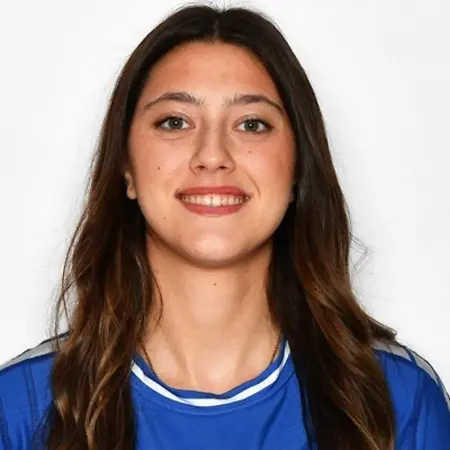
Her Story
About Dimitra
I came to the United States from Greece at age [AGE] to play Division I volleyball, spending 6 years between Louisiana Tech University and University of Cincinnati, where I earned my bachelor's in psychology with a minor in criminal justice. Social work drew me in because it combines sociology, psychology, and criminology with a holistic approach to caring for the whole person. During my master's program, I discovered my passion for working with older adults through an internship at what's now called the Family Center for Healthy Aging at St. Louis University. While I initially wanted to focus on domestic violence and intimate partner violence, I found clinical work in that area too close to home. I went back to aging work, which I loved, and I'm now pursuing my PhD in social work, combining both interests by studying intimate partner violence in older adults, a very understudied area. After facing challenges including being fired from a previous research assistantship and lack of faculty support when studying perpetrators of domestic violence, I decided to return to what I always loved while making my own path in this underexplored intersection. I currently work as a research assistant at St. Louis University, volunteer as a certified cognitive stimulation therapy facilitator for older adults with dementia or MCI since 2022, and mentor international student athletes through Nomos LLC since 2023. I'm set to teach a course this summer and hope to complete my PhD in 2 years.
Her Interview
Ten minutes with Dimitra
01What do you attribute your success to?
I attribute my success probably to my family. They let me make that jump when I was [AGE] and come to the United States. And my own personal resiliency. I'm not a quitter, I'm definitely a complainer, but I'm not a quitter. You will hear me complain about how I have to do this, or how I have to do that, but I will get it done. A big part of it lately has been my new mentor and the folks that I've worked with when it comes to working with older adults. They have created many opportunities for me, and they always try to hire me in the summer for me to make a little extra money. And also the CEO from Nomos LLC. We're family, he's always been there for me, either with schoolwork, or with athletics, or when I was going through a rough time with a previous relationship of mine, he got me out of it when it got dangerous. He was the one to get me out of it. He was family, he is family, away from family. I got married in the United States, and if I could have anybody walk me down that aisle, it would have been him. So yeah, it's a combination of just me trying my best always and never quitting and always rising above, but also, the few people that I've had around me that have made a difference in my life.
02What’s the best career advice you’ve ever received?
Trust your instinct and stick with it. I'm referring to my research topic. Especially with domestic violence and partner violence, we're always thinking of young women, like my age, reproductive age. And when you're trying to advocate for something that is new, it can be very hard to stick with it, so I think sticking with it, and to keep going, and to go to the finish line has been what has kept me going, for sure.
03What advice would you give to young women entering your industry?
Make sure you feel like you have at least half of your life figured out, and if you don't, that's okay. You can still heal while you're pursuing your degree, while you're still working as a social worker, but I would probably also give the same advice I got day one of my first course in grad school. If you're not in therapy now, be in therapy. It will definitely catch up with you. The social work field is not a well-paid field, so we always go into that field because we want to help others. We have our own trauma in our own history. And it's never a bad idea to be in therapy, I think, as long as you have a good therapist and a good person that you're working with, but especially for folks that want to go into the field, I would say, definitely be in therapy, definitely invest in yourself in that way. It will save you a lot of time and a lot of heartache, possibly in the future, professionally and in your personal life as well. What I needed therapy for four years ago is not what I am in therapy now. We evolve, get older, we get married, like in my case, or we have the space and the capacity to possibly analyze and sit with certain things that might have happened in the past, or trying to figure the stuff that we have to or want to do in the future. That's always a moving target, and self-reflection is a big part of it, but too much is when you burn yourself out, too.
04What are the biggest challenges or opportunities in your field right now?
I think isolation, truly, and the imposter syndrome that I'm actively, all day, every day, kind of going through. I am married, my husband is in the Coast Guard, and we've never actually lived together since we got married. He's in California, and I'm still here trying to finish my coursework. Isolation is a big part of it because of my husband and the military lifestyle, but also because international students like me who are excited about what they do, and they're also extroverted when it comes to the work, people don't really like that. It can come off as annoying, or being extra, or too much, or me being clingy, or needy. I'm definitely misunderstood a lot, or I feel like I am. There's a lot of things that citizens are eligible for, like funding, fellowships, things like that, I'm not eligible for. And there's also not a lot of guidance, or guidance at all, from my program and the administration at St. Louis University to help us go for funding that we are eligible for, or create opportunities for us. So it's the cliche of what folks, minorities, kind of go through in academia, honestly.
05What values are most important to you in your work and personal life?
I would say family and boundaries is a big thing for me. I'm still working on that. As a woman, we have a hard time with boundaries, I feel like. I don't want to overgeneralize it, but we have to be perfect, right? We have to come off a certain way, we have to lose weight, have the baby, have the home, be able to clean the house on a timely manner, and also show up for work, and overwork, and be better than anyone else, and you add, for me, at least the layer of immigration. I have to be better than the citizens out there that are competing for my job, or for my topic, or for the spotlight in whatever space. So, yeah, boundaries can... I've struggled with boundaries, because I've let a lot of folks walk over me, like friends and professionals too, and that has definitely distracted me along the way and hasn't left a lot of space and grace for myself, because I was giving it to them, even though they didn't deserve it.
Join Influential Women and start making an impact. Register now.