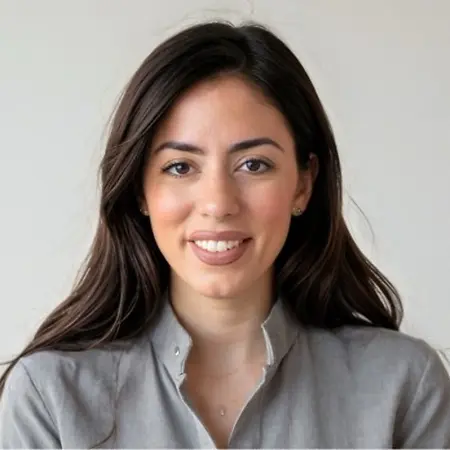
Her Story
About Dina
I've been in the energy field for a little over a decade now, and I'm currently in the front office as a trader, a role I've held for almost two years. I trade and manage California Power, as well as capacity (resource adequacy) and longer-term capacity for our load portfolio. What that means is we serve commercial and industrial end users to meet their power needs, and those large customers are mandated to meet certain portfolio standards and long-term goals for California in terms of supporting renewables. Prior to this, I was managing the non-tradable costs and risks for the retail load business - anything that is tariff-based, driven by regulation, and there's no visible market for it. I started on this path at EDF Trading, where I was connected to a role by a mentor from a prior job at Just Energy. I was brought in to build a financial forecast for the retail business because there were a lot of reporting gaps and lack of visibility. It was supposed to be a six-month role, but it turned into almost a four-year role. I have a very technical background because I was working on my PhD, and I have basic coding skills as well as sharp analytical skills and a lot of commercial acumen. I spent a year during COVID developing a forward growth margin forecast model using Python and SQL to forecast out profitability for the business, and honestly, that was a key tool to evaluate the retail business when BP wanted to buy it. I'm very proud of that - all the blood, sweat, and tears that went into it. The EDF retail book was bought out by BP during an acquisition about three and a half years ago. I started in the power sector at Just Energy within a supply rotation program, which was the platform for me to learn the business really quick because I had more of an oil and gas background. I worked on experimental pilots within Just Energy Labs, supported billing operations, assisted gas schedulers, and worked on complex financial structures thinking about portfolio risks related to weather. After the rotation, I got an opportunity to work on an expansion project where Just Energy wanted to open a retail business in Germany. I was flying between Hamburg and the US, and I speak German, so that was instrumental. I worked on that for one year before they decided to scale back. Prior to power, I started in oil and gas at Stat Oil (later became Equinor) as a land analyst, working with the U.S. Onshore team to value large land lease swaps in the Marcellus and Eagleford shale areas. I'm from Kuwait, a Kuwaiti national, and I grew up during the Gulf War when my family was stranded for a year. Energy security was paramount and shaped my life and upbringing. My father is one of the first petroleum engineers to graduate with a PhD in Kuwait, and he eventually got a position at the University of Leoben in Austria teaching petroleum geology and reservoir engineering. That really pushed me to pursue my PhD as well and shaped the way I think about energy as a necessity for life.
Her Interview
Ten minutes with Dina
01What do you attribute your success to?
I would say my biggest achievement, and what I attribute my success to, is growing the people around me at the same time that I've grown in my career. I've mentored so many younger, early career individuals - people starting off in the power sector - and they've really flourished into different fields, gone in different directions, and they're very successful. I continue to work with students, especially at the University of Houston, and now being at BP, I have a really good platform to do so. I would say my biggest achievement is giving back. I think that has been a reward - educating, spreading education, awareness, and helping others push themselves forward from that sense, professionally and personally, and learn more about the industry. I love being a mentor, and I love pushing people to the next level, and I think that's very meaningful to do that.
02What advice would you give to young women entering your industry?
I would say to be agile and to always put yourself out there and communicate. Connect with others. People think that networking is a very selfish thing and it's only one-sided, but I couldn't be further from the truth. I think connecting with others is so important, not only in this industry but in other industries as well. It's not just to build rapport, it is to create a community and to build this group of like-minded individuals who will stay with you for many years to come and help you be fluid in your career and help you give back and pursue different opportunities, which you couldn't do if you were kind of on your own. Agility is also very important. Early career candidates and students coming fresh out of college are not very flexible at times, and they kind of have this image of what they want to do in their head, or on the contrary, they have no idea what they want to do. But having the agility and being fearless and being able to pivot to a different direction if it's not the direction you want to go in, and to seize opportunities as they come - I think that's what really helps build their careers and pushes them to a direction that they want to be in and they're more in tune with, and they start to really shape their careers. The ones that have been the most successful are the ones who have those conversations with their managers, with their peers, and then they go out of their immediate circle and have conversations more broadly around the organization or the industry. They start to discover things about themselves, about what they like and where they want to be and what motivates them and what's interesting to them. And those are the ones that have gone further, faster, and felt more in tune with their career. So, definitely agility and networking are very, very indispensable.
03What values are most important to you in your work and personal life?
I grew up in an environment where energy security was paramount and shaped my life and my upbringing. My father came from very humble beginnings where his parents did not have schooling beyond high school. He's not only a first college graduate, but he's one of the first PhD holders in the country in his field. That really shaped my upbringing, the way I think, the opportunities that I pursue. I know that energy is a necessity for life, and it's paramount. I knew I was choosing a field that was going to always be relevant, and it would shape not only my own life, but the lives of many others. And to me, that was instrumental, and that was motivating and important at the same time. I think being a contributor transcends the business that you're working for. If I want to make an impact for other women, if I want to make an impact in the energy field, if I want to drive change, if I want to build a brand, build a legacy, I'm going to do that agnostic of wherever I am. I'm very grateful for being at the company that I'm at and having the opportunities to work for such really good companies, leaders in my field, but that's not going to define my contribution. I like to earn my credibility just through my work in general.
Join Influential Women and start making an impact. Register now.