Her Story
About Dipti
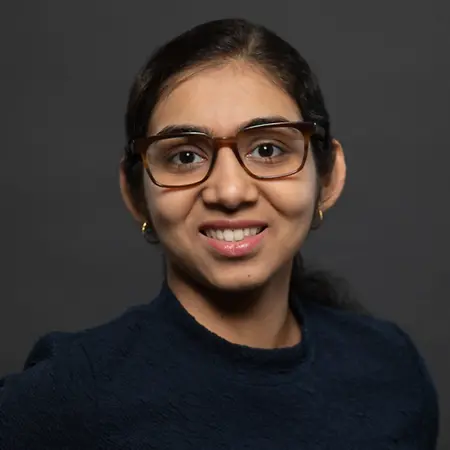
Dipti Motwani serves as an Automation Engineer at Insitro, where she builds hardware and software infrastructure for robotic work cells that automate wet lab experiments at scale for machine learning in drug discovery. Her professional journey spans nine years and includes a bachelor's degree in mechanical engineering from the National University of Singapore, a master's in robotics from Stanford University, and ongoing completion of a second master's at Georgia Tech emphasizing AI for robotics. Earlier in her career, she developed hardware for robotic startups focused on warehouse automation and industrial cleaning robots before spending three years as a motion controls engineer at KLA, where she overhauled a semiconductor platform to a new motion control architecture. At Insitro, she designed, built, and launched the company's first in-house robotic work cell from scratch, an achievement she considers her most notable to date.
Her Interview
Ten minutes with Dipti
01What do you attribute your success to?
I think the biggest factor definitely has been my family supporting me in chasing my dreams and giving me the freedom to learn whatever I want to learn, and to take the risk to work on something that's challenging. That involves my parents as well as my husband now. And I think, apart from that, being focused about what you want to do, and sometimes giving up what seems like a good opportunity for something that will be better in the long run. Making wise decisions about what you want to work on, what you choose to spend your time on, and then, of course, working hard on it, and trying to complete things until you're sure that they're 100% reliable.
02What advice would you give to young women entering your industry?
Chase the field with as much rigor and as much thoroughness as you can. Spend a lot of time to understand the fundamentals. I think it's easy now, especially more so with AI, where we try to do things quickly and arrive at a solution as fast as we can, but I think now it's even more important to step back and make sure that you understand the fundamentals, because that is what will sustain through the years. And then the second thing I'd say is to take a chance in yourself and to believe in yourself. I think I've been very lucky to have people around me who sometimes even believe in me more than I believe in myself, so I would say believe in yourself even when you're one of the very few women in the room.
03What are the biggest challenges or opportunities in your field right now?
One of the biggest technical challenges is that industrial automation for the past 40 or even 60 years has been very pick-and-place oriented towards hard-coded pick-and-place robotics, where robots work in very structured, predefined environments without much variability. We've had great challenges in adapting robots to environments where there is unpredictability or the environment is dynamic. Tasks that are seemingly very useful for humans to do physically are really hard for robots, like grasping an object reliably and manipulating it without breaking it. The opportunity right now is that we are starting to see that robots are learning really well from various types of data, whether that is simulation or demonstrations from humans doing certain tasks, or teleoperation data, or even data of robots deployed in the field. In the last 2 years I've seen an exponential progress in the field that hasn't been seen even in the last 20 years.
04What values are most important to you in your work and personal life?
In my work, I would say, rigor, technical rigor is one of the most important values because people are relying on things that you design to not break, to work 100% of the time, maybe 24 by 7, even when you're not around to troubleshoot issues. So, I think being rigorous, and then at the same time, that comes hand-in-hand with being a good communicator to people, and being transparent about how the system works and what its limitations are. Having a sense of or having a good work ethic in the sense of being both disciplined and focused towards your work. In personal life, sincerity in a relationship is the most important, whether it's with your parents, your family, or your spouse. Being always open and even vulnerable at times to talk about what actually is going on in your mind and then also being open to listening when somebody close to you is sharing that with you.
Join Influential Women and start making an impact. Register now.