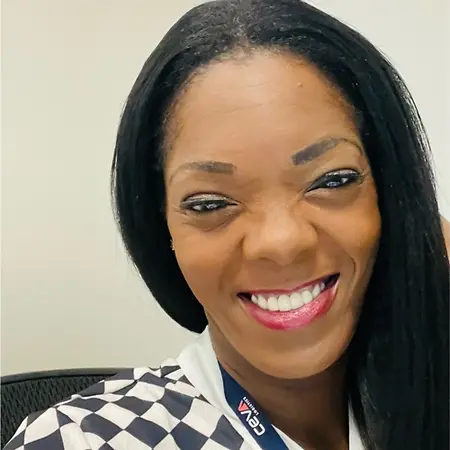
Her Story
About Wayndisha
Disha Parker is a maritime compliance and risk executive based in the New York City metropolitan area with more than 15 years of experience across global logistics, ocean freight operations, and military transportation. Her career began with a 10-year tenure in the U.S. Army as an 88N Transportation Management Coordinator, where she developed deep expertise in logistics planning, contingency operations, and mission-critical transport coordination. This foundation shaped her disciplined, mission-driven approach to managing complex regulatory and operational environments in the civilian sector.
In her current role as Maritime Compliance Manager at CEVA Logistics, Disha oversees global ocean compliance programs, ensuring adherence to Federal Maritime Commission regulations as well as international frameworks such as ITAR, EAR, OFAC, SOLAS, and MARPOL. She is responsible for strengthening internal controls, managing audits, overseeing hazardous and dangerous goods compliance, and training ocean freight personnel across the organization. Her work also spans cross-functional collaboration with business development, IT, and operations teams to improve documentation standards, risk mitigation strategies, and regulatory adherence across global supply chains.
Disha holds a Bachelor’s degree in Homeland Security from St. John’s University and recently completed her MBA in Business Administration in 2026 while working full-time. One of her notable professional achievements includes publishing a Container Management Standard Operating Procedure in 2018, which continues to be used across multiple Middle Eastern regions. Outside of her professional responsibilities, she values continuous learning and personal development, and enjoys activities such as biking, swimming, and reading self-help literature.
Her Interview
Ten minutes with Wayndisha
01What do you attribute your success to?
My journey began in the U.S. Army as a Transportation Management Coordinator, where I learned how to lead under pressure, make critical decisions, and stay accountable. Those lessons became the foundation for my transition into maritime compliance and executive leadership.
Entering a highly regulated, male-dominated industry meant I often had to prove myself but I used that as motivation to sharpen my expertise and strengthen my voice. Today, my success comes from not just understanding complex regulations, but translating them into real-world solutions that protect organizations and improve operations.
I believe in creating opportunities, sharing knowledge, and making space for more women especially veterans to lead with confidence.
At every stage, I’ve stayed grounded in integrity, purpose, and growth. My success isn’t just about where I am it’s about the path I’m helping create for others.
02What’s the best career advice you’ve ever received?
“The best career advice I’ve ever received was: ‘Don’t wait to be recognized, position yourself to be undeniable.’
Early in my career, that shifted how I showed up. Instead of waiting for opportunities or validation, I focused on mastering my craft, speaking with confidence, and consistently delivering results. In both the military and corporate spaces, I learned that visibility and value have to go hand in hand, you can’t assume your work will speak for itself.
That advice also taught me to advocate for myself, take up space in rooms where I may have been underestimated, and pursue growth even when it felt uncomfortable. It’s something I carry with me today and pass on to others: be prepared, be consistent, and don’t shrink my impact deserves to be seen
03What advice would you give to young women entering your industry?
“My advice to young women entering this industry is to own your expertise early and don’t be afraid to take up space.
Maritime compliance is complex and often male-dominated, so confidence matters just as much as competence. Learn the regulations, understand the operations, and speak up—even when you’re still growing. Your perspective has value.
I’d also say: build relationships and find mentors who will challenge and support you. This industry runs on collaboration, and having the right people in your corner makes a difference.
Most importantly, don’t let being underestimated discourage you, use it as fuel. Stay consistent, stay curious, and be willing to step into opportunities before you feel 100% ready. Growth happens in those moments.
04What are the biggest challenges or opportunities in your field right now?
“One of the biggest challenges in maritime compliance right now is the pace of change.
From evolving environmental regulations and decarbonization efforts to increasing cybersecurity risks, the industry is becoming more complex and interconnected. Compliance leaders are expected to stay ahead of shifting global standards while managing real-time operational risks.
At the same time, that creates opportunity. Companies that embrace digital tools, strengthen risk management, and take a proactive approach to compliance are gaining a competitive edge.
What excites me most is that compliance is no longer just about enforcement, it’s becoming a strategic function that drives resilience, innovation, and long term growth.
05What values are most important to you in your work and personal life?
“The values that guide me most are integrity, discipline, selfless service, and purpose.
Integrity is non-negotiable doing the right thing, even when it’s difficult, is what builds trust. Discipline, shaped by my military background, keeps me consistent and accountable.
Selfless service is at the core of how I lead. I believe true leadership is about putting the mission and the people you serve first whether that’s protecting an organization, supporting a team, or creating opportunities for others to grow.
And purpose ties it all together. I want my work to have impact beyond the immediate to build something meaningful and leave the door open for others behind me.
Those values guide how I show up, both professionally and personally.
Join Influential Women and start making an impact. Register now.