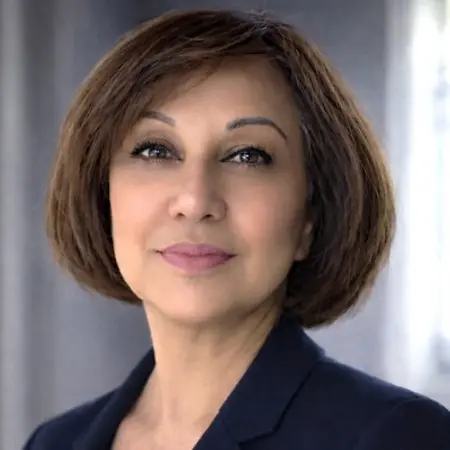
Her Story
About Dolores
I've been in the technology field for over 20 years, and for the past 13 years I've been teaching at Bellevue College, which started as a part-time role while I was still working in the corporate world. I really love the idea of being challenged, and teaching is truly a two-way street - as a professor, when you interact with students, you're realizing how you transmit information in real time, looking at your own work from a different perspective while helping students look at their world and how they're practicing their technical skills. It becomes a really good win-win growth situation for both teacher and students. Throughout my career, I've worked at major technology companies like Amazon, Microsoft, and T-Mobile, and my best expertise is solving problems using systems thinking - I look at how we got to where we are, what we missed, and why we have problems, then figure out a path going forward with a holistic view. Being a product manager was really one of my biggest joys, because you're designing the concept, researching and validating your hypothesis, then working with engineering teams, development people, platform people, software and app design teams to see your dream and vision come true. When I developed the kids' smartwatch, I had to think of the children as my end users and the parents as my secondary users, but I also had to maintain what I call the ethical integrity vision of the product - I didn't want to give them too many games because I didn't want the kids addicted to my device. If we don't think from that perspective, then you design a product just for money and you don't care about the effect on human beings. After leaving Amazon last May due to a layoff, I decided to take time away from the hectic world and focus on writing my books - I currently have four books in flight on different topics, including one about reversing the archetypes at the workplace to focus on employee archetypes rather than leader archetypes, and another on the disenfranchisement of the medical industry and how people are struggling within the pill economy.
Her Interview
Ten minutes with Dolores
01What do you attribute your success to?
I believe that what has contributed a lot to my success is being able to think about things critically, without fear, without judgment. Growing up in Singapore, I had a wonderful education that was much more rigorous and highly focused on critical thinking, and even conversationally, all the kids I grew up with were taught how to dissect and argue about our positions. Then at the University of Washington, I was able to get a super rich environment with my double major, and after working for about 10 years, I realized I was good but I was missing something - that's when I went back to graduate school, and that was the pivoting point of coalescing all the critical thinking into systems thinking. I feel that what has made me really successful as a human being is to look at life, even my own journey, my own wellness, my own well-being, my own growth, through those lenses of holistic systems thinking and critical thinking. I live my life by the principle of my education. The School of Hard Knocks also taught me that you can be all in your head and all in theory, and then you practice your theory, but sometimes there are moments where none of that theory, none of that practical stuff will see you through life. When I had to make the tough decision between taking care of my companies during the bad economy of 2006-2009 or taking care of my sick mom, I chose to take care of my mom. I lost the companies, I lost a million dollars, I lost a beautiful house on the lake, but I was with my mom, and I realized that real leadership is on the ground about how you see your value as a human being and the society around you, and making that very tough decision about what becomes first.
02What’s the best career advice you’ve ever received?
The best career advice I ever received came from a professor in grad school who said, 'Make thinking visual.' I've never forgotten that. I had to learn how to visually make my thoughts come out because I had to speak harder and try harder throughout my career. That advice has shaped how I communicate and how I approach problem-solving - it's about making people see things in a different way and feel it in a different way. I believe that's the gift of what maybe God or my divine self has given me, that I'm now arriving in a place where my spoken word is becoming more powerful and impactful by making people see things in a different way.
03What advice would you give to young women entering your industry?
Come in mindfully knowing that product environments are filled with men, and think about how we as women around the entire world, racially, are using products that only represent one-third, one-fourth, one-fifth for us. Enter that space to bring all of ourselves there, not to counter what the men are doing, but to enhance the design of what's already in place with a stronger sense of humanity going into it. Don't forget that it's your career, that it's going to make money, that you want the product to sell, but put in more of the values that come with us, because we as women are more holistic, are more systems-oriented than most men ever will be. We can see with the back of our eyes - that is the unique gift that women have that men don't. Being hunters, men look with what I call a reverse conversion, but we can look with a diffused wide lens and bring it all in. We should not compromise and narrow down our world to the myopic sense that men look at, but bring with pride our wide-lens ability to see more, feel more, deeper and wider. I want women to be unafraid to show up at the table and fight back, because you are going to see more, and don't be afraid to speak up to show how you see more. You can make products so much better, reduce the wastage, stop the landfills, because we will bring more ability of how to reduce that. We simply have to show up challenging ourselves to do better. I would argue with technology guys all the time, and I realized they were so proud of themselves and how they saw technology, and they were busy putting me down for the way I see it because I don't see their way. But I can see double what you see, and I would get respect at the table after fighting for my right, because I could see more than they ever saw.
04What values are most important to you in your work and personal life?
To me, honesty is an important aspect, and honesty has two faces. What I mean by honesty having two faces is if you are honest in a good way, you will always live with yourself comfortably and bring along a lot of other people, because they know exactly where they stand with you, how you live your life, and what you expect from them. If you create a phony sense of honesty, you at the end of the day do not really know who you are, and the people that come along with you will get hurt along the way, because someday when you wake up and say that's not how I want to do it or that's not what I meant, people are going to question whether your words match what you said before. I'll give you an instance - if I design a product just for money and work with a team just to get to the end goal with no sense of how the future is tied to that product, it's a very different result than when I can say we're building a product to help children, but we also need to be mindful that we're designing something for children who don't have the ability to think logically. We have to be, as the adults, mindfully and consciously think for them without manipulating them. That product, that moment, is very different when we drive to testing it and making sure everything that sits on that product has been designed with as much honesty and integrity by all the grown-ups touching that product, because we care about that one little child that's going to use my product.
Join Influential Women and start making an impact. Register now.