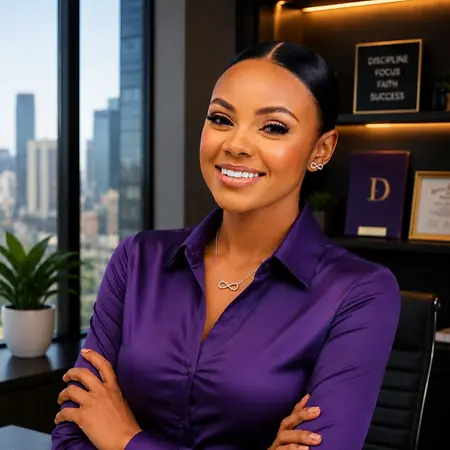
Explore how underrepresented leaders can navigate spaces not designed for them, leverage authenticity as a competitive advantage, and create inclusive cultures that inspire the next generation of transformative leadership.
Her Story
About Donnesha
Donnesha McBride is a transformational leader and organizational development strategist with over a decade of experience in the nonprofit sector. Rooted in a deep personal commitment to equity and access, her career began in direct service — working alongside young people and families in underserved communities who faced systemic barriers not of their making but very much within their lives. Those early experiences shaped her conviction that untapped potential is rarely the problem; limited opportunity and under-resourced systems are. That belief propelled her from the classroom and the community into progressively senior roles, including Vice President of Programs, Interim Executive Director, and Director of Operations and Strategic Initiatives, where she has translated organizational vision into concrete, measurable action.
Throughout her career, Donnesha has distinguished herself by building the internal structures and cultures that allow organizations to move with both intention and agility. She leads with a rare combination of analytical rigor and relational intelligence — fostering environments where teams think critically, communicate openly, and are empowered to make data-informed decisions that advance shared goals. Recognized among South Florida's Most Influential Women and honored as a 40 Under 40 awardee, she has earned a reputation for operational excellence, change management, and the kind of purpose-driven leadership that produces lasting institutional impact rather than short-term solutions.
Donnesha holds a Bachelor's degree in Organizational Leadership and Development with a double major in Political Science from Penn State University, as well as a Master of Professional Studies in Organizational Leadership. She is currently completing her doctorate in Organizational Leadership and Development at Barry University. A board member, mentor, and consultant, she remains deeply invested in the next generation of leaders — encouraging them to lead with purpose, embrace systems thinking, and understand that meaningful, lasting change begins with the courage to build what does not yet exist.
Her Interview
Ten minutes with Donnesha
01What do you attribute your success to?
My success is rooted in discipline, accountability, and results-driven execution.
I maintain a high standard for consistency in my work and take ownership of outcomes from start to finish. I’m intentional about aligning teams, clarifying expectations, and removing barriers that slow progress. When challenges arise, I focus on solutions rather than delays, and I adjust quickly without losing sight of the end goal.
I also attribute my success to strong strategic thinking and follow-through—being able to move from planning to implementation while ensuring quality and measurable impact.
02What’s the best career advice you’ve ever received?
The best career advice I’ve received is to stay grounded in excellence right where I am. Not to rush the next title or opportunity, but to fully own the space I’m in—execute well, stay consistent, and let results speak before I ask for more.
That shifted how I move. I focus on delivering with intention, being reliable, and making sure my work holds weight without needing constant explanation. Over time, that builds trust, credibility, and naturally opens doors.
I’ve also held onto the reminder that your reputation and relationships will carry you further than anything else. So I’m intentional about how I show up, how I communicate, and how I leave people feeling after working with me.
03What advice would you give to young women entering your industry?
Representation matters, and your presence in this space is powerful. Lead with purpose, be intentional about your growth at every stage, and understand that meaningful change is built through strategic, systems-oriented thinking and consistent action. Every phase of your journey is preparing you for the next, and the field is better because you are in it.
Take up space early—don’t wait until you feel “fully ready” to speak, lead, or contribute. Confidence is built through doing, not before it.
Be excellent at the fundamentals: communication, follow-through, organization, and emotional intelligence. In this field, your credibility is built in the small things people can consistently rely on you to do well.
Learn how to navigate relationships strategically. Who you connect with, how you show up in rooms, and how you handle pressure will matter just as much as your technical skills.
Protect your time and your name. Say yes intentionally, not out of obligation, and make sure your work reflects the standard you want to be known for.
And lastly, don’t shrink to make others comfortable. You can be respectful, collaborative, and still firm in your voice, your value, and where you’re going.
04What are the biggest challenges or opportunities in your field right now?
The biggest challenges in my field right now are centered around workforce stability, funding complexity, and increasing compliance and accountability expectations.
Staff recruitment and retention continue to be a major pressure point, especially for qualified early childhood educators and family support staff. At the same time, organizations are expected to maintain high-quality programming while navigating layered regulatory requirements, particularly within federally funded systems like Head Start. Funding diversification is also a constant challenge—balancing grant requirements, sustainability, and service expansion without compromising quality.
On the opportunity side, there is significant momentum around systems-level integration and whole-child development. There’s a growing recognition of the importance of early intervention, trauma-informed care, and family-centered programming, which creates space for deeper impact. Technology is also opening doors for better data tracking, outcomes measurement, and operational efficiency, allowing programs to be more intentional and evidence-driven. Stronger community partnerships and workforce development pipelines are also emerging as key levers to build more sustainable, high-performing early childhood systems.
05What values are most important to you in your work and personal life?
The values that guide my work and personal life are integrity, accountability, and impact.
Integrity shows up in how I lead and make decisions—staying aligned with what is right, even when it is not the easiest path. Accountability is about ownership; I hold myself responsible for outcomes, not just effort, and I expect the same standard from the environments I am part of.
Impact is what anchors everything. I am intentional about ensuring my work contributes to something larger than tasks or titles—whether that is improving systems, supporting people, or strengthening organizations in meaningful ways.
I also value consistency, growth, and respect for people. Consistency builds trust, growth keeps me evolving, and respect ensures I show up in a way that honors both the work and the people I am connected to.
I believe storytelling is one of the most powerful tools we have, and every opportunity to be seen or heard is a chance to amplify voices that deserve to be uplifted. Representation is a value I hold deeply—I want emerging leaders to see what is possible and understand that purposeful, intentional work can create change that extends far beyond any one person.
Ultimately, being recognized reflects a commitment to service, resilience, and impact that reaches beyond myself.
Her Content Hub
Articles by Donnesha
Leading in Spaces That Weren't Designed for You: Transforming Barriers into Opportunities for Lasting Leadership
Leadership in spaces not designed for you is not about waiting for permission—it's about bringing your authentic self and creating pathways for those who follow.

"The room may not have been designed for you, but your leadership may be exactly what it needs."
Leadership has never been simply about holding a title. Throughout history, it has been about challenging systems, expanding opportunities, and creating pathways where none previously existed. For many women and underrepresented leaders, success has meant navigating workplaces, boardrooms, and institutions that were never intentionally designed with them in mind.
Not long ago, women were legally restricted from many aspects of professional and financial life. Before the Equal Pay Act of 1963, wage disparities were openly accepted. Before the Civil Rights Act of 1964, workplace discrimination based on sex and race lacked meaningful federal protections. Even after those landmark laws, leadership opportunities remained limited, and women often found themselves expected to support organizations rather than lead them.
Today, we have made remarkable progress—but the journey is not complete.
According to McKinsey & Company’s Women in the Workplace report, women represent nearly half of entry-level employees, yet only 29% of C-suite executives. One of the most significant barriers remains what researchers call the “broken rung”—the first promotion into management. For every 100 men promoted, only 93 women are promoted, and for women of color, that number falls to 74. These early-career disparities compound over time, creating fewer opportunities to advance into senior leadership.
These numbers are more than statistics—they represent untapped talent, overlooked innovation, and leadership potential organizations cannot afford to lose.
Leading in Spaces Not Designed for You
As someone who has navigated rooms where I was underestimated before I was understood, I have learned that leadership is not about waiting for permission to belong. It is about bringing your expertise, your vision, and your authentic self into every space you enter.
Leading in spaces that were not designed for you requires more than credentials. It requires resilience when your ideas are questioned, emotional intelligence when you encounter resistance, and confidence when you are the only person in the room who looks like you or shares your lived experience.
Those moments are defining.
You can choose to allow them to diminish your confidence—or you can allow them to strengthen your purpose.
Authenticity Is Your Greatest Competitive Advantage
One of the greatest misconceptions about leadership is that success requires conformity. Too many professionals believe they must become someone else to earn credibility. While every leader should adapt their communication style to different audiences, authentic leadership never requires abandoning your identity.
Authenticity is not a weakness.
It is your greatest competitive advantage.
People may forget presentations, meetings, and job titles, but they remember leaders who consistently demonstrate integrity, humility, empathy, and courage. Authentic leaders build trust because people know exactly where they stand.
Equally important is shifting your focus from validation to contribution.
Recognition is rewarding, but it should never become the reason you lead. The most influential leaders solve problems, elevate people, and create measurable impact. They understand that true influence is not measured by applause—it is measured by the lives, organizations, and communities that are stronger because they showed up with excellence.
History continually reminds us that transformative leaders rarely wait for ideal conditions. They step into uncertainty, challenge assumptions, and expand what is considered possible. Every generation benefits because someone before them had the courage to go first.
That responsibility now belongs to us.
Building Cultures Where Belonging Is an Expectation
Leadership is not simply about breaking glass ceilings—it is about ensuring no one else has to spend their career looking up at one. That means mentoring emerging professionals, sponsoring future leaders, advocating for diverse perspectives, and creating cultures where belonging is more than a buzzword—it is an expectation.
Research consistently demonstrates that organizations with diverse leadership teams make better decisions, foster greater innovation, and achieve stronger long-term performance. Inclusive leadership is not simply the right thing to do; it is a strategic advantage in today’s increasingly complex and interconnected world.
But inclusion does not happen by accident.
It happens because leaders intentionally create environments where every voice has the opportunity to contribute.
If you have ever questioned whether you belong in a particular room, remember this:
- Your presence may be the catalyst that transforms its culture.
- Your perspective may solve a problem others have overlooked.
- Your leadership may inspire someone else to believe that they belong too.
Never underestimate the impact of showing up authentically, speaking with confidence, and leading with purpose. Every barrier you overcome becomes a bridge for someone who follows behind you.
Leadership Affirmation
I belong in every room my purpose leads me to.
My voice carries value.
My perspective creates innovation.
My leadership opens doors—not only for me, but for those who will come after me.
I will not shrink to fit outdated expectations or seek permission to lead.
I choose courage over comfort, purpose over popularity, and service over self-interest.
Every challenge I overcome strengthens my capacity to lead with excellence, integrity, and lasting impact.
A Call to Action
Leadership is not reserved for those who inherit opportunity. It belongs to those who create it.
This week, I challenge you to take one intentional action that reflects the leader you aspire to be.
- Speak up in the meeting where you have been silent.
- Apply for the position you have convinced yourself you are not ready for.
- Mentor someone whose potential deserves to be recognized.
- Advocate for a voice that has not yet been heard.
And if you find yourself walking into a room that was not designed with you in mind, do not question whether you belong there.
Instead, ask yourself:
How can my leadership leave this room better than I found it?
Because history is shaped by leaders who refuse to wait for permission.
The room may not have been designed for you—but your leadership may be exactly what it needs.
Lead boldly.
Open doors intentionally.
Build longer tables.
And leave a legacy that makes it easier for the next generation to rise.
Join Influential Women and start making an impact. Register now.