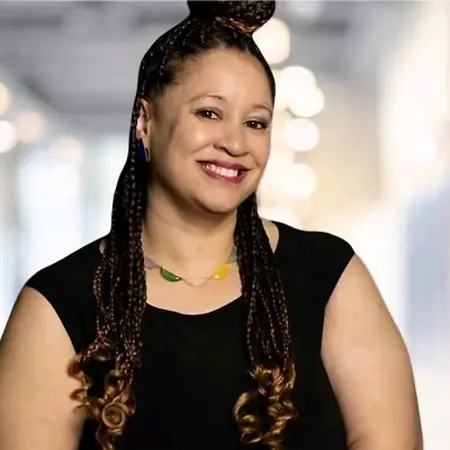
Her Story
About Dr.
I started in education in 2004 when I was in college at Temple, working at Allegheny Child Care, which is now Brightside Academy. I was in school with the goal of becoming a social worker - I wasn't planning to go into education, I kind of fell into it. My undergraduate degree is in liberal arts with a concentration on Pan-African studies. As time progressed, I went and got a master's degree in early child education, and then later on, I got my PhD in organizational Educational Leadership with a concentration on diverse ministry education, which talks about the ministry side and the secular side of education. Growing up, I had an IEP with 5 parts - I was behind in reading and math, I had a speech impediment (now called a speech delay), and there was also selective mutism, though they didn't know that's what it was back then. My village was my father, my teachers, my IEP team, and my administration - they all came together to be my village. In 2010, I played around with the idea of Anointed to Write, which was my first business name. In 2012, I started writing my first book, then walked through a divorce and lost my manuscript. I picked it back up in 2016, went the traditional route, and published my first book in 2017. In 2019, the publisher passed away, and in 2021, Anointed to Write was born. In 2024, a girlfriend asked me when I was going to do what I know I'm supposed to do - what comes second nature to me - and she said I needed to do a book. So I did a book that turned into a three-part anthology called Educators Rise Voices of Change, a collection of educators who are also authors trying to bridge the gap that separates us. In March 2024, after speaking to a trademark attorney about Anointed to Write versus Educators Rise Enterprises, I transitioned to Educators Rise Enterprises as the business entity. I'm a kindergarten teacher by trade, and I'm also a nationally certified trainer able to give Continuing Professional Development Units to those who attend my conferences. Volume 1 of the anthology had 9 educators, followed by an in-person conference that was a success. There was high demand for Volume 2, which had a virtual launch. Volume 3 is launching on July 18th with my in-person conference. This isn't just a book - it's a movement about curriculum building, infrastructure, training staff and leadership, and giving a voice to teachers so we can enhance the experience for the teacher in the classroom, as well as the student in the classroom, which in turn enhances the experience of the parent.
Her Interview
Ten minutes with Dr.
01What’s the best career advice you’ve ever received?
In 2024, a girlfriend asked me, 'When are you gonna do what you know you're supposed to do? It comes second nature to you.' When I asked what she was talking about, she said, 'You need to do a book.' That conversation pushed me to create what became the three-part Educators Rise Voices of Change anthology series. She saw something in me that I wasn't fully embracing - that this work of bringing educators together and giving them a voice was what I was meant to do, even though I'm a teacher by trade and didn't anticipate that being the route I would go.
02What are the biggest challenges or opportunities in your field right now?
There are so many gaps in education right now. Teachers don't feel like parents want to come together and work with them as a team, they don't feel like they're getting the support of their administrators, and administrators are saying they don't feel like teachers are being forthcoming with the support they need. There's burnout on both sides - administration and teachers - and teachers feel there's a lack of support or wanting to come together from parents, where it's like you just rush and drop off and rush and pick up. But it's not that parents don't want to be a part of it - either they don't know what to do, or they feel offended because of the way things are being presented. Educators are saying they feel burned out, they're not being heard, they're not being valued. Students are feeling a certain way too. In a public school kindergarten classroom with 30 students, you might have 5 above average, 7 below average, and 18 on target. The average teacher working by themselves doesn't have the capacity to individualize lessons for three parts in one classroom. The ones on target are bored because they have to be held back to catch up those below target, and the advanced ones are having behavior issues because no one is meeting them where they are. We're talking about the difference between equality and equity - equality is doing a professional development day and training everyone on the same thing, but equity is observing individually, finding out where the weaknesses are, and helping in those areas. It's not one size fits all, it's about meeting people individually where they are. The direction we're going is not good. The way education is highlighted is very lukewarm - we don't have people actually delving into what's working or how we can do things differently. That notion that it takes a village to raise a child has been thrown out the window because now everybody is either offended quickly - and that's not just the parents, that's also the teachers and administration. Everybody's kind of on edge trying to figure out how we could make this make sense.
03What values are most important to you in your work and personal life?
The saying 'it takes a village to raise a child' is fundamental to everything I do. That village I actually had growing up - my father, my teachers, my IEP team, and my administration all came together to be my village when I had an IEP with 5 parts. I can honestly say, without my village coming up, I don't know where I would be. That's why I'm so passionate about bridging the gaps that separate us in education - bringing together parents, teachers, administrators, and students. It's about meeting people individually where they are, not one size fits all. I believe in giving a voice to teachers and creating a platform for them to utilize their voice so that we can enhance the experience for the teacher in the classroom, as well as the student in the classroom, which in turn enhances the experience of the parent. If you get the student as a teacher, you got the parent. But if they don't have that connection with their child, they're not gonna want nothing to do with these things. Teachers are the heartbeat of education - without teachers, schools can't function, daycares can't function. Being able to take it from not just a woman's perspective, but from a female teacher's perspective that had the IEP, that had the five sections, that knows what it's like to have a village and then knows the damage of not having a village - that's what drives me.
Join Influential Women and start making an impact. Register now.