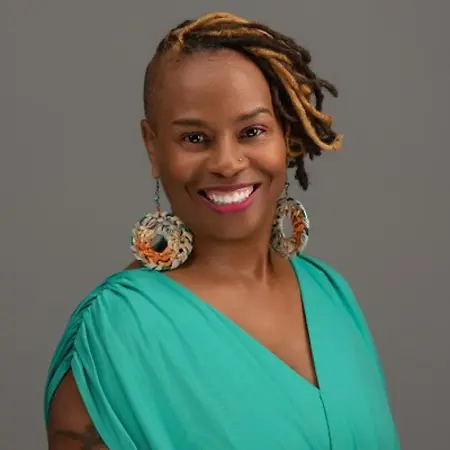
Her Story
About Dr. Kendra
I've been in education for 32 years, starting as a non-traditional teacher in New York City through Teach for America's third cohort. I had graduated with a degree in film and television and was planning to go to grad school for journalism, but it was too expensive. I taught in the South Bronx, then designed and opened a middle school there, became a principal of a middle school in Manhattan, and eventually became the Executive Director of Leadership Development for a school district in Georgia. As I climbed higher in leadership, the microaggressions became more pronounced, some racial, some misogynistic. After 15 years, I hit a ceiling when I was passed over for a position for someone who was mediocre and unqualified, and was told to go help him. That's when Kelly and I began writing stories about women in leadership and took the things we'd learned over time, our own skills and knowledge and research on how women can navigate systems like this. Now as co-founder of Lucy Leadership Project, we help women in leadership thrive, navigate systems, disrupt the ones they're in, and create new ones so they can show up as themselves and do their best work educating kids. My main expertise is coaching and facilitating, pulling people along and learning from them, coaching forward from a strength-based approach. I'm also a storyteller, taking information and making it into compelling stories, which aligns with my degree in film and television.
Her Interview
Ten minutes with Dr. Kendra
01What advice would you give to young women entering your industry?
The first thing I would say is, you are enough. You are perfectly imperfect, and those things you call flaws, those things make you unique. It makes you a beautiful human. It's hard to say those things when we're butting up against an industry, social media, marketing, all about how to make yourself look better, the size of yourself, the color of your hair, your skin. You see young girls early on looking at themselves in the mirror, trying to change their hair, thinking about surgeries. That starts the spiral into I'm never enough, and that's destructive. It takes them into the workplace, which is why when women see a job description, we look at all the qualifications. The man has one qualification out of the 10, and he's ready to apply. We have to try to do all 10 before we even apply. It really messes with our psyche in terms of how we even think of ourselves and being more, because we think we're never, ever enough. So to a young girl, you are enough. Find your sisters, find the sisters who you can be co-conspirators with. Don't settle for being an ally, we need co-conspirators who will go with us and say, hey, you've been an assistant principal for two years, you're ready, girl, go, and we'll figure it out with you along the way. Find those sisters who will be disruptors with you. Take those opportunities. Don't settle for what others are telling you that you can have. Be a disruptor. Understand very clearly what your strengths are, because if you ask a woman what her strengths are, she usually gives you skill or knowledge, and that is not strength. Understand very clearly so you can put yourself in the right seat, in the right positions, and you can clearly articulate those to others. And the last one, which is one of the hardest things for women to do, set healthy boundaries from day one. Understand how you are going to allow people to have access to you and stick to that, because if you aren't thriving, you are not good for yourself, and you're not good for anybody else that you might be leading. We have to unwrap the way we're socially conditioned in order for us to set healthy boundaries so we can thrive.
02What are the biggest challenges or opportunities in your field right now?
The biggest challenge within the education system is reducing the education gap that exists for students, and that gap goes all the way through adulthood. Some students are starting in deficits, without access to clean food, housing, healthcare, the basic things you need to just be a healthy human being. All the way through school, I'm also fighting images of myself in books and literature. We get into colleges and careers, and I'm continuing to hurdle. If you talk about women of color, or women in general, you can follow the trajectory of women in certain communities as they go from birth through their leadership, and you can see the gaps widening. The gaps widening in access to high-quality education, gaps in access to job opportunities and leadership opportunities. In educational leadership, it's predominantly male and white, even though 70% of the teachers in this country are women. Only 28% of the superintendents, or those in C-suite level, are women. And when you talk about women of color, 7%. That gap just didn't start, it starts from the community, it starts from birth. We can see it happening early on with the types of positions, lanes that we are sort of conditioned to go in, that perpetuates that gap. As much as we try to chip at it, we see progress, women get into the jobs, and then more often than not, the culture and climate is not conducive for them, and they drop out. It's unhealthy, and in fact, we've seen data of women dying on the job, specifically Black women. We're still running a century-old system that is based on primarily agriculture, a manufacturing kind of system, one size fits all. If it was a system that was really and truly focused on individuals and individual student strengths, and what students do well, and how do we prepare them for whatever's next, I think it would look very different. We're still stuck in this testing, manufacturing mindset. That thinking is still there. Not only is it a very patriarchal system that women and leaders are trying to navigate, because it was a system that was never created for us, or with us in mind as leadership, if you drill down even to the students that we serve, we've created that same system for them, and then wonder why as girls become women, they're still struggling, because they're in that same system.
Join Influential Women and start making an impact. Register now.