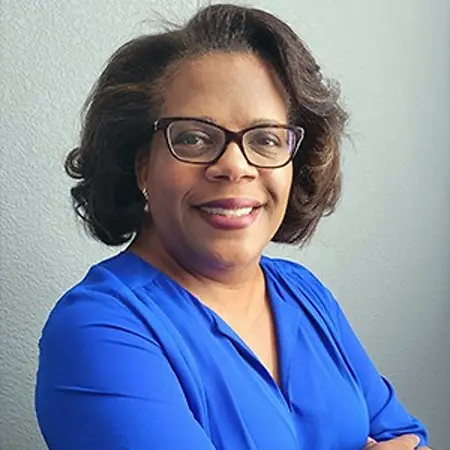
Her Story
About Effie
Effie Hubbard Ruggles is the Manager of Community Health Relations at Vivant Health based in Sacramento, California. She is a seasoned public health leader with 30 years of experience in Medi-Cal program administration, with a strong focus on maternal and child health, preventive care, and reducing health disparities in communities of color. Her career reflects a deep commitment to whole-person care within Medicaid (Medi-Cal) and Medicare Advantage systems, emphasizing partnerships between health plans, providers, and community-based organizations to improve access and outcomes for vulnerable populations. She earned her Master of Public Health in Policy and Administration from the University of Michigan School of Public Health, where she developed a strong foundation in public health systems and maternal-child health policy. Her early professional work included involvement in WIC programs and breastfeeding coalitions, experiences that shaped her lifelong dedication to improving maternal and infant health. Over the course of her career, she has served in leadership roles across public health and managed care organizations, including long-term work as a liaison with Sacramento County public health programs and contributions to initiatives addressing social determinants of health. Throughout her career, Ms. Ruggles has focused on building innovative, community-centered health strategies that bridge policy and practice. She has led and supported programs that connect healthcare systems with schools, churches, and community based organizations to meet people where they are and improve health equity outcomes. Her professional philosophy is grounded in the belief that healthy children and families are essential to a thriving society, a perspective reinforced by her guiding question inspired by the Maasai greeting: “And how are the children?”
Her Interview
Ten minutes with Effie
01What do you attribute your success to?
I think two things- my faith and my mother - I see my work, both my professional job and all the things that I do personally, outside of work, in terms of service. Yes, it's great that I get paid, don't get me wrong, but I view my job/career in terms of service. That mission, or that need to serve, to make things better - that should always be the goal, to make things better, your community, your city, your school, whatever. I tell my kids this too - whatever you're doing, do it because it makes you happy, do it because it's the right thing to do, do it to serve, and do it to help someone else whenever you can. I grew up in a very nurturing and empowering environment. My mom was like a superpower, and I had other women around me who were also superpowers. With that example, there's that need to be a similar empowering force for the next generation. You can never stand on your own - or rather you shouldn't. One, it is lonely and pedestals are not that roomy. You can get knocked off. It's much better if you have a podium and stand side by side. Then you have a broader and stronger foundation with room for support.
02What’s the best career advice you’ve ever received?
The best life advice I ever received is also the best life advice I've ever received.
- Your career should give you purpose and light a fire within you.
- Never stop learning and growing.
03What advice would you give to young women entering your industry?
I would tell young women entering the health care industry today.
- Stay strong, be resolved and give your best because our work not only impacts individuals' health, but the socio-economic "health" of the nation as a whole for generations to come.
- Don't let the fear of failure keep you from an opportunity to shine and make an impact. Go earn your flowers!
04What are the biggest challenges or opportunities in your field right now?
There's a lot changing with HR1 and just in general where healthcare is going and where need is. We're really in a time where appropriate planning steps are needed to ensure that the public's health remains strong and that individual health remains strong, because there are a lot of factors now that are pushing and pulling. At the end of the day, people still need to have good health and maintain their health. It's a challenging time, but there's still opportunity. We're going to be 250,000 doctors short in the next 10 years, and already it's hard to get appointments. There are metropolitan deserts as well as rural areas. What really scares me is in terms of what that means for maternal health with so many hospitals closing their maternity wards. You have women that have to go 30 miles or more to get to their hospital. The question is, are they foregoing prenatal care? And if the facility is so much further away, what if there's an emergency when she goes into labor? What if that baby and mom are in distress? We have a persistent maternal mortality disparity among African American mothers. With these hospital and birthing center closures we're looking at a brewing rural maternal mortality crisis as well. How do we support the facilities, or if change is happening, what do we put in place? What kind of solutions do we come up with so that we are still maintaining people's health? Do we have mobile clinics? Do we partner with community centers or churches where a provider or a federally qualified health center (FQHC) does a roving clinic, kind of like my colleagues at WIC have done with satellite sites at churches, community centers or farmer's markets? From the programming perspective how do we make it work logistically and within regulatory standards? There's a lot to consider, but that's not to say that the answers can't be found. We have to think even further outside the box in order to solve the health care challenges we face today.
05What values are most important to you in your work and personal life?
SERVICE: I see my work in terms of service. That mission, or that need to serve, to make things better - that should always be the goal. Whatever you're doing, do it because it makes you happy, do it because it's the right thing to do, do it to serve, and do it to help someone else whenever you can.
DEDICATION: Always give your best.
TEAMWORK: As an only child I learned the value of teamwork early. We can get along fine on our own, but we can achieve so much more when we work collectively drawing on one another's strengths and having support when we need it.
Join Influential Women and start making an impact. Register now.