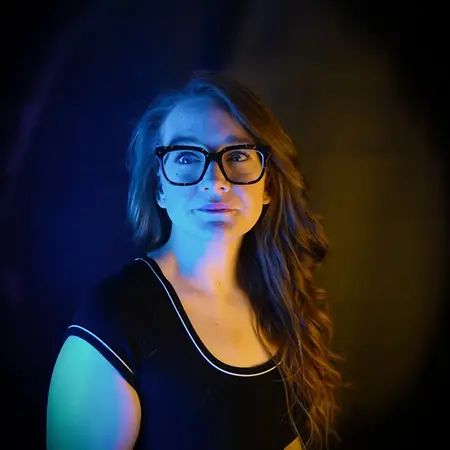
Her Story
About Eileen
Eileen Haefner is an Account Development Manager at PhotoShelter, a digital asset management platform that helps creative teams organize, manage, and distribute visual content. Based in Lincoln, Nebraska, she works closely with organizations—particularly higher education institutions—to optimize creative workflows and ensure teams can efficiently manage content from creation to final delivery. In her role, she collaborates with clients to refine processes, share best practices, and maximize the value of PhotoShelter’s platform, which powers content operations for major organizations and events, including professional sports teams and large-scale productions.
Haefner’s career path reflects both adaptability and entrepreneurial spirit. She earned a Bachelor of Science in Applied Behavior Analysis from the University of North Texas and began her professional journey in healthcare as a behavioral therapist working with children on the autism spectrum. After completing extensive supervised training toward professional credentialing, she chose to pivot from clinical work and explore opportunities in business and sales. Drawing on her background in entrepreneurship and a family tradition of sales professionals, she transitioned into healthcare sales before eventually finding her niche in technology and digital asset management.
Since joining PhotoShelter, Haefner has built a reputation for her people-first approach, strong relationship-building skills, and commitment to improving workflow efficiency for creative teams. She is passionate about helping organizations get the most value from their content and the effort they invest in producing it. Recognized for her contributions to business development—including generating significant sales pipeline—she continues to focus on empowering clients, supporting creative storytelling, and fostering inclusive, collaborative professional environments.
Her Interview
Ten minutes with Eileen
01What do you attribute your success to?
I attribute my success to the way I was raised and a defining moment when I was young. My dad is one of seven, I have 21 first cousins on my dad's side, and summers were spent in the basement playing ping pong or out on the dock fishing. It was always about who's gonna win the most games or catch the biggest fish, and I always wanted to win. But the real turning point came during a massive storm in Dallas when I was young. My dad had just left his restaurant gig and had boxes and boxes of candles in the garage. I asked if I could go sell them on the street since no one had candles or electricity. The power was out for 48 hours, and in that time, I sold 24 cases of candles. When I was counting the money with my dad, he sat me down and explained the full sales cycle - I had to pay for the product, he was taking a cut because he supplied them. That's when I realized I did that, no one told me to do it, no one set it up for me. I went and did it myself. I'm fully capable of doing whatever it is that I want to do. The teachers at school telling me that I'm not that smart because I'm ADHD, they know nothing. Everything my parents have been telling me about life skills being just as important as being book smart, I was seeing it right there. Ever since then, I've just ignored anything anyone has ever told me of 'Eileen, you can't do that.' If I think I can do it, I'm gonna give it my best shot, and until someone who's either been doing it with me or is a mentor says they don't think it's smart, I'll take their advice and then I'm gonna try again.
02What’s the best career advice you’ve ever received?
The best advice I ever received came from my mom when I was struggling with being different because of my ADHD, dyslexia, and OCD diagnoses. I used to cry to her saying I'm different, this sucks, I don't want to be different. She told me that different isn't bad, it's just different. That piece of advice has stuck with me to this day. It helped me reframe how I see my challenges and turn them into strengths. I've learned that what you tell yourself is how you're going to perform. If you're telling yourself that everything is going wrong, everything will go wrong. But if you stay positive and have an optimistic mindset, that can be the difference between everything crumbling and pushing through to become stronger. I also remind myself that I'm doing more than I think I am. When I feel overwhelmed or like I'm not doing enough, I make what I call a to-done list instead of a to-do list - everything I've done that day. I can look back on it and realize I actually crushed it, and I need to stop being so hard on myself.
03What advice would you give to young women entering your industry?
My advice for young women getting started is that you can be your biggest cheerleader and you can be your own biggest downfall. What you tell yourself is how you're going to perform. If you are telling yourself that you are going to miss quota, you're not doing well, everything is just going wrong, then everything is going to go wrong. As hard as it is to stay positive and have an optimistic mindset, sometimes that is the difference between everything crumbling and pushing through and becoming stronger. I would also say you're doing more than you think you are. If you ever feel overwhelmed, or struggle with feeling like you're not doing enough, take a second and remind yourself what you've done today. One thing I like to do is make what I call a to-done list instead of a to-do list - it's everything that I've done that day. I can look back on it and go, oh my gosh, I booked 3 meetings, I got this follow-up email sent out, that contract went out. It was a really hectic day and I didn't have time to stop and honor my accomplishments, but you know what? We actually crushed it. Why are we being so hard on ourselves? Be positive. There's nothing to be upset about.
04What are the biggest challenges or opportunities in your field right now?
One of the biggest challenges in my field today is the rapidly aging population, often called the “silver tsunami,” which is increasing the demand for better elder-care coordination, support systems, and solutions for caregivers. At the same time, the financial complexity of elder care and the growing risk of fraud targeting older adults present significant concerns that require stronger safeguards and education.
Despite these challenges, there are important opportunities to develop supportive platforms for caregivers, create more intentional spaces for women to share their stories, and continue advancing meaningful conversations about neurodiversity in the workplace to foster more inclusive and innovative environments.
05What values are most important to you in your work and personal life?
Efficiency and strong workflows are core values in both my professional and personal life. I am passionate about helping people get the most out of the effort they put into their work by creating systems and processes that make daily tasks more effective and manageable. I’m also driven by empathy and the importance of bringing people together, which is why I value storytelling and community-building.
I believe in creating supportive spaces where people feel understood and encouraged, whether through collaboration, shared experiences, or even the comfort that emotional support animals can provide. Above all, I try to maintain a positive outlook by focusing on the people who are helping and the silver linings that remind us of the good in challenging situations.
Join Influential Women and start making an impact. Register now.