A powerful personal account of 25 years of sobriety, exploring the transformative journey of recovery through hard work, faith, and unwavering commitment to becoming the best version of oneself.
Her Story
About El'Anya
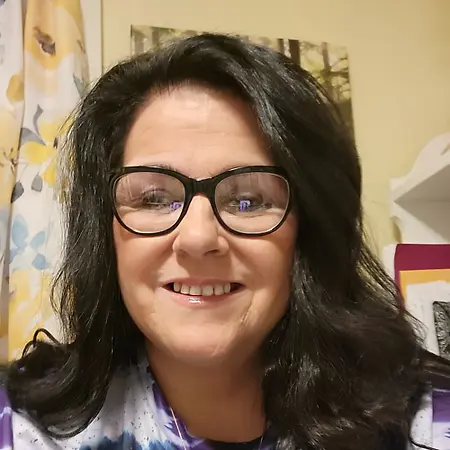
El’Anya (L’Anya) Nightingale is a Certified Alcohol and Drug Counselor I at Discovery Counseling, Inc., which serves clients with offices in Corvallis, Lincoln City, Newport and Waldport, Oregon and surrounding areas. After completing a two-year counseling internship and earning her CADC I certification, she now works as a facilitator of change in an outpatient treatment setting, supporting people with substance abuse issues from all walks of life, both self-referred and mandated to treatment, as they begin and learn to deepen their recovery journeys. Her approach is grounded in compassion, accountability, and a deep respect for each individual’s capacity for transformation. With more than 25 years of continuous sobriety, El’Anya’s professional path is inseparable from her lived experience in long-term recovery. She began her career in the peer support movement, progressing from Peer Support Specialist to Certified Recovery Mentor before completing over 1,000 hours of supervised clinical training and formal addiction studies. Her earlier work includes advocacy and education with Friends of Recovery Vermont, mentoring in women’s Oxford Houses, and counseling roles in both Vermont and Oregon—experiences that shaped her recovery-oriented, peer-informed philosophy of care. In parallel with her clinical work, El’Anya spent a few years as Director and Minister of The Center for the Study of God’s Living Heart, where she provided spiritual advising, teaching, and program development for individuals and communities across the country. She is deeply devoted to helping others discover their inherent God-Consciousness and integrate spiritual awareness with healing and personal growth. El'Anya has also volunteered her time and effort to her passion projects; helping women to heal and recover through the Clearwater Project and helping people in recovery from substance use and mental health issues reach resources throughout the state of Oregon through her work with Peer Galaxy, a huge peer-led information calendar and clearinghouse (www.peergalaxy.com). Outside of work, El’Anya enjoys jewelry making with semi-precious stones, gardening, retreats, and meaningful time with her recovery community—living what she defines as success each day: sobriety, service, and presence.
Her Interview
Ten minutes with El'Anya
01What do you attribute your success to?
I contribute my success to an internal drive to be the best version of myself that I can be every day, and to unfold that version in as helpful of a manner that I can, so as to be of service and support to as many humans as I can. I have also had a lot of help from many angels and helpers along my own path, and I am eternally grateful to everyone who has ever given me a hand up.
02What’s the best career advice you’ve ever received?
Just keep moving forward, no matter what.
03What advice would you give to young women entering your industry?
If you have lived experience, I strongly recommend beginning with Peer Support Specialist training and exploring Certified Recovery Mentor pathways, as they provide a solid foundation rooted in empathy, practical skills, and real-world understanding. If you do not have lived experience, I encourage pursuing comprehensive classroom education combined with extensive supervised clinical hours to build the knowledge, structure, and professional confidence necessary for effective and ethical practice.
04What are the biggest challenges or opportunities in your field right now?
The biggest challenge in my field right now is the lack of external supportive resources for and the habitual relapse of some of our clients. The best opportunities lie in that addiction is a continuous, growing problem and there is always room for and the need for new counselors and clinicians.
05What values are most important to you in your work and personal life?
The most important work values for me are the sharing of my lived experience and authenticity with and for my clients. It is imperative that a clinician be as forthcoming and genuine as they can be, no matter what their actual experiences with addiction are. This is called, "meeting clients where they're at" and then helping them to move forward in their individual recovery.
In my personal life, I live with integrity and Spirit, and I have a completely dialed-in moral compass these days that keeps me "on the Beam", as I like to call it.
Her Content Hub
Articles by El'Anya
The Art of Recovery
From Darkness to Light: A 25-Year Journey of Sobriety, Self-Discovery, and Transformation
Over the years, I’ve often been asked, “How did you get here? How have you stayed sober for so long and become the person you are today?” As of this writing, I have 25.5 years of continuous sobriety, and I work as a Certified Alcohol and Drug Counselor.
My usual response is simple: “Hard work, facing my shadows, and always moving forward.” But I believe that answer only scratches the surface of the reality of recovery.
The truth is that my sobriety—my whole recovery—is fueled by a relentless desire to become the best version of myself that I can be, and the courage to discover where that self might lead. It is anchored in a clear memory of who I once was and a firm resolve never to return to that life. It requires a gritty, down-to-earth understanding of what sobriety truly demands: living day by day, moment by moment, step by step, trusting that the answers will come if you ask the right questions.
Recovery means going nose-first into the unknown, walking that path with humility and determination. And it means faith—faith in a higher power, faith in the process—which tells me that even in the heart of darkness, if I hold tight to my highest ideals and continually strive toward them, I will find my way.
My sobriety was hard-won. I spent years trying to find my sober footing, and in that struggle—before I was successful—I lost everything that ever mattered to me. It felt like a constant tug-of-war: one force pulling me back into the depths of alcoholism and addiction, the other fighting just as hard to pull me back out into the light.
Finally, in July of 2000, I broke completely free, and my recovery took hold. The years of heartache and “incomprehensible demoralization,” as it’s described in the program I’m deeply involved in, began to loosen their grip. In their place came a lighter way of living and being. Over time, my life experiences softened, and my entire existence changed for the better.
I firmly believe that one of the most profound discoveries of the past hundred years is this: a person can change their entire life by changing their mind about their life. And change my mind, I did.
I went from someone with absolutely no hope or faith in myself to someone with a grounded understanding of who I am and what I am capable of achieving. I made this transformation by doing the work—consistently, imperfectly, and honestly—and by facing myself as I was, trusting in something greater than myself, and choosing, again and again, to move forward, both in my life and in my recovery.
Join Influential Women and start making an impact. Register now.