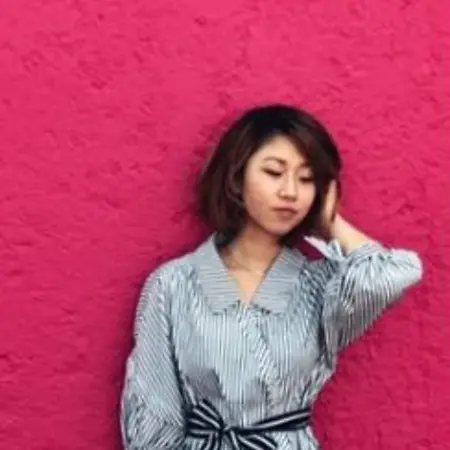
Her Story
About Elenore
Elenore Pan is a Los Angeles–based founder, producer, and creative executive working at the intersection of media, storytelling, and emerging creative technologies. She is the Co-Founder of Wildebloom and has built a career spanning over a decade across film, television, and digital media production. Her work focuses on turning niche creative concepts into scalable, category-defining media ventures, with a strong emphasis on adapting storytelling to evolving audience behaviors and distribution platforms.
She began her academic journey with a Bachelor’s Degree from Northwestern University, where she studied filmmaking and humanities, and received advanced film training at the National Film and Television School (UK) and Prague Film School (Czech Republic). Early in her career, she worked across creative production and strategy roles at organizations including Starlight Media Inc, COL Media, and Harvard CAMLab, gaining experience in both traditional narrative filmmaking and experimental media environments. Her projects span independent film development, studio productions, and festival-circuit work, including contributions to works showcased in major international festivals such as Sundance and Tribeca
In recent years, she has shifted her focus toward media technology, short-form content, and next-generation storytelling format , including 3D, interactive media and platform-native productions. Her professional philosophy centers on adaptability, continuous learning, and leveraging new technologies to expand how stories are created and experienced. Across her work in film, fashion, music, and digital platforms, she emphasizes accessibility in storytelling and the importance of evolving with the rapidly changing media landscape.
Her Interview
Ten minutes with Elenore
01What do you attribute your success to?
Self-awareness and persistence. I really think self-awareness is one of the most valuable things in this world, and you cannot be self-aware without a healthy mindset. I started doing yoga when I was young and got my yoga teaching certification, and even till now, I do yoga all the time, play tennis, and go hiking. Staying on top of your physical health is so relevant to your mental health. I think people who work in high-stress industries, it's very easy to lose adrenaline and serotonin, and then you just get into the groove of having so many meetings and things to do. It's very hard to reserve spaces for you to just focus and meditate and reset, and be aware of the things that you are currently doing and how some of them are most likely working better than others at any given point in life and professional life alike. You need the clarity to find order in chaos, and see problems before they happen. When you talk about any kind of success or influence around anyone's career, people look at those highlights of the moments where things are working, but everyone goes through phases where some things are just not working the way that you think, and others won’t see those days. You couldn't get to the brighter side of it if you don't have the mental health and the mental strength to go through challenging and hard times, and to not be jaded or have bad stress management. It's very crucial for the longevity of any career. I always say that persistent people will always win in the end, and with a lot of creativity, it is a marathon, not a sprint. Finding ways to keep yourself mentally healthy, to feel grounded and not overly worried - that's the only way that you can gain clarity and start to become better.
02What’s the best career advice you’ve ever received?
The best career advice I've ever received is really that you don't know until you do it, and to have a beginner's mind no matter how many times you've done something. Especially after people have been working in certain industries or things for a while, it's very easy to approach new projects with a lot of assumptions - this should be done this way, or this is gonna work, this is not. Sometimes you're right, but there are more times that things will just not go the way that you expected at all. That's one of the fun parts of media industry as well - what people consider as good and effective, there's almost no set answer to it. You have to do it, and you have to learn it from reality. A lot of things sound really good theoretically, but when you put it to practice, a lot of elements would change. The ability to stay with the change and constantly learn, even when things don't go the way that you expected, and to do it over and over again and adjust as you go - it takes real mental tenacity. You might think A, but if B happens, you not only need to embrace B, but also figure out what are the missing links, and there might be other things beyond B that you don't see because you were so busy thinking about A. To really approach every single project with enough fresh perspective and open mind is actually a very hard thing. The more you do something, you just couldn't help but have certain habits. But sometimes a project will just tell me, oh, I was wrong about this and that decision, and it's okay, and I'll be wrong again in the future too. Just to really stay on top of it and be open enough to listen and respond is something that I find extremely valuable, especially now when the industry is changing every few months.
03What advice would you give to young women entering your industry?
Trust yourself. I grew up in a fairly female-empowered household. My mom, my grandmother are all hard-working women. So growing up, I never had the feeling that there are things that I couldn't do just because I was a woman. I think a lot of the dialogue we have today around females, both as far as social justice goes and everyday professional performances of women, has a lot of undertone of women being in a disadvantaged place to start with. It’s certainly true in a lot of cases - I'm a woman and I'm a minority, so I get more of it still, but the fact is, if you don't even believe that you can do it , no one else will. You're gonna make mistakes along the way, even if you try your hardest to avoid it, it’s just gonna happen. You’ll have to trust that you can do it, and do it over and over again until you see results. It's really just a learning by doing thing. I really feel like with media and tech, both the intersection of it and even alone, a lot of the things you learned at school get thrown out of the window once you're in the professional field. You have to have faith in yourself first - that's the starting point of anything.
04What are the biggest challenges or opportunities in your field right now?
The challenge is that new media technology has made content production far cheaper, faster, and more creatively flexible than anyone could have imagined a decade ago, but we have not yet developed a sustainable business model that can accommodate that shift. The film and media industry had pre-streaming days and post-streaming days if you really want to look at the industry for the past few decades. We have just very few players in the industry consolidating over 90% of the resources and distribution outlets for traditional content, and it's inevitable that they're less and less willing to take risks because those projects are huge budget with really long development timelines. You really can't afford for something that you and a full team put 5, 6, even 10 years of work into to have bad results. Inevitably, traditional studios are gonna become more conservative about choices, and that makes total sense from a business standpoint. But the trade-off is really that we lose a lot of diversity in the content format. We used to be able to pitch to 50 different places, now it's probably 10. People are picking up less shows and less content. There's not a lot of space for people to try new things and take on risks. It's just really hard for the industry to have innovation. The industry today has a lot more similarity with broadcast days back in the 60s and 70s than the 90s and 2000s. But the flip side and the opportunity is that I think 10 years ago, people wouldn't take content on Youtube, social media, or different mini outlets seriously as real content. But with how the industry is now, in so many ways you can have a lot more reach and influence on people, and you'll see the results a lot faster with the internet. Internet distribution just gives people an insane amount of opportunity. With the media technology part, it's become more and more of an industry where if you are a creative, you can really show the world the vision that you have with very little budget and tools. You're not very dependent on a lot of people. Back in the day, even if you had this really amazing idea, you needed a full set of crew and so many people working very long hours to get one thing done, and then you had to sell it to a traditional distributor and wait forever. These days, there's really nothing preventing anyone, regardless of their background, from having access to really amazing tools that you can very easily pick up and execute tasks that you used to have to be dependent on other people for and pay a lot of money and wait a lot of time for. Those tools have become more and more accessible now. There is actually more democracy in content creation today, and it's really more about the creatives and the idea and the voice than execution, because now you really can get high-quality stuff executed with a very skeleton team.
05What values are most important to you in your work and personal life?
I think accountability is really important to me and for the people that I work with. I need to be able to take your words at face value, and if we agree on doing something, I can trust that you would hold up your end of the bargain, and I would on mine. media is a very high-stress industry, and sometimes delegation gets really muddy because it's by nature so collaborative. You just have to rely on other people or be dependent on other people for some parts of it, so to be someone that other people can count on is very important to me. And vice versa - I want to be with people that I feel like if you say this will be done, I can trust that it will be done. Another quality that's really important to me is tenacity or persistence. Sometimes when there is a task or a goal that we want to go after, there will be unexpected issues or hindrances that just come up along the way, and I don't like excuses. I’m someone who doesn’t stop until there is absolutely no way - I always pivot and find ways to get to our original plan and goal. giving up is just always a lot easier when there is an issue or challenge in a project. The people who have the quality to persistently try and don't stop at the first no or the first issue that comes up are my people. There are things that just eventually cannot be done, obviously, but I think that quality really sets people apart.
Join Influential Women and start making an impact. Register now.