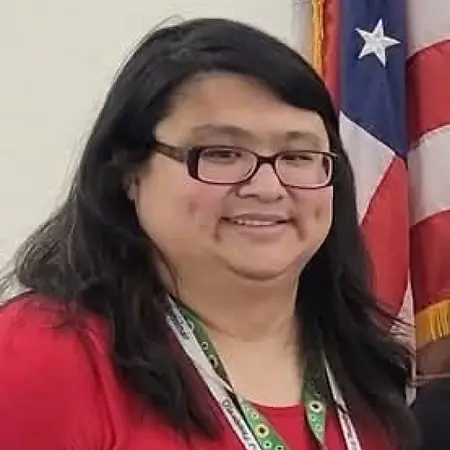
Influential Woman · Health and Human Services (Developmental Disability Services)
Elizabeth K Graham
Autistic LGBTQ advocate, Elizabeth Graham
Silver Spring, MD 20907
Her Story
About Elizabeth
Elizabeth “Lizzy” Graham is an autistic and transgender advocate based in Silver Spring, Maryland, with a professional background in developmental disabilities services and disability policy. Adopted in infancy from East Asia and diagnosed with Asperger's during high school, she brings lived experience to her work supporting autistic and neurodivergent individuals. She earned a bachelor’s degree in psychology from Marshall University in 2013 and began her career in direct support roles, working with adults with developmental disabilities in community-based residential settings before moving into service coordination for Medicaid Home and Community-Based Services (HCBS) for children with autism. Since 2015, Lizzy has worked as a service coordinator for the Maryland Medicaid Autism Waiver in Prince George's County at The Arc where she supports autistic children in accessing therapeutic services, monitoring care plans, coordinating providers, and ensuring continuity of supports for children with developmental disabilities. Her professional focus emphasizes a neurodivergent-affirming, social model of disability approach, prioritizing autonomy, inclusion, and community-based support. Outside of her primary job, she serves on advisory boards and collaborates with organizations focused on improving healthcare access and outcomes for autistic and intellectually/developmentally disabled (IDD) populations. Outside of her formal role, Lizzy is active in intersectional advocacy work centered on autism and transgender rights. She co-facilitates Maryland Trans Unity, a volunteer peer-led support group for transgender and non-binary adults in Maryland, and participates in national disability advocacy initiatives through advisory councils and self-advocate networks. She has presented and published on topics related to autism, gender identity, and disability systems, and her work emphasizes the importance of including disabled and LGBTQ+ voices in policy, research, and service design.
Her Interview
Ten minutes with Elizabeth
01What do you attribute your success to?
I attribute my success to the fact that I'm alive and thriving despite the tough rate of mental health and discrimination issues for trans people and the lack of acceptance we can and do face. Given the high unemployment rate and job loss rate for people on the autism spectrum, regardless of level of support needs, the fact that I've held one job for so long is an overall accomplishment. Being 10 years in a job this day and age is a good milestone. I didn't have to seek a job that I totally did not want to in order to be myself. There are some trans people who wind up in other lines of professions because that was the only choice they had, but I was able to stay in the same line of work and move on up to case management, which was good. I have less direct contact with people, which sort of helped, especially in the early days of my gender transition. I think keeping the same job and also maintaining a freelance advocacy career on the side is an accomplishment, given the job turnover rate and unemployment rate for many people with developmental disabilities. My mom who raised me, Kathleen - a classical musician and piano teacher and musician in the Army Band, who died in her 50s from melanoma when i was 15 years of age - has also helped me even from the grave - she was influential to my life and showed me through her actions that women have to work twice as hard to be viewed as half as good as men.
I also want to thank my mentors from Marshall University, my friends and colleagues with The Arc, friends in the autistic and IDD self-advocate community, friends in the transgender community, and all those who I consider dear friends and chosen family.
02What’s the best career advice you’ve ever received?
The best specific advice I received was from an HR recruiter when I was doing an internship at a psychiatric rehabilitation agency after graduating from college. She heard me applying for different jobs, including one at a developmental disability-based organization, and she knew about my expertise with autism. She said to me, 'You have the skills to work in one of our group homes and there is an opening, but is this the population that you want to work with?' She told me to think about it for the day and call her the next day, and she sort of hinted that working in the developmental disability population might be a better fit for me. I think she was right because 13+ years later, I'm doing a lot and contributing a lot to the developmental disability field. The broader advice I would give to anyone is, whatever your major is or whatever career path you want to go in, find your niche. Find something that only you, or very few people, can specialize in. Yes, people in your position could be replaced, but find something about you that if you were to leave, someone would miss that thing. Make yourself unique in a way that you will be missed.
03What advice would you give to young women entering your industry?
You need to work smart and hard. Try to work harder, as my mom, through her actions, showed that women have to work twice as hard to be viewed as half as good as men. Have a strong work ethic, learn the profession not just the job, be punctual, have good writing skills. , The Army, even the Army Band, where my mom worked, is still pretty male dominated, from my observations. Thankfully for me, in the developmental disability field, there's a lot more women working in the field than men. But I think the key is to find your niche and work hard. Prove yourself so that even if you could be replaced in terms of position, you'd still be missed. An accomplishment is one accomplishment, and then you just think of another accomplishment, but you also want to make milestones.
04What are the biggest challenges or opportunities in your field right now?
One of the biggest challenges we're seeing in the developmental disability field is turnover of the direct support staff, the ones who are on the front lines. Part of it is low salary, and that's also a policy advocacy matter as well. That's a bigger level thing. I do say that if you want to go into the developmental disability field, work in a direct position first before you find other jobs within the developmental disability field. I've seen people who are able to do the job itself well, but they don't really have much of an in depth understanding of what they're doing as case managers from a concrete level. Starting in a direct support role helps you understand the work from the ground up.
05What values are most important to you in your work and personal life?
I value consistent and sincere work ethic and interest. I value people who are passionate about what they do. If you don't like a certain aspect of your job, find another part of your job that you are passionate about. For example, when I was working at Starbucks while finding my job after college, I knew I wasn't going to stay there, but what I did enjoy was helping people maximize their rewards benefits and drinking coffee. I'm known for my puns if you get me in the right mood, and a lot of the customers liked my jokes and puns as well. There was never a boring moment, especially on the morning shift. So even if you're in a job that you don't like, at least find some aspect of the job that you do like and make the best of it. I'm the type of worker that doesn't always need external motivation - I'm not really motivated by those employee of the month things. What tells me if I'm doing my job is: Are the clients getting the support that they need and am i meeting my recurring deadlines? Those are examples of what often tells me if I'm doing a good enough job. In my free time I enjoy reading books by Jodi Picoult and Freida McFadden. I also enjoy opera - my favorite opera is Puccini's Tosca; I especially enjoy going to The Metropolitan Opera in New York or watching their performances broadcasted to local movie theaters.
Join Influential Women and start making an impact. Register now.