Her Story
About Emilie
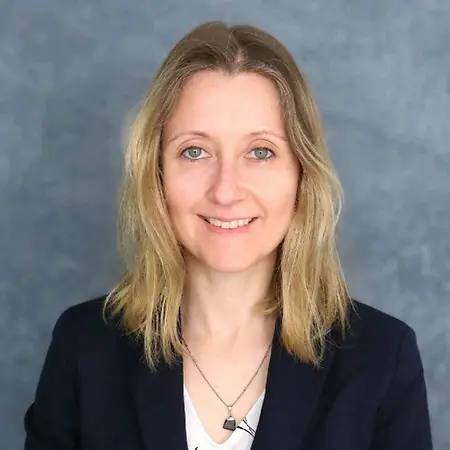
Emilie Douine-Barthelemy, MS, GC, CCRP, is a Clinical Research Program Manager at Cedars-Sinai in Los Angeles, where she focuses on oncology clinical trials. She earned her Master’s degree in Genetic Counseling from Aix-Marseille University in 2010 and has been SOCRA certified since 2020.
She began her career in France as a genetic counselor specializing in cancer between 2010 and 2012. She then moved to Geneva, Switzerland, where she took on a pioneering role in psychiatric genetics, working in a hybrid clinical and research position until 2014. These early experiences established a strong foundation in both patient care and research.
After relocating to the United States in 2014, Emilie transitioned into rare disease research at UCLA Health, a shift that required significant adaptability, as she was no longer able to practice genetic counseling in a clinical setting. Over nearly a decade, she worked with the California Center for Rare Disease and the Undiagnosed Diseases Network, supporting complex diagnostic cases and advancing precision medicine initiatives. During this time, she maintained direct patient-facing responsibilities, including consenting patients and families for advanced genetic sequencing (whole exome and whole genome) to support diagnosis. In parallel, she served as a study and regulatory coordinator on therapeutic trials, including studies focused on Duchenne Muscular Dystrophy and myotonic dystrophy, contributing to study execution, regulatory oversight, and coordination.
During her time at UCLA, she also supervised clinical research coordinators and mentored work-study students, an experience that sparked her passion for team development and leadership. This interest evolved into progressively greater oversight responsibilities, ultimately leading to her transition into program management.
After more than a decade in patient-facing roles, transitioning into a fully managerial position was a deliberate and meaningful step. While stepping away from direct patient care was not easy, she found a strong sense of purpose in leading teams, mentoring staff, and supporting the growth and development of others.
In October 2023, Emilie joined Cedars-Sinai, driven by her passion for clinical research and a desire to return to oncology. She now oversees four clinical research teams spanning sarcoma, hematology, lymphoma/CAR-T, and pediatric oncology, supporting approximately 60 trials open to accrual. In this role, she leads a team that includes clinical research coordinators, a clinical research associate, and a research nurse coordinator, and is actively expanding her team to support continued programs growth. She works closely with principal investigators to strategically expand and optimize the clinical trial portfolios through thoughtful planning, feasibility assessment, and pipeline development. She collaborates closely with regulatory and finance partners to ensure efficient study activation and execution. Building on her early mentorship experience, she is particularly passionate about people management, team development, and creating high-functioning research programs that improve patient access to innovative therapies.
Her Interview
Ten minutes with Emilie
01What do you attribute your success to?
I attribute my success to resilience and adaptability. My career has evolved across countries, specialties, and roles, each requiring me to quickly learn and adjust to new environments. One of the most defining moments was moving to the United States, where I was no longer able to practice genetic counseling in a clinical setting. That experience pushed me to redefine my path and grow within clinical research. I’ve never been afraid to start from scratch—whether entering a new field, joining a new team, or building expertise in a new area. Staying flexible, solution-oriented, and forward-focused has been key to my development.
02What’s the best career advice you’ve ever received?
The most valuable lesson I’ve learned is the importance of mentorship. My first mentor in oncogenetics taught me not only the science, but also how hospitals function behind the scenes—politics, funding, and grants. Later, a mentor in psychiatric genetics taught me how to think critically, navigate uncertainty, and ask better questions. Just as importantly, I’ve learned to stay aligned with my values. The organization I work for should share my values, and I should share theirs.
03What advice would you give to young women entering your industry?
Be open to evolving your path. Careers in clinical research are rarely linear, and some of the most meaningful opportunities come from unexpected directions. Adaptability, curiosity, and collaboration are essential. Don’t hesitate to step into roles that push you outside your comfort zone, and seek out environments where you can continue learning and growing.
04What are the biggest challenges or opportunities in your field right now?
Clinical research is becoming increasingly complex, requiring coordination across multiple stakeholders and functions. A key challenge is managing that complexity while maintaining efficiency and compliance. At the same time, staff retention is evolving, with newer generations changing roles more frequently. This creates an opportunity for leaders to rethink how we engage and support teams—through mentorship, flexible structures, and clear growth pathways. Strengthening cross-functional collaboration and streamlining processes can not only accelerate study execution but also build more resilient teams and ultimately improve patient access to innovative therapies.
05What values are most important to you in your work and personal life?
Transparency and collaboration are central to how I work. Open communication builds trust and allows teams to operate effectively. I am also deeply motivated by contributing to research that has a meaningful impact on patients’ lives. Leadership is equally important to me—supporting teams, fostering growth, and creating positive, high-performing environments. Outside of work, I prioritize balance with family life and make time for activities that help me recharge, including gaming, spending time outdoors, staying active, traveling, and learning about other cultures.
Join Influential Women and start making an impact. Register now.