Her Story
About Emily
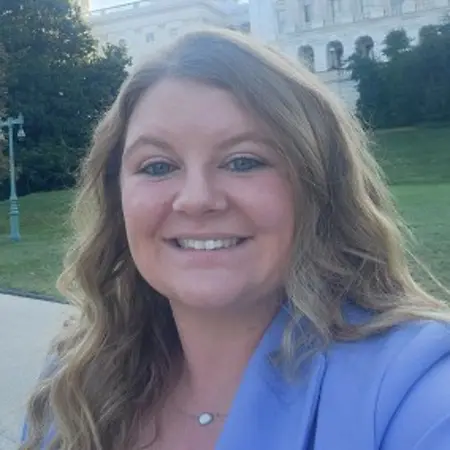
Emily Arthur is an environmental and water policy professional specializing in agriculture and water systems management. She currently serves as Agriculture and Water Manager at the Ohio Environmental Council in Ohio, where she works to advance access to clean, safe drinking water by coordinating collaboration between agricultural stakeholders and environmental organizations. Her work focuses on science-based, collaborative policy solutions that improve water quality and support sustainable land and water use practices across the region.
Emily holds a Bachelor’s degree in Biology from Bowling Green State University – Bachelor of Biology and a Master’s degree in Environmental Science from Unity Environmental University – Master of Environmental Science. She began her career with the Ohio Department of Natural Resources as a Natural Resource Technician, gaining hands-on experience in water quality sampling, data collection, and environmental reporting. She later expanded her experience through roles in marina management, grant writing for coastal and stormwater improvement projects, and nonprofit environmental organizations including the Lake Erie Foundation and Ohio Citizen Action.
Throughout her career, Emily has developed expertise in water quality monitoring, harmful algal bloom assessment, stormwater runoff mitigation, coastal management, and agriculture-environment policy relations. She is actively involved in environmental advocacy and community engagement through her work with watershed organizations and policy initiatives across Ohio. Emily is known for her commitment to place-based environmental stewardship, emphasizing collaboration, education, and science-driven action to protect freshwater ecosystems for future generations.
Her Interview
Ten minutes with Emily
01What do you attribute your success to?
I attribute my success to the mentors who have guided me throughout my journey, including professors and professionals who inspired me through both academic and real-world environmental work. I also draw motivation from firsthand experiences, especially observing the impacts of harmful algal blooms on local communities and businesses. These experiences strengthened my commitment to protecting water resources and advocating for meaningful change.
02What’s the best career advice you’ve ever received?
The best career advice I’ve received is to stay confident in my knowledge, trust my training, and never be afraid to speak up. I’ve learned that having a strong foundation in your work allows you to stand firm even when facing differing perspectives or challenges.
03What advice would you give to young women entering your industry?
I would say keep a strong voice and be confident in yourself. In my role managing relationships between agriculture and environmental sectors, there are a lot of different narratives that can come out or get you down or seem to create doubt in your mind. When you have a strong background in what you're doing, you should trust your gut and stay true to yourself. Having confidence and staying true to your trainings is so important. Never be afraid to speak up in any room. You have to advocate for yourself first, because how can you advocate for sustainability or the environment if you don't know how to advocate for yourself? The environment can't advocate for itself either, so we have to give them a voice.
04What are the biggest challenges or opportunities in your field right now?
One of the biggest challenges in my field is balancing the differing perspectives between agricultural stakeholders and environmental priorities, especially when addressing issues like water quality and harmful algal blooms. Another challenge is maintaining balance and preventing burnout in a deeply passionate field. At the same time, there are strong opportunities in collaborative water policy, local restoration projects, and expanding community engagement in environmental protection.
05What values are most important to you in your work and personal life?
Staying true to my message is incredibly important to me. Being in the agriculture room one day and then being in an environmental room the next can bring a lot of different issues and perspectives. I make sure to hear them all out, but I understand that the message I'm trying to pursue down the middle is what matters. I've also learned not to be too hard on myself. I pushed myself for years thinking I wouldn't be successful or wouldn't reach my goals, but it just takes one step in front of the other. You can't rush success or the time it takes to get there. I've really slowed myself down to appreciate the now, because you can't go back in time, so you've got to soak it all up. Taking time to reset and rebalance is essential. I take about 30 minutes or more almost every day after meetings to walk along the lake or around the neighborhood to reset and be able to carry all the roles and responsibilities that come with multiple hats.
Join Influential Women and start making an impact. Register now.