Her Story
About Emily
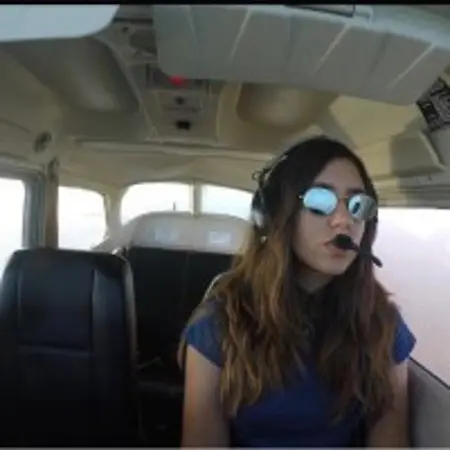
Every day I get up really early in the morning, make my coffee, get ready, and then go to work at Boeing's Miami Flight Training Campus where I work with flight simulators. As a regulatory engineer, I interface with agencies like the FAA, EASA in Europe, Transport Canada, and many more throughout the world. My job is to make sure these simulators are compliant from a regulatory standpoint so that when pilots come in to train every day, their time in that simulator counts towards the requirements of both their company and their regulatory authority to be able to fly safely. In the morning when I first come in, I'm there for the shift change meeting where I get to hear what all the mechanics did throughout the night since we run a 24-hour operation. I go into our systems to make sure there's nothing that needs to be reported to the FAA or any other regulators. After that, I run a couple reports to check if there's any discrepancies on any of our devices, and if there are, I go along with the team to troubleshoot whatever that discrepancy may be. Another part of my role is we have to run these things called QTG tests throughout the calendar year for all 20 devices we have here, and you have to grade them and compare that data against real flight data to ensure that the simulator data is accurate to the flight data. Towards the end of the day around 2:30, we start the next shift change where I give them any announcements and tell them anything they might have to look out for, like if we have a certain customer coming in or there's a regulatory evaluation. I've been with Boeing since August 2022, and before my current role, I was a quality engineer for one year, which was very new to me. I'm pretty proud of what I accomplished there because when I first arrived, I had five major accounts assigned to me that were all either yellow or red on their scorecards, and by the end of the year there, all those scorecards were green, so it felt very rewarding to know that I had directly contributed to establishing a better relationship with such important customers.
Her Interview
Ten minutes with Emily
01What do you attribute your success to?
I would say my mother, 100% my mother. My mother immigrated from Cuba in 1995. She was not college educated or anything like that, but it was very important for her that I had the opportunities that she didn't have. My mother always supported all of my wishes, all my desires, especially academic and career-wise. I'm from South Florida, but I went to California for college. That was hard for her - I'm her only daughter and her only child, but she's always been really supportive and never made it about her, even if things hurt her, like seeing me go all the way to California and being away for 7 years. I eventually moved back, but anytime I would tell her about the things I wanted to do in the future, my dreams, that I wanted to fly planes someday, she never shot that down, she never said that that was too hard or that it was impossible. She just said, yeah, you can do that. That was her approach to any interest that I had. If it wasn't for my mother being so open-minded about all of these things, I don't think I'd be here today, especially in our culture, because sometimes something like engineering or anything that's STEM-related, some generations within our culture do see that as more like a man thing, like a man's job or a man's role, but my mother never brought any of that into the discussion. She was always there.
02What’s the best career advice you’ve ever received?
The best advice I've ever received is when somebody once told me: do not write yourself off, let them make the decision for you. The context of this was just looking at roles that I wanted, but I felt like I was too young or too inexperienced, or maybe I was looking through the description and I fit into parts of what they described in the role, but not 100%. But someone told me that, and I took that advice to heart, and I've always just applied to everything. I've always cast a very wide net, and if there's something I really wanted, I applied for it to see where it goes. I mean, this position, for example, I didn't think that I would get it. I thought I was too young or too inexperienced. I went ahead and applied and they gave me the call, and I did land the role, so I think it's just go for it, you never know what's gonna happen.
03What advice would you give to young women entering your industry?
I would say don't be afraid to speak up. You know, this is a male-dominated industry by far, the aerospace engineering industry. If you were hired, if you were led into the room, you were led into that room for a reason. There's no reason why you should keep quiet or not speak up during meetings, especially if you have something to contribute. Sometimes you feel this pressure, and maybe you have to shut up because you could be too young, or because you're a girl, or a combination of both. But you were hired for a reason, so don't be afraid to speak up.
04What are the biggest challenges or opportunities in your field right now?
I think some of the challenges that I'm seeing are with AI. It's so new, but everybody's trying to implement it and find the best use for it. I think it's a challenge in the sense that you have to be very careful with how you use it. I think there's a lot of concern with data leaks, privacy, that sort of thing. So figuring out how to use the AI tools while maintaining cybersecurity, I think is a big challenge right now, especially to use it in the way that would be most beneficial to a lot of these teams. I mean, you have such delicate information in your hands that you work with every day, real flight data, stuff that if somebody wanted to cause harm to the commercial aviation industry or a particular flight, getting their hands on this kind of data could be really dangerous. In terms of opportunities in the field, in the United States at least, the DEI initiatives have been scrubbed, so internal programs that had to deal with DEI are also gone. So now there's nothing really forcing the industry to be inclusive, but I think it's an opportunity because as a woman in this industry, you can be a focal point for DEI. You can be a mentor, you can be an inspiration, you can organize events that are women-centered, and there's nothing stopping you from doing that. There's power to be taken back into the individual's hands to bring this community together and present more opportunities for those that maybe don't have it as easy.
05What values are most important to you in your work and personal life?
I think the intersection of both my personal life and my professional life is integrity. I am who I am, regardless of who's looking around. Both in my personal life and in my work life, that's just how I am. I like to be very honest. I like to not break any promises in the sense that if I set a deadline, by that deadline, I'm delivering. I think this quality has been something that's taken me further into my career.
Join Influential Women and start making an impact. Register now.