I co-founded Latinas Rising LLC to amplify women's voices, challenging the calladita phenomenon and the expectation that women stay silent. It stops with us. Calladitas no more!
When She Built Something That Didn’t Exist Yet
Explore more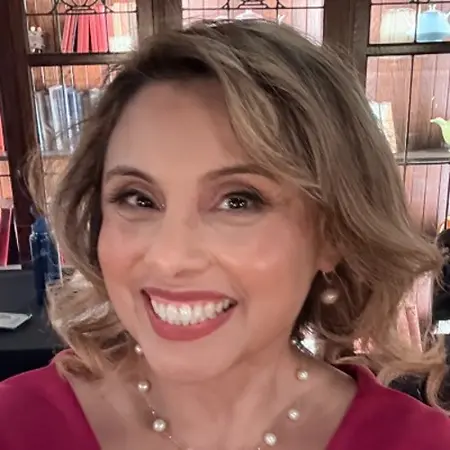
Influential Woman · Higher Education and Women's Empowerment
Co-Founder, Latinas Rising LLC
Scott Air Force Base, IL 62225
Expertise is the unique perspective I bring such as my military service, education, and life experiences offer insights no one else can, with the same heart, courage, and conviction.
Esmeralda Aharon, M.A. · In Her Own Words
I co-founded Latinas Rising LLC to amplify women's voices, challenging the calladita phenomenon and the expectation that women stay silent. It stops with us. Calladitas no more!
When She Built Something That Didn’t Exist Yet
Explore moreHer Story
Esmeralda Aharon, M.A. is a combat veteran, educator, storyteller, and nationally recognized advocate whose work empowers individuals and communities to lead with courage, authenticity, and purpose. A retired United States Air Force Senior Noncommissioned Officer, she served 26 years in the Chaplain Corps, providing intercultural leadership, crisis response, and interfaith care across global and high‑stress environments, including four deployments to the Middle East. Her military service forged a lifelong mission that continues to guide her work: to walk alongside others through seasons of transition, loss, growth, and renewal, helping them reconnect with their inherent worth, reclaim their voice, and lead from a place of wholeness rather than survival.
Esmeralda currently serves as Program Director for Faculty, Staff, and Community Engagement in the Office of Ignatian Mission in Medicine at Saint Louis University School of Medicine. Grounded in the Jesuit value of cura personalis, care for the whole person, she designs and leads initiatives that foster belonging, well‑being, equity, and meaning within academic medicine. Her leadership centers the belief that healing, justice, and excellence are inseparable. Deeply rooted in service, Esmeralda contributes to her region through the SLU Women’s Commission, VetBiz, and Belleville VFW Post 1739, and previously served on the board of the Hispanic Leaders Group of Greater St. Louis. Her work reflects her identity as a Latin American woman, veteran, and bridge‑builder, committed to transformational, community‑centered change.
As co‑founder of Latinas Rising LLC, Esmeralda advances women’s leadership across the Americas by amplifying voice and agency through storytelling, mentorship, leadership development, and consulting. Through the #1 international bestselling anthologies Calladitas Rising and Amigas Rising, she has helped more than 60 women, many speaking publicly for the first time, transform silence into agency and reclaim narratives long shaped by cultural invisibility. Her work affirms a simple truth: when one woman finds her voice, she creates space for others to rise with her.
Esmeralda’s impact as a veteran, author, and equity‑centered leader has been recognized with numerous honors, including a 2025 City of St. Louis Resolution and Mayoral Proclamation of “Esmeralda Aharon Day.” Yet the recognition she values most is witnessing others see their courage reflected back to them through her journey. As a speaker and facilitator, Esmeralda is known for her warmth, candor, and ability to invite honest reflection and collective action. Her message is both an invitation and a charge:
Your voice is power. Your story matters. And together, we rise, stronger, higher, and unstoppable.
Her Interview
01What do you attribute your success to?
I attribute my success to a deep, intrinsic sense of purpose rooted in love, faith, and service. From a very early age, I knew I was called to lead. As a child, I learned how to connect deeply with people, and growing up in the church shaped both my character and my sense of responsibility to others. I didn’t wait for permission or external validation to lead; I understood intuitively that leadership is something you live into, not something you are crowned with. According to my faith, this calling was placed in me by God. My faith has always been the compass that guides my decisions, the source of my motivation, and the foundation of my resilience. The love, joy, and deep appreciation for life that God placed in my heart are not meant to be kept to myself; they are meant to be shared. That desire to uplift others is what fuels my work and sustains me through challenges.
I also attribute my success to having the privilege of my military service, particularly in roles focused on spiritual care and leadership; I had the honor of walking alongside people from many backgrounds and faith traditions, helping them cultivate spiritual resilience in the midst of adversity. That experience strengthened my ability to lead with empathy, humility, and courage.
Ultimately, my drive is intrinsic, but I believe it comes from above. My success is the result of faith in action: listening to what is placed in my heart, responding with courage, and committing my life to helping others recognize their own strength and dignity.
02What’s the best career advice you’ve ever received?
The best career advice I’ve ever received was this: lead from who you are, not who you think you’re supposed to be, and don’t wait for permission to do it.
03What advice would you give to young women entering your industry?
The advice I would give to young women entering any industry is be yourself. Nobody is like you. You were created to be different. You were created to be you. So own it. Own your story. Own who you are. Embrace all of you. Bring yourself fully to universities, to the workforce, anywhere you are, whatever industry you are, be yourself. Empower yourself by using your voice and using your whole identity, whatever that is. If I were to ignore who I am and the fact that yes, I dropped out of high school, others who may have gone through something similar may not know that it is possible to earn your bachelor's degree; it is still possible to earn your master's degree, and it is still possible to actually aspire to get a PhD. When we see it, we can be it. I see an opportunity, and it's an opportunity for me to tell my story, for others to hear about it and to be able to hopefully be inspired by it, and also realize that they too can do hard things. They too can aspire to do whatever it is that is in their heart. Whatever was planted in the heart to be.
04What are the biggest challenges or opportunities in your field right now?
One of the biggest challenges in my field right now is that leadership spaces are still not fully built for authenticity, healing, or belonging, especially for underrepresented women such as African American, Latin American, women veterans, and those carrying lived experiences of grief or trauma. Many systems continue to value performance over humanity, productivity over presence, and outcomes over people. This creates environments where individuals are expected to lead without acknowledging the emotional, cultural, and historical labor they carry. For many Latinas in particular, leadership often requires navigating unspoken expectations to remain agreeable, quiet, or “manageable,” rather than bold, expressive, or fully seen.
This is deeply connected to the “calladita te ves más bonita” culture, a gendered, cultural message that teaches girls and women that silence is safety, compliance is beauty, and speaking up is a risk. While often framed as advice rooted in protection or respectability, this message can translate into leadership norms that penalize voice, discourage boundary‑setting, and render emotional labor invisible. In professional and academic settings, it shows up as code‑switching, self‑silencing, over‑functioning, and the pressure to prove worth without taking up space. Over time, this erodes belonging and reinforces systems where dominant voices are amplified while others are expected to endure quietly.
At the same time, this challenge presents a powerful opportunity. There is a growing hunger for values‑based leadership, storytelling, and spaces where people can show up whole. More institutions and communities are beginning to recognize that well‑being, equity, and belonging are essential to sustainable success. The opportunity lies in reshaping leadership development to center care for the whole person and to create pathways where voice, culture, and lived experience are recognized as assets rather than obstacles.
Another opportunity is the rising visibility of storytelling as a leadership tool. Naming experiences like the calladita culture has opened conversations that were once kept within Latin American households and communities, unseen or misunderstood in dominant spaces. When people finally have language for what they have lived, validation and transformation become possible. Storytelling disrupts silence, challenges inherited norms, and creates collective understanding across cultures and generations.
The work ahead requires courage, challenging systems while still building within them, but it is deeply hopeful. I believe we are in a moment where leaders who lead with heart, integrity, and truth are not only needed, but finally being heard.
05What values are most important to you in your work and personal life?
The values most important to me, in both my work and my personal life are faith, integrity, service, belonging, and courage. At the center of everything I do is faith. It grounds me, sustains me, and guides the way I make decisions. My faith reminds me that leadership is not about status or recognition, but about stewardship being responsible for how we care for one another and how we show up, especially in moments of difficulty or transition. Integrity is equally essential. I strive to live and lead in ways that are aligned, where my values, words, and actions are consistent. This means being honest, accountable, and willing to name hard truths, even when doing so is uncomfortable. I am deeply committed to service. Whether in uniform, in academic spaces, or in community work, I believe our greatest calling is to uplift others and leave spaces better than we found them. Service, for me, is not transactional; it’s relational. Belonging is a value shaped by lived experience. I believe everyone deserves to be seen, heard, and valued as their full self. Creating environments where people can show up whole, without having to shrink, silence, or assimilate is core to my work. Finally, I value courage, the courage to speak, to lead with heart, to grieve honestly, and to keep moving forward with hope. Courage is what allows transformation to happen, both individually and collectively. These values are not separate from my life, they are how I live, lead, and love.
Join Influential Women and start making an impact. Register now.