Her Story
About Evelyn
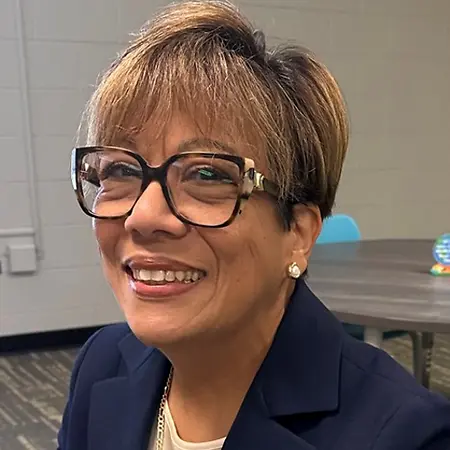
Dr. Evelyn Cruz is a visionary K–12 educational leader with over 41 years of experience, including 13 years as a transformative principal across elementary, middle, and high school levels. She began her career as a college tutor in organic chemistry, which inspired her to pursue teaching over a pre-med path. After 26 years in the classroom, she transitioned into administration in 2012, becoming a principal without prior assistant principal experience. Known for her ability to connect deeply with teachers, she created an innovative self-video recording peer coaching program that empowered educators and earned mentorship from Monmouth University, where she completed her doctorate in educational leadership in just two years.
Throughout her career, Dr. Cruz has championed innovation, equity, and student-centered learning. As principal of the Denver School of Innovation and Sustainable Design, she implemented STEM and project-based learning initiatives, workforce-connected curriculum, and early college programs, all designed to prepare students for future success. Her leadership has secured over $600,000 in grants to expand STEAM pathways, integrate project-based learning, and enhance student wellness and mental health. She currently serves as interim principal at Oakland Elementary School, leading academic turnaround efforts and ensuring every student has access to high-quality education.
Beyond her school-based leadership, Dr. Cruz is an active advocate for educational equity. She is a dedicated member of the Latine Education Advisory Council (LEAC) and will assume the role of Co-Chair in 2025, advising on statewide initiatives to support multilingual learners and historically underserved communities. Her professional focus emphasizes teacher empowerment, innovation in curriculum design, and community partnerships, and she is committed to leaving a legacy where every child is seen, valued, and supported—and every educator is equipped to inspire meaningful learning.
Her Interview
Ten minutes with Evelyn
01What do you attribute your success to?
I attribute my success to the values my parents instilled in me. They taught me that education was the key to opportunity and encouraged me to focus on my studies above all else. They also emphasized independence, especially as a woman, showing me that I could rely on my intelligence and determination to achieve my goals.
Mentors and supporters have also been critical. Dr. John Henning inspired me to pursue a doctoral program, and Dr. Alvin Freeman funded my early initiatives, believing in my ideas from the start. Their guidance, combined with my upbringing, shaped my mindset to start strong and finish well in everything I pursue.
02What’s the best career advice you’ve ever received?
The best career advice I ever received came from my father in one of our last conversations before he passed away. I was sharing with him some challenges that I was having, and he basically shared with me that one thing he knew about me was that whatever I start, I finish it. He told me he knew I was gonna finish it, and I was gonna finish it well, because he knew the mindset that I've always had. That advice has stayed with me throughout my entire career and has helped me push through difficult times, reminding me of the values my parents instilled in me about perseverance and not giving up. It's something that has guided me through completing my doctorate in two years, through my transition from teaching to administration, and now as I work to turn around a struggling elementary school before I retire.
03What advice would you give to young women entering your industry?
My biggest recommendation for young people entering education right now is that regardless of the politics, keep your focus on students and accessing the best educational opportunities that they can. I think sometimes, from my experiences, I've always tried to keep the focus within the district that I'm in, within the community and the families. If you ground yourself there and not let politics depress you, it will help, because I see a lot of people going into education and then leaving education. We're at a time, and continue to be at a time, where it's progressively getting worse in terms of how many people want to be in education and stay in education. So pulling more people into this field is important, and when young people are thinking about education, they need to think about how they can also pull more of their peers into the wonders of making sure that learning and enjoying learning is everyone's access, equitably. I think about how many good people, good teachers, good leaders we lose, and sometimes it's for financial reasons, because this is a profession that people can't go in and expect to get rich. You have to be in it for the right reasons, and many times when we network with other educators, networking is so important because when you think you're at a place where frustration is eating you up for whatever reason, you network and you go out and you learn new things and you get rejuvenated, and then you remember why you got into it, why you went in it.
04What are the biggest challenges or opportunities in your field right now?
The biggest challenge in education right now is that we're losing good people, good teachers, and good leaders at an alarming rate. It's progressively getting worse in terms of how many people want to be in education and stay in education, and I don't think it was as bad when I started in education back in 1985. Sometimes people leave for financial reasons, because this is a profession where people can't expect to get rich, but there's also the challenge of politics depressing educators and pulling them away from their focus on students. Right now, I'm facing the challenge of being interim principal at one of the lowest achieving elementary schools in Denver, which is a turnaround school that has to increase academically significantly this year or it may be another school that will close. We have to push and make sure that their growth is evident this year, and then next year it continues, so the school may survive. The opportunity in all of this is to ground yourself in the district and community you're in, focus on the families, and remember why you went into education in the first place. Networking with other educators is so important because when frustration is eating you up, you can go out, learn new things, get rejuvenated, and remember your why.
05What values are most important to you in your work and personal life?
The values that are most important to me come from the way I was raised and what my parents instilled in me. First and foremost is the value of education as being the way to access anything that you wanted in life. My parents always emphasized not fearing hard work and finishing what you start, which my father reminded me of in one of our last conversations when he told me that whatever I start, I finish it well. Another core value is independence and not allowing gender to limit what I can achieve. My parents instilled in me very early on that I should never put myself second to a man, and that whatever I wanted to achieve, it wasn't gonna be the gender that was gonna keep me from achieving it. In my work, I value keeping the focus on students and accessing the best educational opportunities for them, regardless of politics. I believe in grounding yourself within the district and community you're in, within the families, and making sure that learning is equitable and accessible to everyone. I also deeply value networking and supporting other educators, because when we connect with each other, we get rejuvenated and remember why we went into education in the first place.
Join Influential Women and start making an impact. Register now.