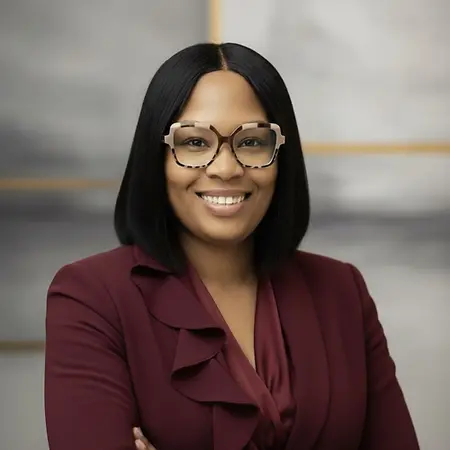
Her Story
About Farrah
Farrah Lawrence, MPA is a seasoned executive leader in child welfare, government strategy, and community engagement with more than 20 years of experience advancing systems that strengthen children and families. She is the Founder and CEO of Protective Pathways, a nonprofit organization dedicated to delivering in-home prevention services, youth mentorship, and family support designed to prevent unnecessary child removals and promote long-term family stability.
Throughout her career, Farrah has remained deeply committed to preserving family resilience, driving systemic reform, and bridging communities with government resources to create sustainable, measurable impact. Her leadership portfolio includes senior roles within municipal and state agencies, serving as County Director for Georgia’s Division of Family & Children Services and Director of Field Operations for New York City Children’s Services. In these roles, she led multidisciplinary teams, strengthened permanency outcomes, implemented data-driven performance strategies, and expanded community-based programming serving thousands of children and families annually.
Her expertise spans child welfare reform, family preservation, public health integration, youth empowerment initiatives, and evidence-informed policy implementation. Farrah is known for building high-performing teams, cultivating cross-sector partnerships with schools, nonprofits, and corporate stakeholders, and embedding accountability frameworks that improve service delivery and equity.
A lifelong learner committed to organizational excellence, Farrah is currently pursuing a Doctor of Education in Organizational Leadership with an emphasis in Behavioral Health at Grand Canyon University. She holds a Master of Public Administration from John Jay College of Criminal Justice.
Recognized with multiple honors for advocacy and leadership, including Woman of Action and Hero of the Year, Farrah remains actively engaged in civic and professional service. She serves as Social Action Chair for Nu Mu Sigma Hinesville Alumnae Chapter of Sigma Gamma Rho Sorority, Inc., where she leads initiatives focused on civic engagement, scholarship, and community advocacy, and is an active member of the National Coalition of 100 Black Women, advancing policy and social action efforts that uplift women and families.
Her Interview
Ten minutes with Farrah
01What do you attribute your success to?
I attribute my success to sustained commitment and dedication to the work, building strong community partnerships, and maintaining a patient, people-centered, and empathetic approach in everything I do.
02What’s the best career advice you’ve ever received?
The best career advice I received was to lead with vision, not position. Titles may open doors, but impact is what sustains influence. Growth requires courage. Don’t shrink to fit spaces you were called to expand.
03What advice would you give to young women entering your industry?
The advice that I give is we have to go in with a pure heart and also have patience. If you think that in this field you would save every family, that's not true. But if you make an impact with one or two, that's how you know you're doing a great job. We have to also remember that in this field, change is difficult, especially when families don't have the appropriate tools. So we often have to meet them where they're at and assess if they're ready, willing, and able to change. Never lose focus that this is their life. They are a partner in their change, so you can't come in telling them what they should do, but we should come in asking them what is the vision for their family, and what can we do to equip them with the tools for change. In this field, we deal with our own burnout, and secondary trauma. Self-care is important. You have to tap out for a moment to get yourself together, because you cannot pour from an empty cup.
04What are the biggest challenges or opportunities in your field right now?
One of the greatest opportunities that I've had is getting the community involved. Child welfare is not just an agency issue, it's a community issue. Every year, I'm able to host back-to-school events where we come together as a community. I reach out to my community partners, whether it's Amazon, Coca-Cola, and other nonprofit agencies. We put on back-to-school events, making sure that children, once the school semester begins, they are ready to begin on a strong note. I love the community engagement piece because once they really hear the vision of my program and they see the impact that I have been able to make, it makes it easy for everyone to join in. We have the police department, the fire department, everyone comes together to support these children. One of my most notable achievements was working during COVID. During COVID, we saw an influx of cases coming in because the school system was saying children were not logging in for school instruction. We were able to do a lot of lunch and learns to help schools understand that some of these families don't have the capacity to log in, whether it's Wi-Fi services, or maybe we're dealing with families where the parents do not know how to read themselves. We were able to partner with Spectrum Cable Services where families received free hotspot services to children living in New York City public housing. We were able to reduce our repeat maltreatment cases and help families navigate the education system during COVID.
05What values are most important to you in your work and personal life?
The values that are most important to me are patience, dedication, and commitment. You have to be committed because everyone wants to help the population, but it's about being committed to do the work. Because it's a challenging field, but we have to be committed. Compassion and being empathetic are also crucial. Learning the difference between sympathy and empathy is the biggest thing, because unless you've been in their shoes, you can't sympathize, but it's about being empathetic and also being people-centered. Those are the main values.
Join Influential Women and start making an impact. Register now.