Her Story
About Fatima
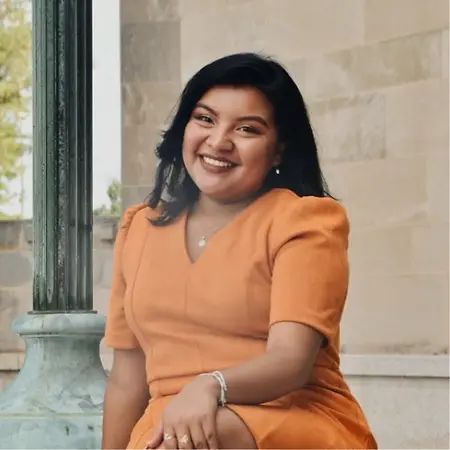
Fatima Vasquez-Molina is a Campus Minister in Catholic education at Cathedral High School, where she has served across various roles in campus ministry for approximately four years. In her work, she focuses on holistic student development through community building, faith formation, and culturally responsive programming. Her approach to ministry emphasizes empowerment, inclusion, and the integration of culture and spirituality into the daily life of students, reflecting a modern and relational model of campus ministry.
Her path into education and ministry was deeply shaped by her upbringing and family values. Raised by parents who prioritized education, especially her mother who is Mexican, Fatima grew up with a strong belief that every woman deserves access to quality education and the opportunity to reach her full potential. This foundation, combined with the mentorship she experienced during her academic journey at The Catholic University of America and Boston College, inspired her commitment to service and faith based education. These experiences helped her recognize the importance of bringing her cultural, religious, and personal identity into her professional calling within education.
In her daily work, Fatima supports students through retreats, service learning experiences, campus ministry clubs, and individual check ins that address academic, spiritual, and mental health needs. She collaborates closely with students to ensure they have access to appropriate resources and long term support systems that foster their success and well being. She also engages in ongoing curriculum development for service programs and helps connect students to both their internal school community and the broader world beyond the classroom, embodying a comprehensive and evolving vision of campus ministry.
Her Interview
Ten minutes with Fatima
01What do you attribute your success to?
I attribute my success to my parents, especially my mom, who believed that any woman, including her daughter, had the right to a good education. She's Mexican, and she invested in me not just as her daughter, but because she saw the potential I had. That's why I fell in love with education. My community from back home has also been incredibly supportive of me and my dreams. When I decided to engage with theology and education, there was no backlash from my family or community - instead, it was just 'you can do it.' It was new and wasn't known to anyone that a Latina wanted, in this day and age, to become a theologian, but they supported me anyway. I also had mentors during my college career at Catholic University in Washington, D.C., who really inspired me to give back and influenced me to fall in love with higher education and programming. One specific mentor empowered me by helping me understand the need for diverse voices within my field - not only in education but also in theology - and the need for women's voices. He inspired me to not only do small events but to create bigger events for about 1,000 to 3,000 people in college. All of these people have inspired me thus far.
02What’s the best career advice you’ve ever received?
The best career advice I've ever received is that there's always going to be setbacks, but even through the setbacks, there's a reason why you've been placed where you are. That's indicative of where we all are, whether you're about to start your career or you're in the middle of your career. Never be afraid to pivot, even in your career. I could just condense it down to this: never stop being innovative. I think that's a big one for me.
03What advice would you give to young women entering your industry?
I would tell young women entering my industry that we need you. We need you, and never be afraid to speak up for our communities and for us as women. I think especially that you should never stop being innovative and creative in how you impact, whether that's the church or education, because there's always going to be another student or another person that's going to look up to you. I think that's a big one for me.
04What are the biggest challenges or opportunities in your field right now?
I think one of the biggest challenges in my field, whether in theology or education, is that we wear many hats. We don't just do one thing or one objective every single day - every day is different. Because of that, it's given me the opportunity to deepen my own skills and sharpen my own creativity on a day-to-day basis. So it's never a dull day, but it can be quite exhausting sometimes. As educators, we have to wear many hats and balance that with our own personal lives, which can be hard. Within theology specifically, I think the lack of diversity is a major challenge. There's not that many women that look like me, that are Latinas, that are pioneering new research or doing anything, honestly. I think that's one of the biggest struggles we can have within theology - there's just a lack of diversity. But that doesn't mean that we're not there, and that we're not putting up a good fight.
05What values are most important to you in your work and personal life?
Community has to be a big one for me. Social justice is also a big one, along with advocacy. But to top it all off, I think compassion is most important. I work with not only students and teenagers, but I'm also a part of my community, and so compassion is a big one for me, as I am a people's person and my work is people-based as well.
Join Influential Women and start making an impact. Register now.