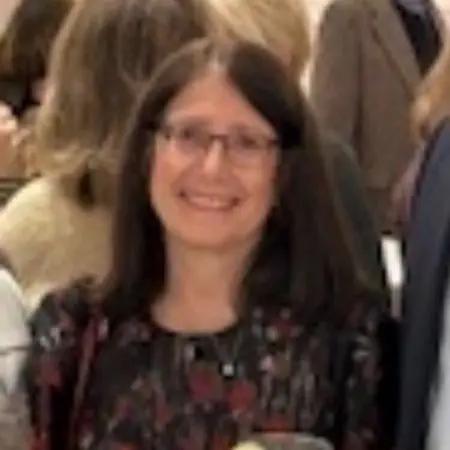
Her Story
About Frances
Frances Pardus-Abbadessa is the Executive Deputy Commissioner at the New York City Human Resources Administration, where she leads the Office of Child Support Services. In this role, she oversees large-scale operations across multiple borough offices, serving hundreds of thousands of families and managing programs designed to balance enforcement with supportive services that strengthen family stability. Her leadership focuses on transforming child support systems into tools for empowerment, reducing poverty, and improving outcomes for children and parents alike.
With more than two decades of experience in public service, Frances began her career in finance before transitioning into child support administration, where she found her long-term professional focus. She holds a Bachelor’s degree from Syracuse University and a Master of Public Administration from New York University’s Wagner School of Public Service. Over the years, she has led major initiatives including debt reduction programs, policy reforms, and efforts to modernize client engagement and improve access to services.
Frances is widely recognized for her commitment to equity-centered public policy and her efforts to reframe child support as a supportive, family-focused system rather than purely an enforcement mechanism. She has been instrumental in advancing trauma-informed practices, cross-agency collaboration, and community engagement strategies within New York City’s social service infrastructure. Her work reflects a deep commitment to strengthening families, reducing structural barriers, and creating lasting, meaningful impact in public service.
Her Interview
Ten minutes with Frances
01What do you attribute your success to?
I think I'm naturally a driven person. I think it's in my DNA, and I think I care about what I'm doing, and I do want to make a meaningful life where I'm making the world better, not worse, and make a difference in people's lives. That's what motivates me. I've always made my own job - what I mean by that is I would go above and beyond. I would try to read more than what was required. Nobody ever told me I had to go read the laws or all the policies, but I did it because I knew if I wanted to really understand what I was doing, I needed to have a bigger understanding, a broader or deeper understanding of the program I was overseeing or working on. I think part of a job is how much you do - you can do exactly what you're told and that's it, or you can take it a step further or look for more work. And I think that's often looked on very positively. At least they kept always giving me more work to do, which I guess maybe it's a downside, but it kept my job interesting and I felt like I was driving a little bit more, and I think it made me better at what I was doing. Always trying to learn more, always trying to understand more, learn from others. I've always kept my eye on what is our purpose, what is our goal, and how do we accomplish it. That's just been my focus.
02What’s the best career advice you’ve ever received?
I could tell you what I wish I received. I used to work a lot. I used to work with a boss that would start having meetings at 7 o'clock at night, and I was in meetings all day, so then I couldn't start my work till after that. I was single at the time and I just threw myself into my job, and I wish somebody had really set me aside and said, no, you gotta have a better work-life balance. That's something I wish someone had really advised me on.
03What advice would you give to young women entering your industry?
I go back to the work-home balance. I think it's just so important. I think one thing I've always told people is that you make your own job. Even though you have your job description and what it says to do, my experience over my career is I've always made my own job. What I mean by that is I would go above and beyond, and I would try to read more than what was required. Nobody ever told me you gotta go read the laws or all the policies, but I did it because I knew if I wanted to really understand what I was doing, I needed to have a bigger understanding, a broader or deeper understanding of what the program I was overseeing or working on. I think part of a job is how much you do - you can finish exactly what you're told and that's it, or you can take it a step further or look for more work. And I think that's often looked on very positively. At least they kept always giving me more work to do, which I guess maybe it's a downside, but at least it kept my job interesting and I felt like I was driving a little bit more, and I think it made me a better, I think, better at what I was doing. Always trying to learn more, always trying to understand more, learn from others.
04What are the biggest challenges or opportunities in your field right now?
The biggest challenge is working for government is really hard. I don't think people realize, especially with all the cuts that happen at the federal government, how whole areas were just wiped out. I think a lot of average persons in the world don't quite understand what it takes to make things run. You just sort of take it for granted that the garbage gets picked up, or your buses arrive reasonably on time, or there's trees along the side and there isn't garbage all over. There's so many services out there that people just don't understand or see, but they're so important that if they stopped, you would notice it. I think people don't really understand, and sometimes government workers are looked down on to some degree, and they really shouldn't be, because they perform such a really important service. And what no one can ever appreciate unless you're in it is it's really, really, really hard work. Unlike the private sector, in government there's so many rules. I haven't been able to hire anyone - we've had this rule where you could only hire if you get what's called an allotment. I've been working with almost 100 vacancies for several years now, and that puts a lot of pressure on the staff. You don't get to hire and select who you want for the position - you have to go to lists. You have people who perform really well and you want to reward them, maybe give them a promotion, but you can't because there's a list and the position has to be filled with someone off the list. These are very real constraints because human resources are really one of the fundamental important aspects of the job.
05What values are most important to you in your work and personal life?
I think at work, one of the things we try to take pride in is I try to make the work environment positive, where people feel valued, where they feel a sense of camaraderie. Even when we interview people, we convey that one of our priorities is to care about each other, care about the environment we work in, to be honest and fair and supportive of each other. Because people work a lot - you're working 8 hours a day, and sometimes some people are working even longer. And when you're spending that much time at work, it should be a place where you feel good. And not only that, I think you produce more in the end. You have staff who are more committed, who are more willing to volunteer, do stuff, and go the extra mile when they're content. I tell them, no, we're not aiming for happy, that's too high a standard - we're gonna set the bar at content. I think that's important to us as a whole, as a group. We work hard at that.
Join Influential Women and start making an impact. Register now.