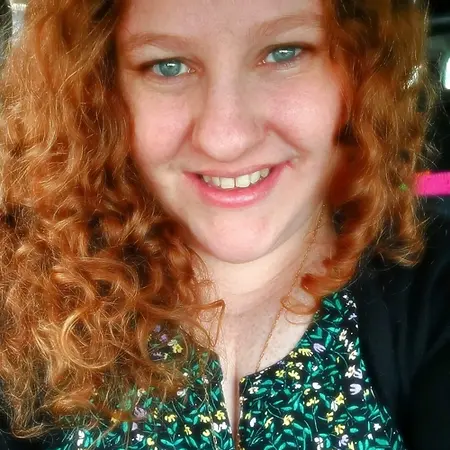
Her Story
About Freya
Freya Holloway is a communications and media specialist in the space science sector, currently contributing to the L’SPACE Program while pursuing her studies in mass communications and planetary science at Arizona State University. Blending technical knowledge with storytelling, she manages outreach efforts across social media, web platforms, and student engagement initiatives, helping translate complex scientific concepts into accessible, inspiring content. As a NASA Lucy Ambassador and space science education consultant, she plays an active role in advancing public understanding of space exploration and fostering the next generation of scientists. Her career reflects a strong foundation in education and leadership, beginning with hands-on teaching roles and evolving into program development and mentorship. Prior to her current position, Freya served as an instructor and later Director of a GED program at Marion Technical College, where she implemented improvements that expanded student success and access to education. She also spent several years working with youth in STEM-focused programs, designing engaging, hands-on learning experiences that sparked curiosity and confidence in young learners. Driven by a passion for mentorship and lifelong learning, Freya’s work centers on empowering others to achieve their goals in science and beyond. She values integrity, compassion, and perseverance, and is especially committed to building inclusive, interdisciplinary communities within STEM. With plans to continue her education at the graduate level in planetary science or heliophysics, she remains focused on bridging the gap between science and society—ensuring that space exploration is not only understood but shared and celebrated by all.
Her Interview
Ten minutes with Freya
01What do you attribute your success to?
I attribute my success to never giving up and not allowing barriers to stand in my way. I've encountered several challenges in my life that could have rendered me incapacitated, but somehow, I kept pushing forward, and I even learned to embrace many of those challenges as learning experiences and opportunities for growth. The moment I first decided to step out of my comfort zone and try something I really wanted to do but didn't think I could, and then I was successful, it started a domino effect. It was like, okay, if I can do this, what else can I do? I think it's about approaching everything with the mindset that you're only going to get out of this experience what you're willing to put into it. If there's something you want to do, if you have a goal, then find a way to do it. That applies at work and in my life. A lot of what I do is driven by my mission to show my children that no matter what life throws at you, you can keep going and you can be or do anything you aspire to.
02What’s the best career advice you’ve ever received?
Never underestimate yourself. In the space industry, we talk a lot about imposter syndrome and how crippling it really can be, especially for women in STEM and aerospace fields. It's easy to feel like you're not capable when you haven't yet tested the waters. But I've learned that once you begin to see what you're capable of, that list of what you can do grows longer and longer. The key is to tell that imposter syndrome to be quiet for 5 minutes and just take a chance, because learning to trust your own abilities is one of the most powerful steps toward success.
03What advice would you give to young women entering your industry?
Never underestimate yourself, and don't let anything or anybody tell you that you can't. Let nothing stand in your way. I encountered many challenges in my life that could have rendered me incapacitated, but somehow, I kept pushing forward. If you're in a place where you haven't yet tested the waters, it's easy to feel like you're not capable of this. In the space industry, we talk a lot about imposter syndrome and how crippling it really can be. But I think the moment that you decide to step out of your comfort zone and try something that you really want to do but don't think you can, and then you're successful, it starts a domino effect. It's like, okay, I could do this, so what else can I do? So I would encourage young women to step outside of that comfort zone, tell that imposter syndrome to be quiet for 5 minutes, and just take a chance. Because once you begin to see what you're capable of, that list of what you can do grows longer and longer.
04What are the biggest challenges or opportunities in your field right now?
The biggest challenge the space industry faces right now is this question of how to conquer the barriers to long-term space travel and sustained human presence on bodies other than the Earth- the Moon and Mars, to begin with. There are so many factors to take into consideration, but there are a lot of brilliant minds hard at work on this, as we speak. There's also this big shift happening from the public sector to the private sector. It's not necessarily a challenge, but it's something that's new. It's a change, and everybody in the industry kind of has to pivot. But at the same time, there are so many amazing things happening. The recent Artemis II mission couldn't have gone any better, and NASA is already rolling out Artemis III. The students I work with, incoming generations, and even my own children are part of this Artemis generation, and through Artemis, we're going to see people land on the moon again and actually begin establishing a long-term human presence on the lunar surface. The private sector is also building a brand new space station to eventually replace the International Space Station. It's a very exciting time with all of these opportunities for people to get involved in.
05What values are most important to you in your work and personal life?
Integrity and compassion are most important to me. I know that I'm in no way perfect, and I set my own goals for myself and strive to reach those goals. I don't expect anybody else to be on the same page as myself all the time. I try to approach everything I do with the mindset that you get out of it what you put into it, and I'm only going to get out of any experience what I'm willing to put into it. That applies at work and in my life. I also believe in not giving up and not letting barriers stand in your way. If there's something you want to do, if you have a goal, then find a way to do it. Taking care of people is crucial, and understanding that diversity and all those little things that make us different and unique are not bad things; they're strengths. Being in the space industry, we recognize the value of having a very diverse or interdisciplinary team- that's where a lot of the big and brilliant ideas come from. Recognizing the value of each person is something that is very important to me.
Join Influential Women and start making an impact. Register now.